




OEMs Now Offer 18 Factory-Built Alternate-Fuel Models
Although aftermarket conversions are available, they may not comply with federal and state alt-fuel vehicle mandates. OEM models typically offer better performance and reliability, plus easier warranty service.
Since the passage of the Clean Fuel Fleet Program and the Energy Policy Act, buying mandates have been handed down from the federal and state governments requiring that certain percentages of new vehicles acquired by covered fleets must be alternative-fuel vehicles. Fleet catalogs from the automakers are including more and more alternative-fuel vehicles, ranging from those that run on ethanol, methanol, compressed natural gas (CNG), liquefied petroleum gas (LPG) or electric battery power. An interesting and important development is that the availability of factory alternative-fuel vehicles is moving up into the medium-duty truck class, even though these vehicles, over 8,500 GVW, are not covered under those mandated programs. At the end of this article there is a specification chart of all the OEM alternative-fuel vehicles currently available, and a list of 2000-model vehicles certified by the EPA as meeting TLEV, LEV and ULEV requirements. Here’s a closer look at some of the alternative-fueled vehicles offered by vehicle manufacturers.
DaimlerChrysler
DaimlerChrysler has been concentrating its alternative-fuel vehicle efforts in the van and minivan areas. The Dodge Caravan, Plymouth Voyager, and Chrysler Town & Country are offered with a flexible-fuel version of the 3.3L V-6 engine. These vehicles are only available in areas of the country where federal emissions rules prevail. Aside from the ability to use E-85 ethanol fuel, they are identical to the gasoline powered versions. DaimlerChrysler also offers the EPIC Electric Minivan in California and New York. It is built on the short (113 inch) wheelbase version and has a 100 horsepower electric motor driving the front wheels. Power is supplied by a nickel-metal hydride (NiMh) battery system which allows a cruising range of 80-90 miles per charge. Standard equipment includes a specially developed heat pump system for climate control. An off-vehicle charging system for use on 220 volt A/C is supplied with the vehicle, which can recharge the batteries in six to eight hours.
Ford Motor Co.
Ford offers a broad range of alternative-fuel vehicles. Of interest are the Econoline Dedicated NGV vans and the new F-Series Super Duty Bi-Fuel Propane trucks. The Econoline Dedicated NGV is available in E-250, E-250 Extended, E-350, E-350 Super Duty, E-350 Super Duty Extended, and E-350 Super Duty Extended Wagon configurations. It is powered by a gaseous fuel prep version of the 5.4L V-8 that develops 206 horsepower on natural gas. It is fitted as standard with three under-body fuel cylinders capable of storing fuel at 3,600 psi, with an interior-mounted fourth tank optional. BostonCoach recently announced the addition of one of these vehicles to its Chicago fleet. Available in January 2000 as a 2000 model will be the F-Series Super Duty Bi-Fuel Propane truck. It will be available as a regular cab or crew cab cab-and-chassis configurations in F-350, F-450 and F550 models with dual rear wheels. Both 4x2 and 4x4 versions are offered. The engine is the 6.8L V-10, coupled to a four-speed automatic transmission. GVWRs from 11,200 to 19,000 lbs. are offered, as is a limited-slip rear axle. The purchaser is offered a choice of fuel tanks and tank locations, depending upon body configuration.
General Motors
General Motors also offers a wide range of alternative-fuel vehicles. For the purposes of this article, we will look at the Chevrolet Cavalier bi-fuel CNG sedan and the C-Series propane medium-duty truck. The compact Chevrolet Cavalier has been freshened for the 2000-model year and was publicly displayed for the first time at the 1999 Dallas Auto Show in April. Along with the freshened exterior styling and upgraded interior styling, the 2000 Cavalier is available in a bi-fuel version using CNG, which qualifies as an Ultra Low Emission Vehicle (ULEV). At the other end of the scale, the medium-duty Chevrolet/GMC C-Series truck is available with a version of the Vortec 7400 7.4L V-8 engine set up to run on liquefied petroleum gas (LPG). This engine develops 270 horsepower and 405 lb.-ft of torque, giving it the capability needed for the available GVWRs of 18,000 to 61,000 lbs. offered in the C-Series. These trucks are available with single or tandem axles in a wide variety of configurations to meet the demands of a wide range of uses.
Toyota
Toyota offers the RAV4 EV Electric to fleets needing zero-emissions vehicles (ZEV). This vehicle, which appears from the outside to be identical to the gasoline-powered RAV4, has been designed as a purpose-built electric vehicle. A flat battery pack consisting of NiMh cells is mounted under the floor, where it contributes to a low center of gravity. The battery pack gives the vehicle a range of over 100 miles in the real world, and can be recharged in six to eight hours from a 220-volt A/C charger.
More Operations

Hidden in Plain Sight: Fleet Compliance Risks
Fleet compliance isn't just about having policies — it's about consistently enforcing them. This practical guide reveals six hidden compliance risks common in public sector and shared fleet operations and outlines proven strategies to improve visibility, accountability, and audit readiness
Read More →
Turning Fleet Payment Data into Executive Insights
Does data alone drive results in operations?
Read More →
Automotive Fleet Opens 2026 Personal Use Survey for Commercial Fleet Managers
Commercial and corporate fleet managers are invited to share how their organizations handle company vehicle personal-use policies, charges, and driver eligibility.
Read More →
Gary Van Orden Retires After Nearly Four Decades in Commercial Fleet
From answering customer calls at Ford Motor Company to leading fleet sales across multiple OEMs and a fleet management company, Gary Van Orden's career reflects nearly four decades of leadership in commercial fleet.
Read More →
How Stellantis Plans to Get Ahead of Fleet Downtime
Vehicle acquisition may grab the headlines, but fleet uptime increasingly determines operating success. Darren Bradshaw of Mopar North America gives the details.
Read More →
Hyundai Releases 2027 Commercial Program Incentives
The 2027 Model Year "Fleet Street Incentives" are available to commercial and government fleets.
Read More →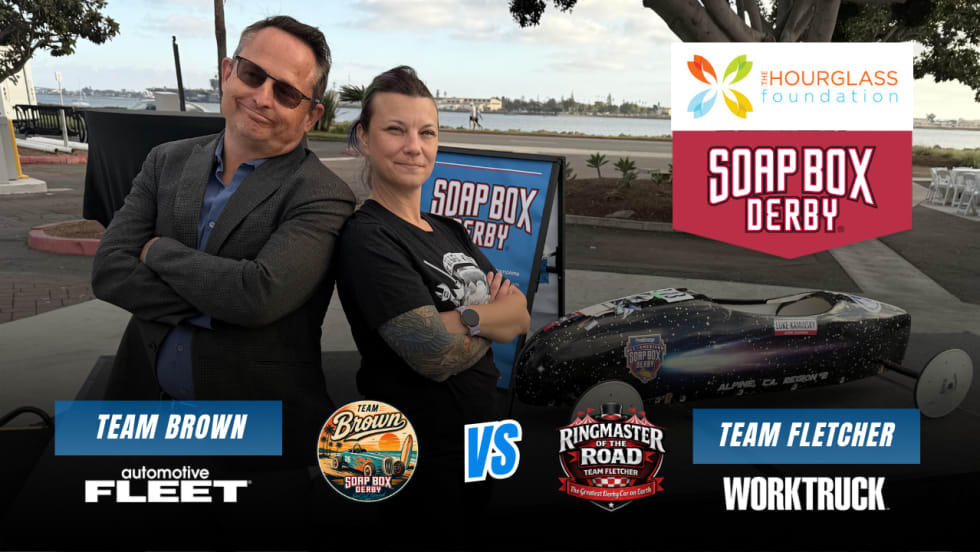
It's All Downhill from Here! Fleet Industry Raises $22,000 for Skilled Trades Scholarships
Work Truck’s Lauren Fletcher and Automotive Fleet’s Chris Brown turned a friendly racing rivalry into $22,000 for automotive technology and skilled trades scholarships.
Read More →
The Top 300 Commercial Fleets
The Top 300 Commercial Fleets: See the List
Read More →

Your Local Dealer Knows More Than You Think
Your local dealer can provide an information advantage that extends well beyond courtesy deliveries.
Read More →