




Meet the 2018 Fleet Manager of the Year
Phil Samuelson, fleet and capital asset manager of USIC is the first fleet manager to receive the renamed Fleet Manager of the Year award in honor of Automotive Fleet founder Ed Bobit.

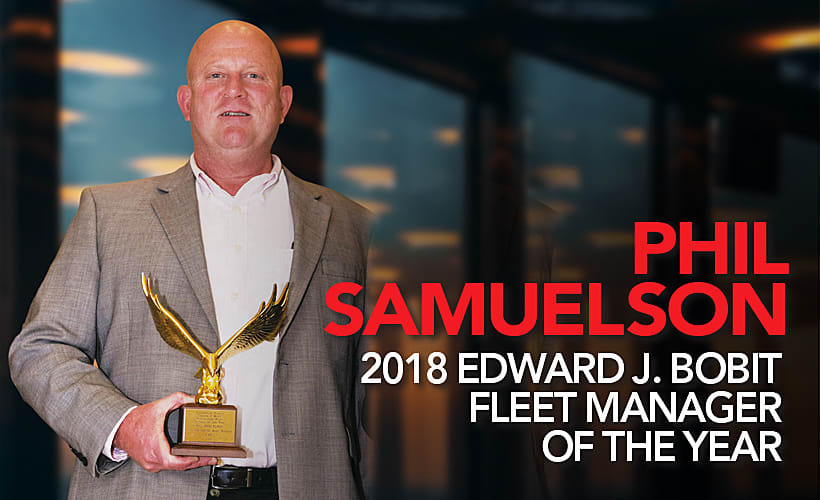
Phil Samuelson accepted the Edward J. Bobit Professional Fleet Manager of the Year Award. Sherb Brown (left), vice president of Bobit Business Media, and Laura Jozwiak of Wheels Inc. presented Samuelson with the award.
Photo courtesy of Lauren Sea.
Phil Samuelson serves as the fleet and capital asset manager at USIC, a company he has been with for nearly 15 years.
On Oct. 1, Samuelson was named the 2018 Edward J. Bobit Professional Fleet Manager of the Year, at the 2018 Automotive Fleet & Leasing Association’s annual conference for his service to the industry.
The award was presented by Automotive Fleet magazine and sponsored by Wheels Inc. and AFLA.
The Edward J. Bobit Professional Fleet Manager of the Year award is a nationally recognized award that is voted on by peers in the industry. The annual award recognizes a fleet manager who manages a fleet consisting of more than 100 vehicles, and who has showed unique abilities and accomplishments in his or her role.
In the nearly three decades that Samuelson has served the industry, he has seen fleet evolve from a fledgling industry into what it is today. He has overseen and led initiatives at the companies he has worked for that have enhanced safety measures, reduced costs, and made operations more efficient.
Samuelson takes pride in winning this award. He appreciates the recognition from his peers and also sees this recognition as acknowledgement that he’s been moving in the right direction.
“I am honored by the award, and proud to accept it for my entire company,” said Samuelson. “We have a great group of people at USIC, everyone supports the same goals and contributes to our success. Accepting the award also gives you a sense of responsibility and motivation to achieve more.”
Managing a Large, Dispersed Fleet
USIC is headquartered in the outskirts of Indianapolis. Its fleet of approximately 9,300 vehicles is dispersed throughout the United States and Canada.
In his role, Samuelson is responsible for overseeing this massive fleet. When asked what a typical week managing this fleet looks like, he responded by saying that it’s difficult to generalize.
There are certain constants in any given week. Things like reviewing fuel and maintenance expenditures for accuracy and possible fraudulent activities, ensuring vehicles and driver assignments remain correct from day to day, and ensuring proper billing and telematics reporting are in place are done every week.
But, every day also brings new unexpected obstacles.
One thing to note is that just five years ago, the fleet’s size was somewhere closer to 4,500. Through natural growth and acquisitions, the company has essentially doubled its fleet in four years.
This rapid growth, he noted has brought growing pains along with it.
“Not only have we doubled in size, we also now hire about 4,000 drivers a year,” said Samuelson. “We’re a very seasonal company, our business is very oriented around residential, commercial, and road construction. Geography and weather also affects when we hire more drivers.”
This influx of drivers, and cyclical nature, has made safety a large part of Samuelson’s focus.
A large influx of drivers on a seasonal basis means that the company has
drivers in need of safety training on a constant basis. This means that he, and his team, need to ensure that they’re providing proper training to each driver.
“It all starts in the beginning, when HR is interviewing and hiring people,” said Samuelson. “[Every driver] goes through MVR checkups. Because many of the drivers we hire are new to the industry, we go through a lot of driver training and initiation to make sure they know how we operate.”
One challenge, in terms of safety, for Samuelson and his team, is instilling a sense of balance to his drivers. The amount of tickets, or assignments, that his drivers complete is a direct correlation of how well they’re doing their job. However, driving safely and completing a lot of tickets don’t always go hand-in-hand. This is the balance that they try to teach their drivers.
Samuelson and his team want their drivers to do their job well, but not at the expense of their safety.
This is where USIC’s safety and telematics programs come into play.
“A couple of years ago we committed to updating our fleet from a typical plug-in device telematics program, to a fully connected fleet through our OEM partner,” said Samuelson. “We also began to use turn-by-turn navigation through the vehicle, in lieu of hand held navigation apps, and we began utilizing the Wi-Fi capabilities in our vehicles, creating 8,000 mobile offices. We are still refining and improving our program’s capabilities and continue to work with our OEM and fleet management partners on a daily basis.”

The 2018 Automotive Fleet & Leasing Association (AFLA) conference was held Oct. 1 to 3, at the JW Marriott Grande Lakes Hotel in Orlando, Fla.
Photo courtesy of Lauren Sea.
The data that the USIC team receives from its OEM partner — roughly 90% of his fleet is comprised of this OEMs vehicles’ — provides valuable insight that has helped curb the fleet’s accident rate.
Pulling the data straight from the vehicles through FMC and OEM partners has also been a boon on an administrative level. The USIC team no longer has to manually install plug-in devices to the company’s national fleet of vehicles.
“When you’re a fleet of our size, from one coast to the other, the install process of it and upkeep of install, and later returning devices, was a complete administrative nightmare. We did away with a lot of administration issues,” said Samuelson.
From a telematics perspective, USIC’s program, is helping the company’s flow of new drivers stay safer through better mapping, better routing, and better ways to use their vehicles.
The USIC team and Samuelson use this data gathered by his company’s telematics program for friendly competition among company drivers.
The telematics program gathers data on how every one of his drivers operate their vehicles. This data, along with a scorecard that USIC’s IT and EHS teams built is used to post everyone’s driver score that all drivers can see.
This, Samuelson noted, is to encourage drivers to improve their scores, if they find themselves constantly toward the bottom of the lists.
What Keeps Samuelson in the Industry
Samuelson has been in the industry for 28 years. When he started, fleet manager wasn’t even really a title.
He didn’t enter the industry intentionally; managing fleet was added onto his actual job. But, as he kept doing it, he found that fleet involved things he was passionate about, specifically cars and customer service.
“I’m kind of a car guy, and always have been,” said Samuelson. “There’s an interest in the vehicles from a technology standpoint. When you combine that with an interest in providing well-performing vehicles for your company, and helping people manage how they use them, it goes together very well.”
One of the most valuable lessons he’s learned is to always listen to what others have to say.
“When we were developing specs and working towards centralizing those specs, a lot of input helped,” said Samuelson. “Things that you thought were no brainers, ended up being issues”
His drivers, specifically, have provided a lot of valuable insight, he added. Drivers are in fleet vehicles the most so they know what they need.
That’s not to say he can always give his drivers exactly what they want, but their input definitely helps build a better vehicle that will help them perform better in the long run.
This sometimes means spending a little more money up front.
“In the long run, it may make sense to pay closer attention, and see if cost is the only reason you’re not putting something in your spec,” said Samuelson. “There’s more than just dollars and cents when it comes to building a vehicle.”
For this year, the Fleet Manager of the Year award has been renamed to the Edward J. Bobit Professional Fleet Manager of the Year award.
The award was renamed to honor the founder of Bobit Business Media and one of the co-founders of AFLA. This annual award goes to a fleet manager who finds innovative ways to improve safety, efficiency, and productivity.
The Future of Commercial Fleet
The future of commercial fleets will be highly dependent on the type of fleet, Samuelson said.
Sales fleets, for example, may be sooner affected by things like autonomous vehicles. Meanwhile, it may take a little longer for service fleets to be affected by this technology.
Regardless, Samuelson believes that autonomous vehicles are coming to fleets, and there’s going to be a lot of changes that they’ll bring along with them; one positive change will be better safety.
And, when autonomous vehicles do come to fleet, they’re also going to bring along with them, a change to the role of the fleet manager, Samuelson noted. Instead of just managing vehicles, managing all aspects of mobility will be within the fleet manager’s responsibilities, he added.
Samuelson also sees a bigger adoption of alternative fuel vehicles, particularly electric vehicles, among fleets.
“Electric vehicles are likely the way of the future,” said Samuelson. “EVs are here, and the rightsizing of those vehicles will be interesting.”
Since the majority of the vehicles in his fleet are light-duty pickups, he sees the widespread adoption of EVs in his fleet to be a little slower, as the technology makes its way into larger vehicles. However, there are functions of his company that don’t require pickups and would make better use of a smaller vehicle. For these functions, he is already looking into how he can implement electric vehicles into his fleet.
More Operations

A buyer's guide to fleet management software in 2027
Buying fleet management software in 2027 means looking beyond features and price. As fleet operations, technology and expectations evolve, this guide explores what today’s fleet professionals should consider when choosing a system that can deliver value now and adapt to what comes next.
Read More →
What Will Shape the Next Era of Fleet Management?
EVs, AI, and autonomous vehicles are reshaping fleet management. Discover what’s ahead—and how fleet leaders can prepare for the next era.
Read More →
How Fleets Can Recruit and Train Veterans for Technician Roles
Here's how the technician shortage has affected uptime for fleets, and what to do about it.
Read More →

Avis Budget Group Deploys Neology Toll Management Technology Across Major Brands
Neology’s neoFleet platform will manage toll transactions and toll-authority operations for vehicles across Avis, Budget, Payless, Budget Truck and Zipcar.
Read More →
Fleet Personal-Use Charges Edge Higher in 2026
Nearly eight in 10 surveyed fleets allow personal use of company vehicles, while just over half of respondents report charging employees for the privilege.
Read More →
The Future of Fleet + What’s Changing Right Now | AF News Recap
Could developments overseas offer a preview of what’s coming for U.S. fleets? This week, we’re looking at the future of AI, autonomy, and electrification, plus Ford Pro’s new certified pre-owned program, smarter vehicle offboarding, and a new way for fleets to manage toll expenses.
Read More →
How to Handle Vehicle Offboarding
What do fleet managers need to do when a driver leaves?
Read More →
Fleet Manager’s Ultimate Playbook: Navigating the New Standard in OEM Connectivity
Rising operating costs, driver safety concerns, and unplanned downtime are putting unprecedented pressure on modern fleets. Discover how fleet managers use embedded OEM connectivity and real-time vehicle data to cut TCO, prevent downtime, and protect drivers without aftermarket telematics hardware.
Read More →
U.S. Bank Adds Verra Mobility Toll Management to Voyager Fleet Platform
The integration allows U.S. Bank Voyager fleet customers to manage toll payments and violations alongside fuel, EV charging and maintenance expenses.
Read More →
ADAS Prevents Crashes. But Repairs Cost More | AF News Recap
ADAS-equipped vehicles may crash less often, but they can cost more when they do. This week, we’re breaking down what that tradeoff means for fleets, plus Subaru’s first Forester Wilderness Hybrid, Nissan’s new e-POWER Rogue, and why Calstart has become Catalyst Mobility.
Read More →