




Look Ma, No Dents! A Look at a Water-Filled Bumper
Formula of H2O and vinyl in new bumper promises significant protection against auto collision cavities
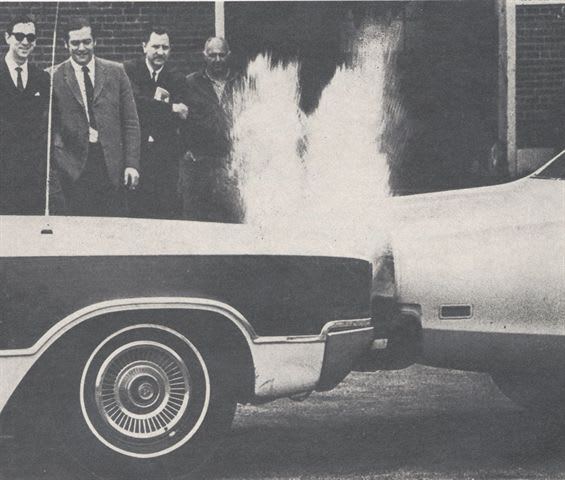
Water bumper on stopped front car absorbs impact shock of a conventionally equipped car striking at 15 MPH.
Passenger cars seem to be to rolling another big mile toward safe driving. In a special showing recently, 1970 fleet models displayed what may be a major advance in automotive safety: rugged, water-filled plastic bumpers.
Water bumper on stopped front car absorbs impact shock of a conventionally equipped car striking at 15 MPH.
A Dodge taxi carrying hydraulic bumpers as optional equipment, or a Chevrolet or a Ford cab modified slightly to automotive safety: rugged, water-filled vinyl bumpers, from the device, can represent a significant safety factor and a major economic saving for fleet operators.
The national bill for automobile repairs amounts to some $5- to $6-billion per year. A good 53% of this staggering figure represents repairs (under $500) where the accidents rarely cause critical injuries. A novel mechanical development, involving hydraulic cushioning, could go a long way toward saving car owners and insurance companies nearly $3-billion annually.
Energy Absorption Systems, Chicago, Illinois, manufacturers of the hydraulic safety device developed by John Rich, believes that the country can put an end to these accidents by adopting plastic "water bumpers" for its cars, and installing Hi-Dro Cushion cells in front of highway abutments and along guard rails in particularly dangerous areas. After nearly five years of evaluation, results show that the Energy Absorption Water Bumper significantly prevents vehicle damage in collisions at speeds up to 18 mph. Also it severely limits the damage at higher speeds, while preventing or dramatically reducing personal injuries to restrained passengers in such impacts. In addition, clusters of Hi-Dro Cushion Cells lower acceleration peaks by as much as 60% in full-scale automobile/barrier impacts at speeds up to 60 mph, compared with impacts against unprotected barriers.
Key to the effectiveness of these safety devices lies in the reduced rate of deceleration they provide to impacting bodies. Molded of tough quarter-inch-thick poly (vinyl chloride) developed from resins and plasticizers, bumpers and cells alike consist of a water chamber with restricted openings for controlled escape of water upon impact. Restraining the water flow cushions the impacting bodies to absorb the kinetic energy of the collision and prolong the period of deceleration enough to greatly reduce the impact forces which damage or demolish vehicles and injure or kill passengers.
Full bumper protection for cars and small trucks include complete units front and rear-painted to match, or contrast with, the body color-replacing the OE (original equipment) bumpers. Buses and other large vehicles employ a number of modular, pillow-like units. The stationary barrier-cells, cylinders six inches in diameter and 3½ to 5 feet high, are fastened together in clusters long enough to attenuate the impact energy of any specified vehicle-mass at highway speeds.
Water Bumpers can virtually eliminate car damage from the chain reaction type collision which is common to expressway and turnpike driving when impact velocities are below 20 mph. When speeds on impact are as high as 40 or 45 mph, damage will usually not be extensive enough to prevent the vehicle being driven away under its own power.
Upon collision the vinyl structures will not rupture and the only maintenance required after a collision involves refilling the unit with water. During periods of below-freezing temperatures, an inexpensive "anti-freeze" type of aqueous solution serves as the hydraulic medium. The vinyl formulation developed for this use provides excellent low-temperature flexibility, to prevent cracking at impact in cold weather.
According to leading marketers of the Rich units, insurance companies are enthusiastic about these hydraulic bumpers and cells. Some 8-million miles of private-fleet experience showed that the bumper produced a 69% decrease in frequency of accidents, a 60% decrease in "reportable" accidents, and a 57% decrease in direct accident cost per mile. And of all accidents involving cars with Water Bumpers, only 18% of the protected cars experienced any damage.
Insurance records show that 72% of all accidents involve cars moving slower than 30 mph at impact and that 68% of all accidents represent rear-end collisions. These tail-gaters usually result in the so-called "whiplash" injuries which have plagued insurers increasingly in recent years as court awards have sky-rocketed for this difficult-to-assess type of claim. Some insurance companies are already giving reduced rates for vehicles equipped with hydraulic bumpers.
In an initial test sampling, nearly 100 taxi fleets from New York to San Francisco reported unexpected benefits from the use of Water Bumpers. Results were sizable reductions in accident-repair costs (down 56%), down-time costs (50% lower), and accident-claim payments (reduced 58%), as well as in time lost by drivers due to accident injuries.
Currently major industrial corporations are evaluating the Water Bumpers intensively on their company cars and trucks, while the "big 3" automakers are studying this novel safety development with interest.
More Operations

A buyer's guide to fleet management software in 2027
Buying fleet management software in 2027 means looking beyond features and price. As fleet operations, technology and expectations evolve, this guide explores what today’s fleet professionals should consider when choosing a system that can deliver value now and adapt to what comes next.
Read More →
What Will Shape the Next Era of Fleet Management?
EVs, AI, and autonomous vehicles are reshaping fleet management. Discover what’s ahead—and how fleet leaders can prepare for the next era.
Read More →
How Fleets Can Recruit and Train Veterans for Technician Roles
Here's how the technician shortage has affected uptime for fleets, and what to do about it.
Read More →

Avis Budget Group Deploys Neology Toll Management Technology Across Major Brands
Neology’s neoFleet platform will manage toll transactions and toll-authority operations for vehicles across Avis, Budget, Payless, Budget Truck and Zipcar.
Read More →
Fleet Personal-Use Charges Edge Higher in 2026
Nearly eight in 10 surveyed fleets allow personal use of company vehicles, while just over half of respondents report charging employees for the privilege.
Read More →
The Future of Fleet + What’s Changing Right Now | AF News Recap
Could developments overseas offer a preview of what’s coming for U.S. fleets? This week, we’re looking at the future of AI, autonomy, and electrification, plus Ford Pro’s new certified pre-owned program, smarter vehicle offboarding, and a new way for fleets to manage toll expenses.
Read More →
How to Handle Vehicle Offboarding
What do fleet managers need to do when a driver leaves?
Read More →
Fleet Manager’s Ultimate Playbook: Navigating the New Standard in OEM Connectivity
Rising operating costs, driver safety concerns, and unplanned downtime are putting unprecedented pressure on modern fleets. Discover how fleet managers use embedded OEM connectivity and real-time vehicle data to cut TCO, prevent downtime, and protect drivers without aftermarket telematics hardware.
Read More →
U.S. Bank Adds Verra Mobility Toll Management to Voyager Fleet Platform
The integration allows U.S. Bank Voyager fleet customers to manage toll payments and violations alongside fuel, EV charging and maintenance expenses.
Read More →
ADAS Prevents Crashes. But Repairs Cost More | AF News Recap
ADAS-equipped vehicles may crash less often, but they can cost more when they do. This week, we’re breaking down what that tradeoff means for fleets, plus Subaru’s first Forester Wilderness Hybrid, Nissan’s new e-POWER Rogue, and why Calstart has become Catalyst Mobility.
Read More →