




LKQ Lean Fleet & Telematics Boost Productivity & Cut Costs
LKQ Corporation keeps fleet operations lean and uses telematics to increase daily fleet delivery stops, dramatically reduce overtime costs, improve driver safety, and trim fuel costs.

As one of the largest nationwide providers of aftermarket collision replacement, recycled OEM products, and refurbished OEM collision replacement products, LKQ Corporation serves tens of thousands of collision-repair businesses, mechanical service shops, and vehicle dealerships throughout the United States and Canada.
The company, also a leading distributor of paint and body shop supplies, was formed in 1998 and is headquartered in Chicago. LKQ seeks to provide the national reach, strict quality standards, knowledgeable sales, and fast delivery customers demand. The company also strives to achieve profitable growth and increased returns to its shareholders by:
Providing total customer satisfaction.
Striving for operational excellence and continuous improvement.
Promoting a culture of professionalism, teamwork, and environmental, health, and safety compliance.
Acting as a good corporate citizen where employees work and live.
LKQ Fleet Team Strives to Adapt to Market Conditions
With more than 10,000 employees, the $2 billion dollar (2008 figures) company operates a fleet of 2,900 vehicles, including trucks, tractors, and trailers from Isuzu, Freightliner, International, Kenworth, Volvo, Great Dane, Wabash, Strick, and Fruehauf.
LKQ's logistics management team, which operates with a lean philosophy, includes the director of logistics, director of fleet, a fleet committee, several regional distribution managers, local dispatchers, and traffic managers. The team helps manage delivery of parts for LKQ and all shuttle work between warehouses and regions.
"We try to do as much next-day service as possible to our customers, as well as provide timely, cost-effective, and damage-free deliveries," said Mike Lahr, director of logistics for LKQ. "Our team has the ability to quickly adapt and change to market conditions and provide quicker service as need be."
When assessing the company's fleet financials, the team measures costs as percent of sales. During the past year, LKQ experienced double-digit sales growth. However, distribution costs as a percent of sales had dropped 0.5 points 3Q 2009 - 8.9 percent compared to same time previous year.
The company's costs by the same time in 2009 were $4 million less than 2008, while the company continued to grow with more locations and increased sales.
"There are so many variables we are constantly looking at," Lahr said. "Luckily, we have a team of people devoted to cost reduction and customer service. We also try to watch our maintenance costs as much as possible and compare them to other fleets operating around the country."
Last, but not least, the team measures its shuttle operations and determines if operating them in-house is most cost effective or whether outsourcing should be considered.
Telematics Creates Significant Savings & Efficiencies
One recent initiative allowed the company to decrease accidents and vastly improve productivity. In 2009, LKQ won a productivity award from fleet management company PHH for utilizing telematics in its fleet. The program led to an increased number of stops fleet drivers are able to make per day, dramatically reduced overtime costs, improved driver safety, and reduced fuel costs.
The company chose PHH's system after experimenting with several different vendors.
"We wanted to use only one system, and we liked what PHH had to offer. Plus, we could jointly use it with their maintenance and fuel programs," Lahr said.
To assess its effectiveness, the fleet team tested the system for four months, then compared before-and-after system implementation data. According to Lahr, the results were staggering and caught the fleet team off-guard regarding several issues, including:
1. Drivers' speed.
2. Out-of-control idling.
3. Vastly improved productivity resulting from quicker start times and more deliveries. Also, drivers returned to dispatch faster at the end of the day because they were monitored.
"We have seen a decrease in accidents because of the controlled speed," Lahr pointed out.
In addition to the PHH award, LKQ has been honored by a number of other vendors and partners, including several customer service awards.
"We appreciate each and every one of them and consider them an honor," Lahr said.
Not only is LKQ a close corporation internally, the company is very "fond of" and "greatly values" its relationships with vendors and partners.
"We have vendors we have used since the inception of the company," Lahr added. "They come to our meetings and give us guidance where they can."
Whether trucks, packaging, LTL (less than truck load) services, small package services, pallet design, liftgate design, box van design, racking systems, truck load services, outsourced shuttle runs, leasing companies, rental companies, tractor spec'ing, telematics, or maintenance, the company values vendor input and involves them as often as possible.
"We feel that because of them, we are where we are at today, although we are constantly looking for improvements," Lahr said.
[PAGEBREAK]
Fleet Financials Stay in Line with Company Goals
To ensure fleet financials stay in line with company goals, the team monitors its budget versus actual company costs on a monthly basis. They continually compare the budget versus actual expenses by company, region, and warehouse. This close scrutiny allows the team to determine the areas that appear out of line and focus on those areas.
"We have noticed the law of averages is not very accurate," Lahr said. "You might have 90 percent of your warehouses in line with the budget; however, those other 10 percent might be hurting the rest, and so you find out why!"
Successfully interacting with senior management on policy and budgetary issues also permits the team to stay ahead of the game in managing financials. Since LKQ is a publicly traded company, staff are budget- and numbers-driven, and when it comes to distribution, the company has been very successful in hitting its numbers.
"We look at each warehouse, each region, and the company as a whole on a weekly basis," Lahr added. "Our management team is constantly monitoring our numbers and 'fixing' the issues where we need help."
The distribution department gets together 2-3 days a year to discuss a host of issues and opportunities, and company vendors and partners are invited to participate in these meetings. Key logistics team management also holds conference calls, visits, and meetings to discuss what is going well for best practices and what needs to improve, in addition to conducting brain-storming sessions.
"Senior management has always had input into the private fleet and some of the outsourcing that we do," Lahr said. "There are always discussions of how we can get our parts to our customers faster, cheaper, safer, and damage free."
Exceptional Communications Help Streamline Fleet
Constant communications between the fleet team and senior management takes place surrounding new transfer rack design and best practices of equipping the delivery trucks with interior racks for parts storage and safety. The risk management department is also actively involved on ingress and egress features of each truck, as well as retrieval of parts from the trucks.
"Where we have smaller trucks with no liftgates, they have helped us come up with the best design for a bumper to step up into the trucks, as well as descend from the truck with parts," Lahr said. "We discuss grab handles and positions of them. Instead of a normal 'step' bumper for getting in and out of a truck, we have chosen to extend the width of it so the driver has a better stepping platform."
Management personnel, including Lahr, ride with LKQ's drivers on occasion to not only observe the driver's habits, but also their interactions with customers and to discuss the truck operation and parts handling.
"Several of our truck/body designs came from drivers letting us know how to improve. An example is the side door in each truck," Lahr said. "We have used roll-up doors, swing doors, and sliding doors. They all like the sliding door because they do not have to open it into the traffic if parked that way, and the wind does not affect it upon opening."
Additionally, all trucks are equipped with automatic transmissions to enhance driver comfort.
Driver Safety Emphasis Leads to Safety System Implementation
Safety is another critical component of the company's fleet operations, and reducing driver injury and accidents remains top of mind. Because of this dedication to safety, many of the company's trucks are equipped with a rear view camera system, as well as a passenger side camera.
The driver views a color LCD monitor on the dash when driving forward or backing up. When driving forward, the camera reveals the passenger-side blind spot. When the driver puts the truck in reverse, the monitor automatically switches to the camera on the truck rear to help the driver see behind the vehicle.
The driver also has a manual switch to view either camera when necessary. For instance, if the driver is on an upgrade in traffic and notices a vehicle pull up close to the back of the truck, with a simple flip of the switch, he or she can see the other vehicle's proximity.
Other safety measures include Drivers Alert decals affixed on all trucks. The public can call in and let LKQ know if a driver behaves erratically, performs in an unsafe manner, or is doing an outstanding job.
Some units are also outfitted with a "drive cam" for management to observe driver actions, as well as what the driver sees in the event of an accident or a close call.
[PAGEBREAK]
LKQ Gives New Meaning to Operating a 'Green Fleet'
Lowering greenhouse gas emissions is important to LKQ. To reduce its environmental footprint, the company banned idling and controlled vehicle speed by installing buzzers on the trucks that sound an alarm until the driver slows down. Management also now procures trucks with limited speed and automatic idle shutdown.
All of these efforts lower the fleet's operating costs and help ensure a cleaner environment with reduced fuel emissions.
"As far as a green fleet, we think we kind of invented it," Lahr said. "What we mean by this is being an automobile recycler, we get tires, freon, gasoline, windshield washer fluid, batteries, antifreeze, etc., out of all of these vehicles we process. Thus, we use these materials in our private fleet, reducing our operating costs substantially. What we do not use gets recycled. Can you have a greener fleet than this?"
Creative Policies & Equipment Refine Fleet Operations
LKQ's fleet team continues to implement innovative measures to elevate driver productivity and streamline fleet operations.
One such measure includes transferring delivery driver pay from a per-hour basis to an incentive-based pay determined by stops, revenue, miles, returns, etc. Drivers ultimately earn more per pay period, make additional stops, and return faster.
Another example of LKQ's innovation involved integrating its acquisition of Keystone Automotive Industries, an aftermarket part business.
"Wherever we can, we have both companies delivering each other's parts instead of two different drivers going to the same customer with different part types," Lahr said. "Here again was another opportunity for our vendors, including PHH, to help design a prototype truck that could haul both types of parts."
The company now operates a hybrid truck, larger than the historically smaller aftermarket truck, but not as big as a larger recycled OEM parts truck.
"We can now get all parts hauled by the same truck and driver, making it safer and more productive for our drivers to deliver these items," Lahr added. "We are adding this type of truck very rapidly as we create more shared routes and replace trucks that are up in useful life."
LKQ to Remain Proactive in Search for Increased Efficiencies
Moving into the future, LKQ's fleet and logistics team will continue to reduce costs, keep up with regulations, keep maintenance costs in line for its 295 locations, and ensure top-notch customer service.
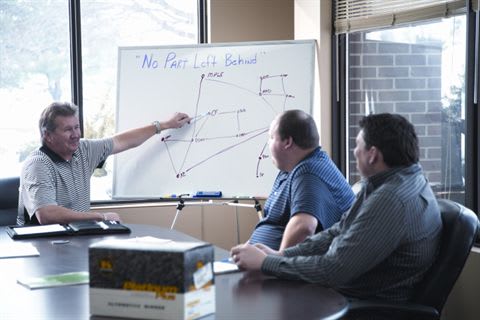
"We have these mottos: 'The Future Is Now' and 'No Part Left Behind,' " Lahr said. "This means that our parts, every one of them, will get to our customers when they want them, damage- free, and delivered economically."
Lahr sees LKQ's delivery and shuttle fleet constantly changing to adapt to the volume of the company's shipped products. The team also looks forward to continued relationships with its vendors and partners to develop new ideas on technology, productivity, and cost reductions.
"We do not beat our vendors/partners up on price reductions, but ask that they help us reduce our operating costs by being creative and design ways of better service," he added.
Lahr's team is also currently experimenting with routing, the fleet's next cost-effective and productivity goal for 2010. Ultimately, LKQ wants to see all of its 295 locations, 2,600-plus delivery trucks, and 300-plus shuttle vehicles using a routing tool.
"We also feel we have a great design on our 'prototype' truck for delivery of both types of parts, but still feel it can be improved for more capacity," he concluded.
More Operations

90% Use Telematics. Are Fleets Getting Safer? | AF News Recap
This week, we're breaking down which industries have the highest rates, how Jamie McKay manages 2,400 vehicles, what's happening with the 2027 fleet awards, and why software-defined vehicles could introduce new costs.
Read More →
What's Best Handled by an FMC, and What's Better Done Directly?
Fleet managers continue to rely on FMCs for essential services but are taking a closer look at where working directly with suppliers can improve efficiency and responsiveness.
Read More →
Fleet Meets: Erin Gilchrist
Meet Erin Gilchrist, the inaugural Mike Antich Spirit of Fleet Award winner, as she shares insights on leadership, mentorship, the power of industry connections, and why people remain at the heart of fleet's future.
Read More →

How 2026 Fleet Visionary Jamie McKay Manages 2,400 Vehicles Across 37 States
How do you keep 2,400 vehicles running across 37 states? Fleet Visionary Award winner Jamie McKay shares how collaboration, flexibility, and a few simple strategies help her tackle fleet management challenges at Aptive Pest Control.
Read More →
Managing Fleet Costs in an Era of Permanent Volatility
Fleet operating costs have risen more than 20% since 2020, raising a key question: When does extending a vehicle's service life stop making financial sense?
Read More →
The Next Evolution of Fleet Management: Autonomous Operations
This opening keynote session at the Fleet Forward Conference highlights the future of autonomous driving for fleets.
Read More →
How to Reduce the Total Cost of Risk From Catalytic Converter Theft
A stolen catalytic converter can cost fleets far more in downtime and lost productivity than in repairs. A total-cost-of-risk approach can help fleet managers quantify their exposure and prioritize theft prevention.
Read More →
Personal-Use Charges Rise as Vehicle Values Fall | AF News Recap
Personal-use charges are climbing, wholesale used-vehicle values are declining, and commercial fleet sales growth is slowing. This week, we're breaking down the latest fleet data, plus how Element Fleet Management is helping Waymo prepare for its first Canadian robotaxi market.
Read More →
Here's When You Should Make an Exception to Fleet Policy
Fleet policies are designed to create consistency, but not every driver or situation fits neatly within standard rules.
Read More →
AI-Native or AI-Acquired: What Should Fleet Managers Look for in an AI Platform?
Six questions can help fleet managers look beyond AI marketing claims to evaluate integration, data access, and real-world operational performance.
Read More →