




Learn More: How Leveraging Technologies Makes Fleets More Efficient
Leveraging AI & Data Technologies to Better Control Charge Costs for Electric Vehicles
Advanced data and sophisticated AI-powered connected telematics are now in place to help fleet operators and users identify the most optimum time to plug in.
by Sumit Chauhan, Cerebrum X
October 2, 2023
Understanding AI and data can help fleets control costs.
Photo: Canva
4 min to read
Battery charging for electric vehicles (EV) remains difficult because of high electricity costs, and users of electric vehicles are frustrated by inconsistent pricing practices, frequently broken equipment, and a lack of battery chargers in strategic locations for all but Tesla drivers.
Some drivers find charging for EVs to be a frustrating experience, especially for those located in states with steadily rising electricity rates due to inflation and intermittent renewable energy sources (wind and solar power).
According to a J.D. Power study of EV owners who use Level 2 charging stations, overall satisfaction with the charging experience has decreased 12 points since last year, primarily because rising electricity prices are starting to affect consumers directly.
Because the permitting and construction of chargers can take 18 months or longer, those funds have not produced many new chargers.
This issue also affects vehicle fleet operators and businesses with fleets since each has a significant interest in “going green” with their fleets.
Fortunately, advanced data and sophisticated AI-powered connected telematics are now in place to help fleet operators and users identify the most optimum time to plug in.
The Cost of Electricity Can Be Problematic
Aside from all the challenges with infrastructure, the energy costs alone can be severely problematic for fleets and users of EVs, further driving the need for this advanced connected vehicle data and insights.
The energy cost for an EV is equated to the cost of electricity per kilowatt-hour (kWh) and the vehicle's energy efficiency.
For example, to determine the energy cost per mile of an electric vehicle, select the location on the left axis (Electricity Cost per kWh) at 10 cents in the graph below.
Draw a horizontal line to the right until you bisect the EV 3 mi/kWh line. Now draw a vertical line down until you bisect the bottom axis (Energy Cost per Mile).
This tells you that the fuel for an electric vehicle with an energy efficiency of 3 miles per kWh costs about 3.3 cents per mile when electricity costs 10 cents per kWh.
It is important to note that electricity costs in the U.S. is about 10 cents per kWh, while the average residential rate is about 11.7 cents per kWh.
Charge rates for EVs in select areas may vary by time of use, day, and season. In the past, these rates have ranged from 3 cents to as high as 50 cents per kWh. Older electric vehicles can also have varying levels of electricity usage, as well as different brands of vehicles.
To determine a gasoline vehicle's energy cost per mile, pick the location on the right axis (Gasoline Cost per gallon) at $3.50.
Draw a horizontal line to the left until you bisect the Gas 22 mi/gal line. Now draw a vertical line down until you bisect the bottom axis (Energy Cost per Mile). This tells you that the fuel for a gasoline vehicle with an energy efficiency of 22 miles per gallon costs about 15.9 cents per mile when gasoline costs $3.50 per gallon.
The mileage for commercial fleet vehicles such as light-duty pickups range from below 17 miles per gallon to generally about 22 miles per gallon.
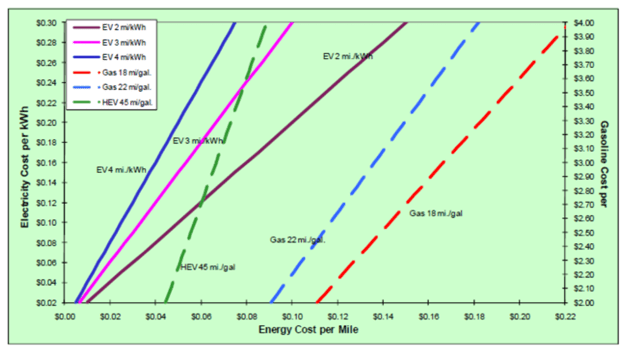
Photo: Idaho National Laboratory
Understanding How AI and Data can Help Control Costs
Despite all of this, leading AI and data technology are offering intelligent solutions that can reduce the headaches and costs associated with driving and charging an EV, or a fleet of EVs for a business.
Today’s leading EV charge data solutions for fleets and vehicles leverage an Augmented Deep Learning Platform (ADLP) that leverages machine learning and data science with unique indicators that allow predictive real-time data insights to OEMs that enhance their vehicle’s performance and quality as well as the customer experience related to vehicle usage.
This data connects and analyzes everything in real time from charge stations to optimized energy outputs at locations and time of day, cost savings, congestion reduction rates, and it can even predict failure cycles that holistically feeds data into smart city data infrastructure platforms.
This AI-driven connected vehicle data helps fleet customers and EV users make a more seamless, successful transition to a greener, cleaner, and sustainable future.
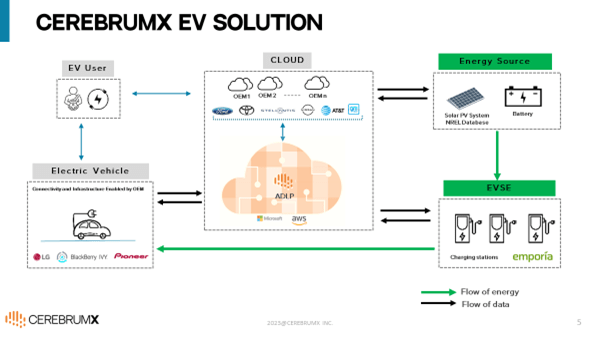
Photo: Cerebrum X
Users can charge EVs with accurate energy cost and rate plan selections. Intelligent energy consumption means they will lower the impact on their energy bill and get the most out of their solar panels by charging Evs at the most optimal time.
Lastly, they can leverage the power of smart cities by receiving in-car notifications for the nearest charging station, and reserving charging slots soon.
With these AI and data strategies available, fleets and drivers of EVs will have a better experience in adopting a greener solution for transportation while better controlling the cost of charging.
Subscribe to Our Newsletter
More Fleet Forward


Erin Gilchrist Receives Mike Antich Spirit of Fleet Award
Last week at AFLA in Vegas, Erin Gilchrist received the inaugural, brand-new Spirit of Fleet Award.
Read More →
Dominika Leja Named the 2026 Fleet Manager of the Year
The AstraZeneca associate director of fleet was recognized for her leadership in fleet electrification, cost savings, and operational transformation.
Read More →
Jamie McKay Named the 2026 Fleet Visionary Award Winner
The Aptive Pest Control fleet manager was recognized for her approach to operations, data, lifecycle management, and driver needs.
Read More →
Fleet Forward Conference Introduces One-Day Passes for 2026
New one-day registration gives fleet professionals the flexibility to attend Tuesday, Wednesday, or Thursday, with passes available for $199 through Sept. 18.
Read More →
Vibe Coding: When Fleet Managers Become Software Builders
Five fleet professionals — none with programming skills — discuss how they’re using AI to build fleet solutions in-house and in a fraction of the time.
Read More →
Fleet Forward Conference Tackles Fleet Industry’s Growing Leadership Gap
This session will examine succession planning, knowledge transfer, and the skills the next generation of fleet leaders will need as veteran professionals leave the industry.
Read More →
2026 Fleet Manager of the Year Finalists Announced
Who are the 2026 Fleet Manager of the Year finalists?
Read More →
John Rossant to Deliver Opening Keynote at 2026 Fleet Forward Conference
The CoMotion founder will draw on developments across Europe, China, the Middle East, and other international markets to identify trends that could influence how U.S. fleets plan for the coming decade.
Read More →
How to Build Custom Fleet Tools With AI and Vibe Coding [Webinar]
A new Automotive Fleet webinar explores how fleet managers are using AI and vibe coding to automate routine work and create simple operational tools without traditional programming skills.
Read More →