




Let’s Not Get Too Worked Up Over an Electric F-150 — Yet
Yes, an all-electric pickup can tow 1.25 million pounds, but to deliver one with verifiable specs, at scale, and at a reasonable price point is a different equation entirely.

Screen capture from Ford YouTube video on all-electric F-150.
Last week, Ford released a video of an all-electric F-150 prototype towing 1.25 million pounds of F-150s on rail cars. Wow.
In the accompanying Medium post, Ted Cannis, global director of Ford’s electrification strategy, states: “We are dead serious about delivering an electric pickup truck that again sets an all-new bar for what light-duty trucks can deliver — not in the science project sense, but in the reality of what tough trucks need to do.”
The video, and the statement from Cannis, is enough to stir the passions of work truck users who also see the future of electric vehicles. For that group, an electric F-150 is akin to Volkswagen’s half-decade tease of a reimagined 60’s Microbus with an electric motor. Cue the Facebook comments: “Yes, please!”
The F-150 has sold the most of any vehicle in the U.S. over the last 35 years, so it’s not surprising that automakers are now including fully electric pickup trucks in their product plans.
This also includes Tesla, and while Elon Musk threw down some markers on price (starting at less than $50k) and capabilities (“better than an F-150”), there are no verifiable specs, price points, or release dates yet.
Other independent OEMs have electric pickup prototypes but have yet to achieve production scale. However, the model that is closest to production gives us a starting point on what’s possible for an electric pickup truck in the near future:
The Rivian R1T pickup, one of two models from the startup manufacturer that was recently imbued with capital from Ford and Amazon, will be produced in an old Mitsubishi plant in Illinois. Sales will begin in late 2020.
We won’t get into the specifics of Rivian’s tech in this post, though the company reports a range of 230 to 400 miles (depending on battery pack), tow 11,000 lbs., and allow a payload of 1,760 lbs.
Those specs are work-truck impressive, particularly considering a zero to 60 that will purportedly beat an F-150 Raptor. Now comes the price — the R1T starts at $69,000 before federal and any state incentives.
To be clear, Rivian isn’t positioning the unibody R1T as a work truck, but as an off-road adventurer for the environmentally conscious Range Rover set. Ford, on the other hand, must make an all-electric F-150 with the capabilities of an F-150 — which means it won’t be easy to cut costs to compensate for the expensive battery pack.
You could call Kevin Myose, fleet manager for San Joaquin County, Calif., a fleet forward thinker. “When I look at our responsibility to reduce our fuel burn, and (lessen) our pollution, yeah, I'm always looking to electrify something,” Myose says.
The pickups in Myose’s fleet average fewer than 100 miles a day and come back to a central base, so electric range isn’t that much of an issue. He could also see scenarios in which extra battery juice could power tools and other accessories on a jobsite.
He’s aware of the Rivian and other startup truck makers. Yet he’s realistic on whether his needs can be satisfied by what is soon to be offered:
How long will it last in a Public Works application? Where am I going to put my rack and my toolbox? Can I toss a 300-lb. grader blade in the back of this baby? How much range will a heavy payload or trailer suck up? (This Rivian forum sheds light on that question. The answer, a lot.) How will the truck perform in the extreme heat of the San Joaquin Valley in August?
Regarding R1T’s price, “I could apply my grant money and each ($69,000 electric) truck would still cost twice as much as I’m paying (for an internal combustion engine pickup),” Myose says.
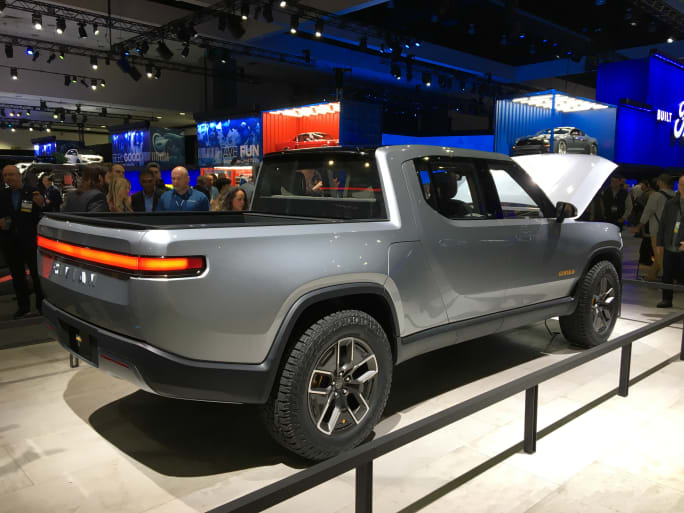
The Rivian R1T debuted at the 2018 Los Angeles Auto Show.
Photo by Chris Brown.
Ford could keep an electric F-150 as a halo model to satisfy a small niche, like the high-end Raptor, but that doesn’t seem to be the intent. Then can Ford, or any other mainstream OEM, deliver those capabilities at a reasonable price point with today’s technology?
“Nobody's cracked the code yet on an all-electric pickup truck,” says Karl Brauer, executive publisher for Cox Automotive, overseeing Autotrader and Kelley Blue Book.
Brauer points out that the added weight of the battery will affect payload, towing, and range, which aren’t primary issues with electric sedans. He says the Rivian-Ford partnership will be useful from a technology, supply chain, and production perspective: “Then you’re just waiting on the battery technology.”
“I’ll wait to see how it handles the Davis Dam in Arizona,” says Ed Sanchez of Strategy Analytics, referring to SAE J2807, the rigorous towing test where all pickups are judged for official numbers. “It's one thing to make claims. It's another thing to back them up, and another for them to be repeatable.”
While an all-electric pickup for substantial fleet use may not be ready for prime time, perhaps Ford’s plans for a hybrid F-150, coming to market first, is a good small step toward full electrification.
In the plug-in hybrid electric (PHEV) vein, there are options for fleets today. XL offers a PHEV system for F-150 and F-250 models. While not designed to travel on electric power alone, the PHEV increases MPG by 50% and reduces CO2 emissions by 33% over the standard models, while the factory performance and warranty remains intact.
The XL upfit, ordered aftermarket or as a new vehicle ship-thru, isn’t cheap — but the cost-benefit analysis is definable. Grant money is often available to cover part of the premium.
The Ford video ends with the line, “The all-electric F-150 is coming” over black.
Yes, an all-electric pickup can tow 1.25 million pounds, but to deliver one with verifiable specs, at scale, and at a reasonable price point is a different equation entirely. At the very least, the Ford video brings the conversation from “if” to “when,” even though we’re still a few milestones away.
For Myose — and many fleets — the more pressing issue is rightsizing. “I have a lot of people in pickup trucks that could be driving a Prius, but in their heads, they need a new truck,” he says.
He estimates about 20% to 30% of his internal customers could be switched from a pickup to a more economical sedan. But for that to happen, “It’ll take a shift in mindset.”
More Fleet Forward

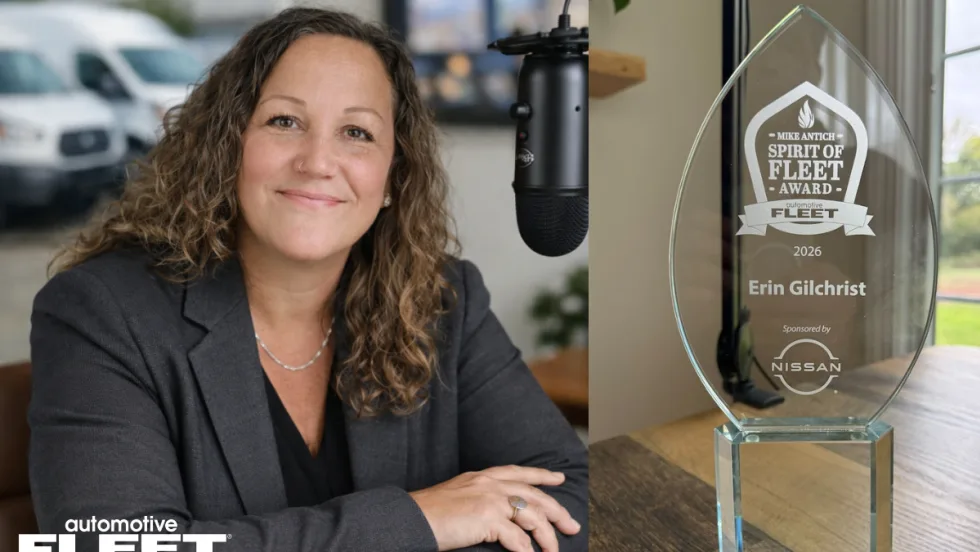
Erin Gilchrist Receives Mike Antich Spirit of Fleet Award
Last week at AFLA in Vegas, Erin Gilchrist received the inaugural, brand-new Spirit of Fleet Award.
Read More →
Dominika Leja Named the 2026 Fleet Manager of the Year
The AstraZeneca associate director of fleet was recognized for her leadership in fleet electrification, cost savings, and operational transformation.
Read More →
Jamie McKay Named the 2026 Fleet Visionary Award Winner
The Aptive Pest Control fleet manager was recognized for her approach to operations, data, lifecycle management, and driver needs.
Read More →
Fleet Forward Conference Introduces One-Day Passes for 2026
New one-day registration gives fleet professionals the flexibility to attend Tuesday, Wednesday, or Thursday, with passes available for $199 through Sept. 18.
Read More →
Vibe Coding: When Fleet Managers Become Software Builders
Five fleet professionals — none with programming skills — discuss how they’re using AI to build fleet solutions in-house and in a fraction of the time.
Read More →
Fleet Forward Conference Tackles Fleet Industry’s Growing Leadership Gap
This session will examine succession planning, knowledge transfer, and the skills the next generation of fleet leaders will need as veteran professionals leave the industry.
Read More →
2026 Fleet Manager of the Year Finalists Announced
Who are the 2026 Fleet Manager of the Year finalists?
Read More →
John Rossant to Deliver Opening Keynote at 2026 Fleet Forward Conference
The CoMotion founder will draw on developments across Europe, China, the Middle East, and other international markets to identify trends that could influence how U.S. fleets plan for the coming decade.
Read More →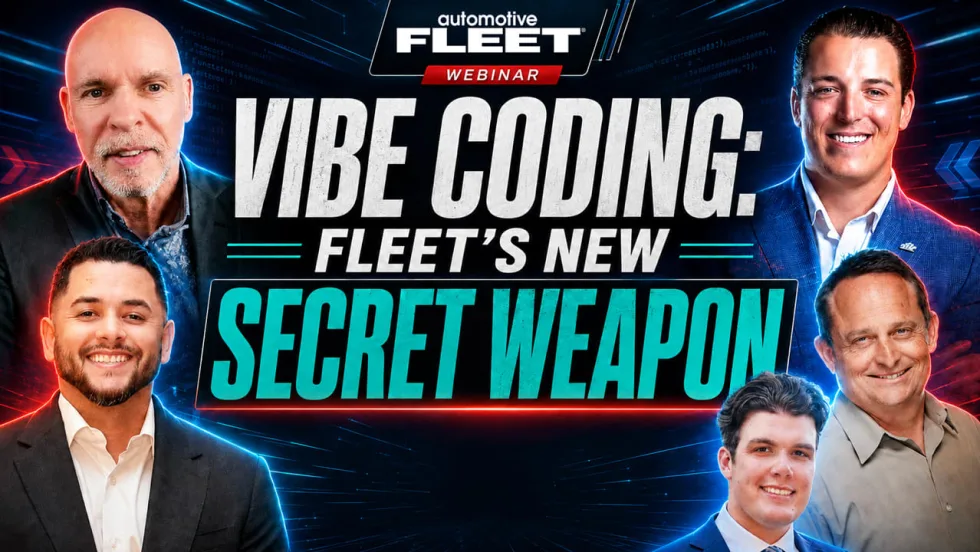
How to Build Custom Fleet Tools With AI and Vibe Coding [Webinar]
A new Automotive Fleet webinar explores how fleet managers are using AI and vibe coding to automate routine work and create simple operational tools without traditional programming skills.
Read More →