




How to Make the Transition to ELD in 6 Important Steps
With the deadline for the FMCSA’s ELD Mandate Final Rule just around the corner, check out tips to make the journey to compliance in six straightforward steps.
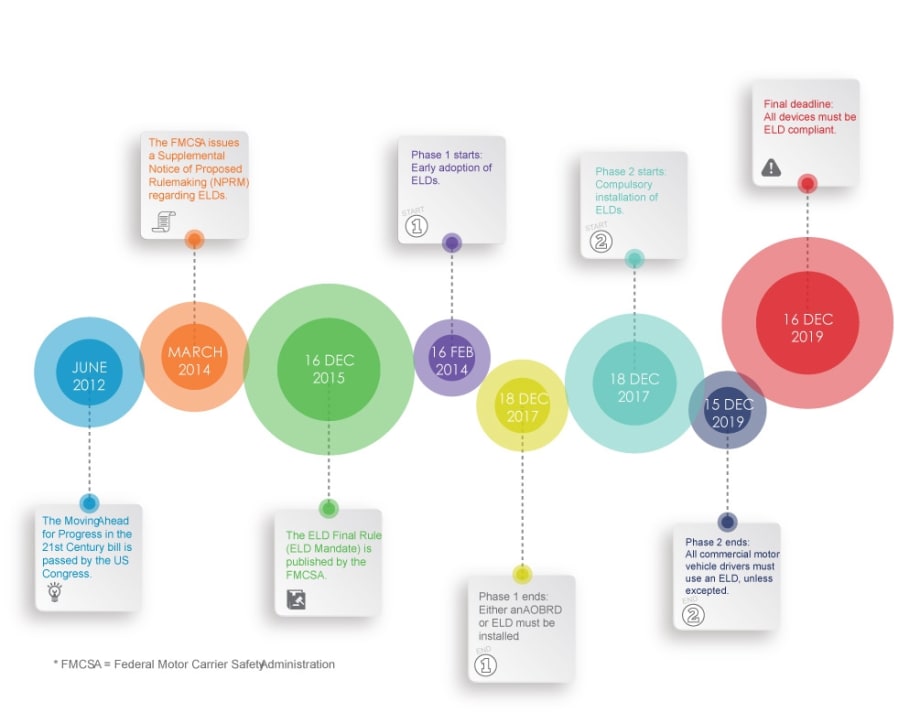
ELD Timeline courtesy of MiX Telematics
With the deadline for the FMCSA’s ELD Mandate Final Rule just around the corner, check out tips to make the journey to compliance in six straightforward steps. MiX Telematics provides some suggestions to make the transition as smooth as possible for your organization:
Step 1: Assess Your Current Situation - Paper, AOBRD, or ELD
The first step to compliance is understanding how the ELD Mandate will affect your fleet. Take note that it applies to all drivers currently required to keep records of duty status (RODS). To do this you need to look at your current system – are your drivers using paper logs or do you have Automatic On-Board Recording Devices (AOBRDs) or electronic logging devices (ELDs) installed? If you’re still using paper logs, you’ll need to have either an AOBRD or an ELD installed by December 2017. If you have AOBRDs, you have until December 2019 to make sure they comply with FMCSA’s regulations as set out in the ELD Mandate.
Step 2: Pick a Provider
The ELD Mandate Final Rule requires that all device providers first self-certify and register the device with the FMCSA, who will then maintain a list of vendors and make it available for review by motor carriers and drivers. However, self-certified does not equal verified. There could be some vendors that self-certify their devices for various reasons, without meeting all ELD requirements. So how do you find the right provider? Ask yourself whether you’ve heard of the vendor before or if you know of other fleets using its products. If the answer is “no”, it’s probably best to do more research and continue your search. Try to stick to one of the big names in the industry, with a solid reputation. Non-compliant vendors will be removed from the FMCSA’s list.
Step 3: Pick a Device
As we move closer to the deadline, there will be more and more ELD solutions to choose from and your options may appear unlimited. However, all devices must meet certain criteria as set out by the FMCSA in its Final Rule. There are various specifications that the device needs to meet, but basic requirements include:
Being integrally synchronized. The ELD must be directly connected to the vehicle’s engine (if it is model-year 2000 or later).
Self-certification. The vendor must be able to provide proof that the device meets the FMCSA’s strict ELD requirements.Ability to electronically send HOS at
Ability to electronically send HOS at the roadside. The device must be able to send Hours of Service data to law enforcement officers using one of two options:
Step 4: Begin Installation
Now that you’ve evaluated your needs and chosen a provider and device, you can set about installing the system across your fleet.
Step 5: Train Staff
Even before picking a vendor and specific make and model of electronic logging devices, you can begin educating staff on the general benefits they offer everyone from drivers and dispatchers to maintenance teams and managers. That way, any resistance to compliance can be tackled head-on as early as possible. Once the specifics of the system are known, you can plan a schedule to train all relevant staff on how to use it. Moving from a manual system to ELD means more than simply changing the hardware and software – it will affect most aspects of the company, including the culture. The key is to be transparent about the whole process from the start.
Step 6: Implement the Transition
Now that you’ve installed the devices and trained your staff, you’re ready to begin using your new ELD. Give yourself and your fleet enough time to test the new processes so you can work out any bugs or conduct additional training well before the relevant deadline.
Transitioning from a manual system to an ELD is no small order, but following these six steps should make the process smoother and ensure you’re not missing any red flags, and hitting all of your targets each step of the way.
About the Author
Pete Allen is the executive vice president for MiX Telematics North America. In his role, Allen is responsible for managing the customer experience. This includes building and managing the Sales and Account Management teams.
Originally posted on Work Truck Online
More Global Fleet

Holman Takes Full Ownership of ARIZA in Mexico
Holman is bringing its Mexican fleet management operation fully under its own brand after more than 30 years as a joint venture. The change gives multinational fleet customers a single Holman operation across the U.S., Canada, and Mexico.
Read More →
Proven Ways to Reduce Work Truck Downtime
The age-old problem of downtime will always be a reality, but with new strategies at hand, fleets have more ways to keep trucks on the road longer.
Read More →
The Top 300 Commercial Fleets
The Top 300 Commercial Fleets: See the List
Read More →

Cameras, Safety and Insurance: From Reactive Claims to Real-Time Prevention (Part 2 of 2)
Part Two: Commercial auto remains one of the most challenging and costly lines of coverage for fleet operators and insurers alike. Continue learning more about how to effectively address these issues from Onur Aksan, Enterprise Business Development Executive, Geotab
Read More →
Cameras, Safety and Insurance: From Reactive Claims to Real-time Prevention
Commercial auto remains one of the most challenging and costly lines of coverage for fleet operators and insurers alike. Learn more about how to effectively address these issues from Onur Aksan, Enterprise Business Development Executive, Geotab.
Read More →
Fleet Costs Are Rising: Here’s How Leaders Are Responding
Fleet leaders are under pressure to reduce costs, adapt to economic uncertainty, and make smarter decisions. See how peers across North America are responding with real data, proven strategies, and forward-looking insights. Download the 2026 Market Pulse Report to benchmark your strategy and uncover where you can gain an edge.
Read More →
Enterprise Fleet Management Surpasses 900,000 Vehicles in U.S. & Canada
Enterprise Mobility connects with mobility solutions around the globe
Read More →
Automotive Fleet's Guide to Fleet Electrification
Unlock the secrets to a successful transition to electric fleets with Automotive Fleet's comprehensive Fleet Electrification Guide!
Read More →
Sumitomo Rubber Industries to Acquire Viaduct
Viaduct will join Sumitomo as an independent subsidiary. Partnership strengthens global reach and accelerates AI-driven innovation for fleets and manufacturing.
Read More →