




How to Develop a Journey Management Plan
Developing a journey management plan tailored for each specific road trip is an important task that commercial fleet managers should not overlook.

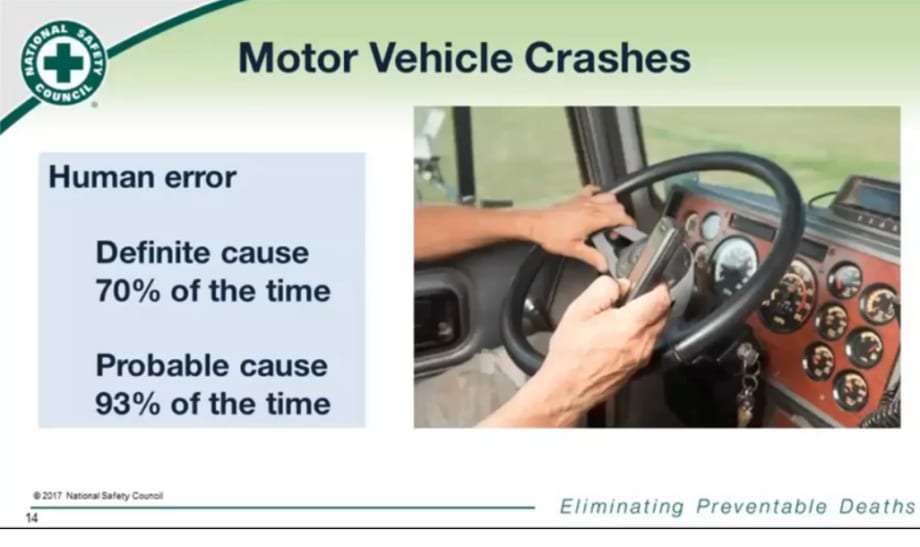
An effective journey management plan is a holistic look at roadway safety risks and how to manage them.
Screenshot via National Safety Council/YouTube.
Journey management is a planned and systematic process for reducing transportation-related risks in a company’s operations. In short, it is a key element of safety in the workplace—for fleets and other employers. Across all industries, motor vehicle crashes cost employers approximately $9.25 billion a year, according to the National Safety Council.
Moreover, research shows that human error is the definite cause of truck or car accidents 70% of the time, and the probable cause 93% of the time.
Therefore, every journey management plan should take into account that your drivers are your greatest safety feature. In short, a company's drivers are its best defense in protecting the organization from risk and liability.
When developing a journey management plan keep in mind that the key objectives of the plan should be to eliminate unnecessary trips, reduce driving distances, and minimize the risks associated with necessary trips.
A solid journey management plan will focus on four key factors: the roadway, your drivers, the vehicle, and the environment. For example, you need to consider route planning in order to make sure drivers avoid construction or closed roads. You need to consider the behaviors of your drivers; for instance, if they are getting enough sleep before hitting the road. Then there are factors such as vehicle maintenance and weather conditions, which must also be considered when developing your plan.
Benefits of a Journey Management Plan
Commercial fleet management frequently deals with multiple vehicles engaged in long-distance driving—in some cases from one end of the nation to the other. But even relatively short journeys can benefit from thorough planning. A proper fleet logistics management plan should guide drivers through each stage of their journey, with the aim of supporting highway safety and accident prevention policies and procedures.
Your plan should aim to mitigate the following hazards:
Driver inexperience
Distracted driving behavior
Poor road conditions
Driver fatigue
Wildlife on the roads
Adverse weather conditions
Malfunctioning vehicles
Unsecured projectiles
Risky behaviors of other drivers
Communication failure
For commercial fleets, the benefits of a solid journey management plan are many, according to the National Safety Council. These include:
Eliminating unnecessary trips to reduce crash risk
Minimize exposure to traffic hazards
Reduce
Reduce wear and tear on fleet vehicles
Reduce
Increase fleet and driver efficiency
Elements of an Effective Journey Management Plan
A fleet safety plan should begin by outlining pre-journey inspection procedures. This involves checking to see that the vehicle is in sound operating condition and is up to date on preventative maintenance service. To aid this task, the fleet driver (or inspector) should have a checklist—these days, it’s often in the form of a mobile app—that includes all areas of the vehicle that require inspection. These areas typically include:
Engine
Ignition system
Fuel system
Electrical system
Exhaust system
Drivetrain
Brakes
Vehicle frame
Suspension
Steering
This can seem needlessly time-consuming, but ensuring that these inspections are completed, and correctly recorded, can go a long way toward bolstering fleet safety and reducing company or driver liability in the event of an accident.
There should also be a procedure where the inspector can take pictures of problem areas and transmit them to the appropriate company authority.
The journey itself should be mapped out so drivers can take the most efficient route to their destination in order to minimize fleet mileage and promote auto safety. This should include usable alternate routes in case of road blockage, inclement weather, or similar hazards. That’s why it’s important to customize each plan for every specific trip, as conditions may have changed since the last time a journey was made down a particular network of roads.
The route should allow the driver to avoid low-clearance obstacles, such as bridges, that can prevent the vehicle from safely passing through. The driver should know the exact dimensions of the vehicle so they can readily comply with posted clearance requirements.
The plan should also be created with the aim of preventing “road fatigue” from becoming a factor in a long-distance driving trip. Driving while sleepy reduces reaction times and makes collision avoidance far more difficult; this is why so many road accidents can be traced to driver fatigue. To ensure optimal highway safety, journey plans should permit the fleet driver to be on the roads only when they are most likely to be sufficiently alert, and adequate rest breaks should be included in the itinerary.
The plan must also provide guidance to the driver in the event of an accident, vehicle failure, or other emergency situation. Trucking tips for the driver should include what to do and whom at the company they should call.
It’s important to understand that a journey management plan is not just a formality. It provides a number of vital benefits that support effective commercial fleet management: promoting sound fleet logistics, enhancing fuel efficiency of vehicles, reinforcing accident prevention practices, reducing risks associated with road fatigue, and ensuring that routine maintenance tasks are followed on schedule.
More Safety
IIHS Crash Avoidance Tests Reveal Safety Gaps in Cargo Vans and Work Trucks
New crash-avoidance ratings from the Insurance Institute for Highway Safety reveal inconsistent performance among commercial vehicles, with several popular cargo vans and heavy-duty pickups struggling to avoid collisions with other vehicles and pedestrians.
Read More →
What’s Next for Fleet? Safety, AI & Industry Recognition | AF News Recap
Could your company's culture be encouraging distracted driving? This week, we're exploring how workplace expectations affect driver safety, what AI, EVs, and autonomous vehicles could mean for the future of fleet management, and how fleet professionals can strengthen their award nominations.
Read More →
Does Your Fleet's Culture Encourage Distracted Driving?
What happens when the people responsible for enforcing safety rules are the ones setting the wrong example? The answer may reveal why some of the biggest risks to fleet drivers have little to do with what's written in the employee handbook.
Read More →
Fleet Manager’s Ultimate Playbook: Navigating the New Standard in OEM Connectivity
Rising operating costs, driver safety concerns, and unplanned downtime are putting unprecedented pressure on modern fleets. Discover how fleet managers use embedded OEM connectivity and real-time vehicle data to cut TCO, prevent downtime, and protect drivers without aftermarket telematics hardware.
Read More →
From Driver Well-Being to EV Charging | AF News Recap
Mental health belongs in the fleet safety conversation. This week, we’re looking at five ways fleets can support employee well-being before a crisis, plus Holman’s expansion in Mexico, new one-day Fleet Forward passes, and why EV charging demand is outpacing infrastructure growth.
Read More →
Nexar-Nauto Merger Aims to Give Fleets Better Safety Intelligence Through Larger Driving Dataset
Stefan Heck tells Automotive Fleet that combining more than 10 billion miles of driving history with Nexar's AI models will give fleets deeper insights into driver risk and roadway conditions than either company could provide independently.
Read More →
Don't Wait for a Crisis: 5 Ways to Build Mental Health Into Your Fleet Safety Program
For Suicide Prevention Month, fleet and safety leaders have an opportunity to put mental health where it belongs: at the center of workplace safety.
Read More →
How Camera Data Can Strengthen a Fleet’s Insurance Renewal
Insights from a commercial insurance carrier and a broker show how fleets can turn video telematic data, driver coaching, and improved claims results into a stronger case at insurance renewal.
Read More →
The Safest Fleets Aren’t the Ones with the Most Technology
You’ve made the telematics investment. Here’s how to capture the other half of its value and build the safest fleet on the road.
Read More →
Hidden in Plain Sight: Fleet Compliance Risks
Fleet compliance isn't just about having policies — it's about consistently enforcing them. This practical guide reveals six hidden compliance risks common in public sector and shared fleet operations and outlines proven strategies to improve visibility, accountability, and audit readiness
Read More →