




Related: Digging into Work Truck Fleet Costs
How to Avoid Running a Truck Until its Wheels 'Fall Off'
Truck lifecycles can be calculated to the mile and the dollar. This can help fleets replace vehicles at the optimal moment.
by John Dolce
November 15, 2013
Truck lifecycles can be calculated to the mile and the dollar. This can help fleets replace vehicles at the optimal moment.
Photo: Work Truck
4 min to read
Depreciation is the largest fleet cost. In fact, when cumulative maintenance cost (parts and labor) equal the original purchase price (no interest included), that is the threshold, the watershed moment, when a truck’s wheels will economically “fall off.”
This moment is completely predictable and consistent. And, interestingly this predictability has been with us since the earliest days of the automotive industry, a general benchmark that states when the cumulative maintenance cost (parts and labor) is equal to the original purchase price of the truck, that’s the moment that’s predicted when the wheels are going to economically fall off.
Measuring Cost
For our purposes, we’ll use a benchmark of $18,500 of accumulated maintenance as the moment when the wheels are going to economically fall off.
The accompanying chart, “$18,500 Light-Duty Truck,” illustrates the predictability of the process, showing that in year eight the wheels will economically “fall off.”
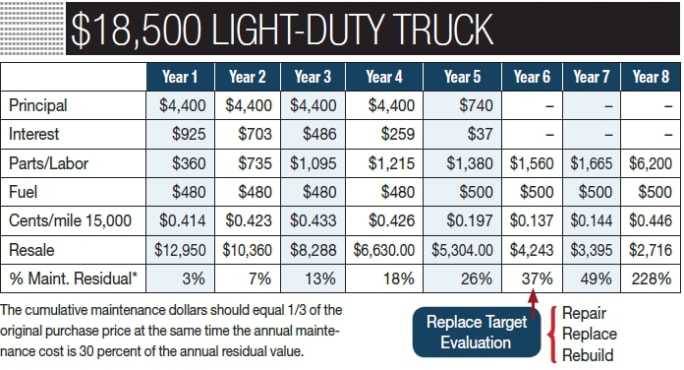
The predictability of the process shows that in year eight the wheels will economically “fall off."
Photo: Work Truck
Since it’s a predictable value, it makes sense to replace the truck sometime in year seven — just before the wheels fall off (forget resale value in this scenario).
Also, note that in operating year five, six, and seven, the truck is cheaper to operate than in years one through four. The reason: There’s no depreciation cost.
Now, the key to maximizing operational life is to stretch out years five through seven with good regular maintenance, and configure the vehicle to do its work within its capability or spec. In year eight, the wheels will economically fall off.
Timing Is Everything
When should the clock be started to begin measuring the accumulation of time toward the choice to proactively repair, replace, rebuild, sell (resale), scrap (liability), or remove instead of replacing a vehicle? I believe the measurement should begin when the maintenance cost for the previous 12 months is 30% of the vehicle’s residual value (year six in the chart).
At that time, the fleet is already in the next year (year seven) and 49% of the residual value, because next year (year eight in this example) the wheels will economically fall off. Maintenance will be 228% of the vehicle’s residual value. Also, the 228% additional maintenance costs will have other consequences, namely the headaches associated with a less reliable vehicle.
As the chart “$70,000 Vocational Chassis + Equipment” illustrates, the same process can be used no matter the equipment type. The only difference is the timing of the 30% tipping point, which occurs at the seven-year mark.
So, to be proactive, for either capital or operating funding, use 30% of the residual value (maintenance costs instead of resale costs) as the optimal time to decide whether to continue to repair, rebuild, replace, sell, or scrap the vehicle in question.
Interestingly, there is a 30% maintenance cost over the residual value. Conveniently, the cumulative maintenance cost at the same point (year six) is 30% of the original purchase price. The 30% benchmark is ideal because it usually gives the fleet a year or two at least to plan for replacement. The numbers take the emotion out of the equation. It’s a black and white equation.
There’s a caveat to this. Anytime within the first six years, the truck is in an accident and it takes more than 50% of its residual value, an analysis should be done to see if it’s worth fixing. In most cases, it won’t be worth fixing.
A Predictable Process
The truck lifecycle process is predictable and cost-effective. It is the fleet manager’s responsibility to fund the repairs, replacements, and rebuild actions, with the appropriate funding, a year ahead for the next capital or operating budget.
Now, the choice to rebuild makes sense if the fleet can safely spend ½ the cost of the new replacement vehicle and get ⅔ to ¾ the life of a new vehicle. The key to making this another cost-effective alternative as long as the vocational vehicle is configured correctly by the manufacturer to do the job it is supposed to do.
For the $18,500 unit example, a new replacement is $24,000. If the fleet can afford to spend $12,000 to rebuild the unit instead of replacing it after seven years, and get an additional five years of life from it, then this option is a cost-effective alternative to consider.
Topics:Vehicle ReplacementTruck LifecycleLifecycle CostsTruck ResaleTruck ReplacementReplacement CyclesVehicle ResearchOperations
Originally posted on Work Truck Online
Subscribe to Our Newsletter
More Vehicle Research

2027 Toyota Camry Offers Hybrid Powertrain Across Five Grades
The 2027 Toyota Camry is a carryover with new pricing.
Read More →
Chevrolet Updates 2027 Trax and Trailblazer with More Standard Safety Features
Chevrolet is updating two of its smallest SUVs with added driver-assistance technology, redesigned interiors, and revised trim options. The changes could add more safety equipment as standard for commercial fleets, while a new Trailblazer configuration adds another all-wheel-drive option.
Read More →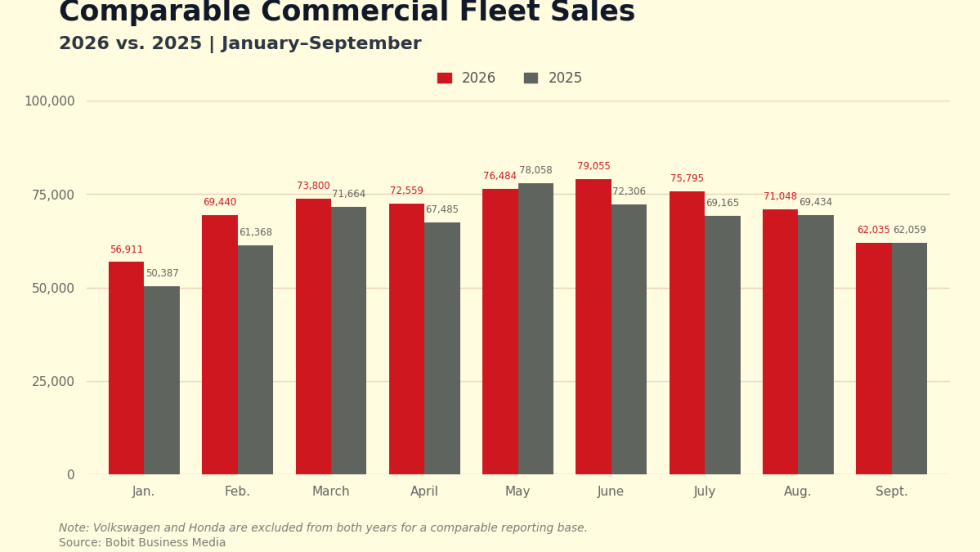
Commercial Fleet Sales Rise 5.8% Through September 2026
September commercial fleet sales were essentially unchanged from a year earlier, slowing year-to-date growth while keeping volume ahead of 2025.
Read More →
Hall of Fame Inductee: John Dmochowsky
The longtime Mondelēz International fleet executive joins the Automotive Fleet Hall of Fame.
Read More →
Hall of Fame Inductee: Lee Miller
After more than four decades at Boehringer Ingelheim, Lee Miller leaves a legacy built on fleet expertise.
Read More →
Hall of Fame Inductee: Mark F. Petersen
From managing fleets of thousands of vehicles to advancing safety and mentoring fellow professionals, Mark F. Petersen made his mark across both the corporate and supplier sides of fleet.
Read More →
When Charger Downtime Becomes a Fleet Availability Problem
As EV deployments move beyond pilot programs, charger reliability can directly affect vehicle readiness, driver productivity and route scheduling.
Read More →
2027 Nissan Rogue Hybrid Adds e-POWER, Standard AWD
The new Rogue Hybrid uses Nissan’s e-POWER system with dual electric motors, offers an estimated 40 mpg and starts at $35,490.
Read More →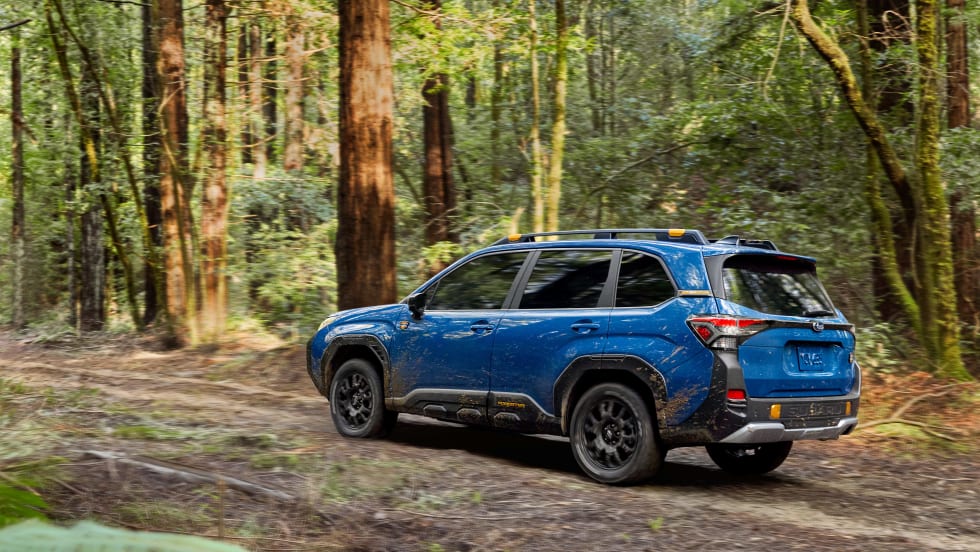
2027 Subaru Forester Adds First Wilderness Hybrid
The 2027 Forester lineup starts at $29,995 and adds a Wilderness Hybrid with 194 combined horsepower and 9.3 inches of ground clearance.
Read More →
EV Realty Names Henrik Holland President as Charging Platform Expands
The former Prologis Mobility and Shell executive will help expand EV Realty’s truck charging business and move its power-first infrastructure model into autonomous vehicle depots and other fleet sectors.
Read More →