Fleet managers are using telematics to promote safe driving by recording speed, harsh acceleration and harsh braking incidents, and then using the data to coach drivers.
Jim Aleson of Vivint Solar uses his Telogis telematics system to promote safety by setting up his operations managers to receive alerts when drivers exceed 10 miles over the speed limit or brake hard. Driver coaching is a consequence. Speeding and idling are on the decline, he says.
6 min to read
Jim Aleson of Vivint Solar uses his Telogis telematics system to promote safety by setting up his operations managers to receive alerts when drivers exceed 10 miles over the speed limit or brake hard. Driver coaching is a consequence. Speeding and idling are on the decline, he says.
Telematics can do more than just report your vehicles’ locations and how long your drivers spend at each job site. The systems can also help promote safety and encourage drivers to engage in safe driving practices — giving fleet managers the ability to hold them accountable.
Ad Loading...
The advanced GPS technology of today’s systems can determine how fast vehicles are moving and whether they are accelerating too quickly or braking too harshly. Some can even tell whether the driver’s seatbelt is fastened. Taken together, the data can create patterns of behavior that fleet managers can use to coach, discipline and reward drivers.
Ad Loading...
To learn more, Business Fleet spoke with fleet managers and telematics experts to find out what some systems are capable of and how they can be utilized to improve safety.
Using Alerts
Hellen Capelli, business systems manager at Airite Heating, Air Conditioning and Sheet Metal of Montclair, Calif., uses a telematics system furnished by GPS Insight. She worked with the provider to set strict parameters: Whenever a vehicle travels 5 miles per hour over the posted speed limit, the driver and general manager are alerted. “There’s a lot of red sometimes,” she says.
The system also delivers daily driver reports, which include start and end times and location and speed, in two-minute increments.
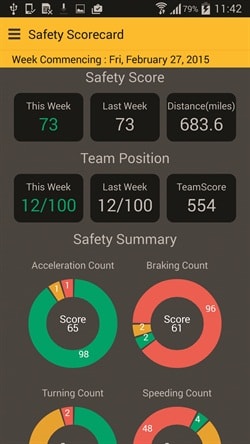
Fleet managers can supplement real-time alerts with a daily, weekly or monthly “scorecard” to hold drivers accountable. Ryan Driscoll, GPS Insight’s marketing director, says he works with one telecommunications company that runs nearly 1,100 vehicles on the system.
A trend in telematics is to collate driver data into a scorecard, such as this one from Trimble in smartphone format. Allowing drivers to see where they rank instantaneously in key metrics is fundamental to motivating them to improve.
Driscoll says the company set parameters to alert management of speeding in escalating alerts, with coaching for excessive offenders. But the simple act of measuring speeding — and communicating the results — had the desired effect.
Ad Loading...
“They reduced [speeding] by 98% in one year,” he says. “The accident rate went down by 20%. That’s your ROI right there.”
Fleet managers and tech experts agree that individual coaching is where the rubber truly meets the road. Rather than rely on general training for all drivers, they say that one-on-one reviews allow fleet managers to focus on each driver’s pain points and address them privately.
That’s one way Jim Aleson, fleet and logistics manager for Vivint Solar, uses his Telogis telematics system to promote safety. Along with vehicle tracking and reporting, Aleson’s operations managers are set up to receive alerts. They coach the drivers with the results.
Speeding is on the decline, Aleson says, as well as idling. The next step, he adds, is creating a training curriculum with modules designed to correct any of a number of common issues, such as hard braking or cell phone use while driving.
Leveraging the Data
Bill Cooper, vice president of customer acquisition for WEX, says safety is a key selling point. But he notes that the data the systems collect doesn’t exist in a vacuum. It should be correlated with other factors, such as time of day, to ensure better decisions are being made about where drivers are sent and at what time.
Ad Loading...
Cooper references drivers who may consistently rush to attend to family matters. Fleets have adjusted drivers’ hours as a result. “The scorecard allows [managers] to start making business decisions that put their drivers in a better position and make their fleet safer,” Cooper says.
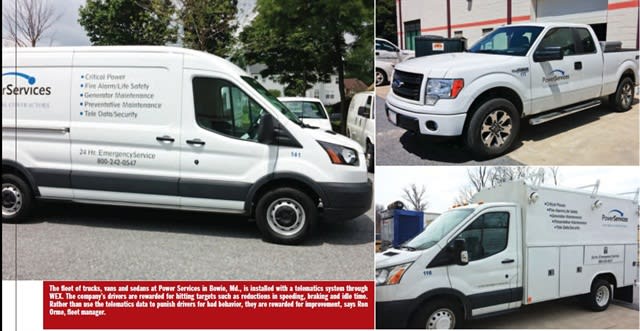
The systems also can give drivers the ability to make better decisions in the field. At Power Services in Bowie, Md., drivers are rewarded for hitting specific targets such as more gradual braking and reduced idle time. Rather than use the telematics data to punish drivers for bad behavior, they are rewarded for improvement.
“We call that ‘consciousness,’” says Ron Orme, fleet manager at Power Services. “They’re very aware of what’s going on and what they’re doing. If they’re speeding, they get text alerts and they get emails. Idle time, speed — you name it, they get it. The system does it all.”
It’s all about catching patterns of behavior early and then helping drivers see the problem and know how to correct it. Telematics technology gives fleet managers insights they didn’t have access to even a few years ago, making for a powerful shift in the way safety is viewed.
“I have some 30 years in motor vehicle fleet safety, and I wish I had this technology 10, 15 or even five years ago,” says Brad Penneau, the safety program consultant for Telogis. “You start moving your safety culture from reactive work — dealing with the outcome — to moving it toward a more preventive safety program.”
Ad Loading...
“We can start modeling behavior over time and address it on a proactive basis. We can bring drivers in, do ride-alongs, teach defensive driving techniques and show them the inherent dangers.”
Joyce Tam believes that empowering drivers to see their own problems and take action, rather than be called out or shamed, creates a better culture overall. “It’s approaching it from the bottom up,” says Tam, the principal product manager for Trimble Field Service Management.
She went on to note that it’s not just the drivers who benefit from having the data. “We try to deliver information to managers who have visibility, but they don’t necessarily have time to coach the driver,” says Tam. “So as mobile devices have become prevalent, we decided to offer a scorecard that can be delivered to a smartphone and let the driver help manage the situation themselves, and give them some guidance. That starts to take the headache off the supervisors.”
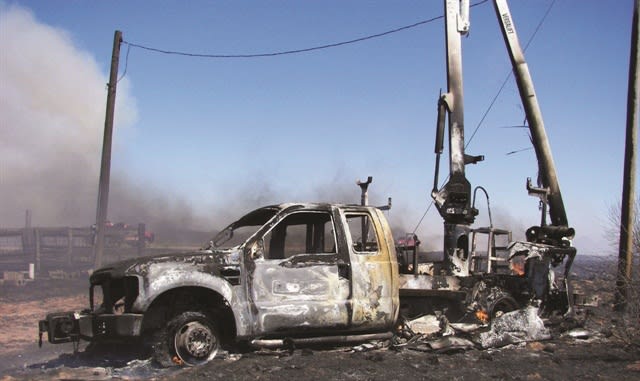
When the Rural Electric Cooperative (REC) power company of Oklahoma had concerns about the safety of one-man crews in the field, GPS Insight provided panic buttons on key fobs. Five months later, a lineman was in his bucket when a hydraulic line burst and ignited his vehicle. He was able to lower the boom and reach ground safely, though he had left his cell phone in the truck. Pressing the panic button alerted dispatch to the emergency while the telematics system identified his location.
Looking to the Future
True for most telematics systems, users are realizing an ROI without tapping into all of the systems’ features. The next step is to overlay speeding, hard acceleration and hard braking data with other information such as fuel consumption.
Going one step further, telematics data from numerous fleets could be collated to create industrywide benchmarks to develop safe-driving profiles — right down to the business type, vehicle type and geographic location. “We’ve got fleets tripping over themselves with ideas,” says WEX’s Cooper.
Ad Loading...
The old way, says Cooper, was to bring in a state trooper to discuss safe driving. Now, the mere idea of a being accountable to hard data — and where they stand in relation to their peers — is having the right effect. Cooper went on to note that benchmarks, rankings and “gamification” of the process can get drivers competitive about safety.
In the end, change won’t happen without buy-in from management. “It’s all about how management approaches it,” says Driscoll. “Some of them have been techs or delivery guys for a long time. If they haven’t gotten a ticket or been at fault in an accident on the job yet, they don’t think they need to change their behavior. Help them understand the need to make the fleet safer and reduce accidents and make the company look better as a brand in public.”
The fleet of trucks, vans and sedans at Power Services in Bowie, Md., is installed with a telematics system through WEX.
Telematics and Maintenance
Statistics show that the vast majority of vehicle accidents come from driver error. Nonetheless, an improperly maintained vehicle can be just as dangerous. Compounding the issue is the fact that drivers often treat vehicle maintenance as one of their lowest priorities, which can lead to problems that could have been prevented if they were caught sooner.
Bill Cooper, WEX’s vice president of customer acquisition, says drivers are more worried about finishing their service calls than dealing with a check engine light. “For them to run over to the dealership just to find out the gas cap wasn’t tight enough, it really ranks dead last for the driver — I’d say just behind typing in correct odometer at the pump when they use their fuel card.”
Telematics systems automate this process by pulling error codes from the vehicle as they occur and sending them to the fleet manager. This gives the fleet manager the opportunity to triage repairs and deal with a pressing alert before it becomes a breakdown.
“That’s one of the things we’re tracking, as well,” notes Jim Aleson, fleet and logistics manager for Lehi, Utah-based Vivint Solar. “We’ll get an alert and we can say, ‘Hey, you’ve got an issue; get our vehicle in for service.’”
Ron Orme, fleet manager for Power Services, takes full advantage of the maintenance-alert feature of his WEX telematics system. The feature alerts for things like brake pad changes, 500 miles before it becomes a problem.
Savings can come from more than just preserving vehicle life, says Joyce Tam, principal product manager for fleet management at Trimble Field Service Management, noting that insurance premiums could be reduced, as well.
Other than for safety’s sake, Cooper notes that maintenance issues were actually a big reason one fleet decided to install telematics in the first place. He recounts the incident of an ice cream company that suffered a truck breakdown and lost its entire inventory.
“We were just starting to talk about our telematics units and that was what pushed them over the edge,” he says. “It was probably $15,000 worth of ice cream. If nothing else, if [the system] prevented that from happening, the unit would have paid for itself.”
Geofencing is a familiar fleet tool today, but its early adoption marked a major shift in vehicle tracking, route monitoring, and the debate over employee privacy.
Holman is bringing its Mexican fleet management operation fully under its own brand after more than 30 years as a joint venture. The change gives multinational fleet customers a single Holman operation across the U.S., Canada, and Mexico.
Regular tire checks can do more than extend tread life. These five maintenance practices can help work truck fleets catch problems early, reduce costs, and prevent downtime.
Part Two: Commercial auto remains one of the most challenging and costly lines of coverage for fleet operators and insurers alike. Continue learning more about how to effectively address these issues from Onur Aksan, Enterprise Business Development Executive, Geotab
Commercial auto remains one of the most challenging and costly lines of coverage for fleet operators and insurers alike. Learn more about how to effectively address these issues from Onur Aksan, Enterprise Business Development Executive, Geotab.
Fleet leaders are under pressure to reduce costs, adapt to economic uncertainty, and make smarter decisions. See how peers across North America are responding with real data, proven strategies, and forward-looking insights. Download the 2026 Market Pulse Report to benchmark your strategy and uncover where you can gain an edge.