




How Glaxo Wellcome Managed Fleet Growth While Reducing Costs
Collins' sales force expansions caused Glaxo Wellcome's flee size to increase by 34% in 1999.

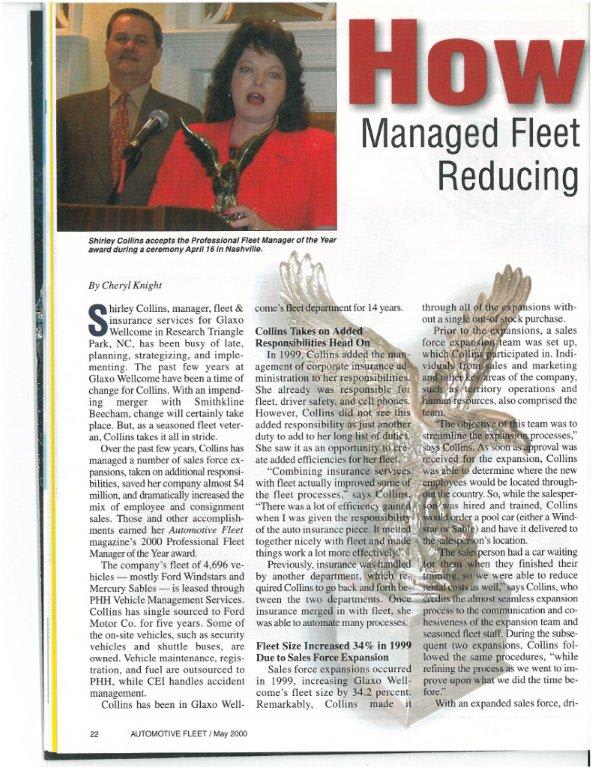
Shirley Collins, manager, fleet & insurance services for Glaxo Wellcome in Research Triangle Park, NC, has been busy of late, planning, strategizing, and implementing. The past few years at Glaxo Wellcome have been a time of change for Collins. With an impending merger with Smithkline Beecham, change will certainly take place. But, as a seasoned fleet veteran, Collins takes it all in stride.
Over the past few years, Collins has managed a number of sales force expansions, taken on additional responsibilities, saved her company almost $4 million, and dramatically increased the mix of employee and consignment sales. Those and other accomplishments earned her Automotive Fleet magazine’s 2000 Professional Fleet Manager of the Year award.
The company’s fleet of 4, 696 vehicles – mostly Ford Windstars and Mercury Sables – is leased through PHH Vehicle Management Services. Collins has single sourced to Ford Motor Co. for five years. Some of the on-site vehicles, such as security vehicles and shuttle buses, are owned. Vehicle maintenance, registration, and fuel are outsourced to PHH, while CEI handles accident management. Collins has been in Glaxo Wellcome’s fleet department for 14 years.
Collins Takes on Added Responsibilities Head On
In 1999, Collins added the management of corporate insurance administration to her responsibilities. She already was responsible for fleet, driver safety, and cell phones. However, Collins did not see this added responsibility as just another duty to add to her long list of duties. She saw it as an opportunity to create added efficiencies for her fleet.
“Combining insurance services with fleet actually improved some of the fleet processes,” says Collins. “There was a lot of efficiency gained when I was given the responsibility of the auto insurance piece. It melted together nicely with fleet and made things work a lot more effectively.”
Previously, insurance was handled by another department, which required Collins to go back and forth between the two departments. Once insurance merged in with fleet, she was able to automate many processes.
Fleet Size Increased 43% in 1999 Due to Sales Force Expansion
Sales force expansions occurred in 1999 increasing Glaxo Wellcome’s fleet size by 34.2 percent. Remarkably, Collins made it through all of the expansions without a single out-of-stock purchase.
Prior to the expansions, a sales force expansion team was set up, which Collins participated in. Individuals from sales and marketing and other areas of the company, such as territory operations and human resources, also comprised the team
“The objective of this team was to streamline the expansion process,” says Collins as soon as approval was received for the expansion, Collins was able to determine where the new employees would be located throughout the country. So, while the salesperson was hired and trained, Collins would order a pool car (either a Windstar or Sable) and have it delivered to the salesperson’s location.
The salesperson had a car waiting for them when they finished their training and we were able to reduce rental costs as well,” says Collins, who credits the almost seamless expansion process to the communication and cohesiveness of the expansion team and seasoned fleet staff. During the subsequent two expansions, Collins followed the same procedures, “while refining the process as we went to improve upon what we did the time before.”
With an expanded sales force, driver safety was more critical than ever to Collins. As chair of the driver safety committee for Glaxo Wellcome, Collins stays in close communication with the company’s corporate executive safety committee. If a change in the safety policy is needed, the committee facilitates that change.
Motor vehicle record checks are conducted annually and an accident review board looks at all accidents that occur. Penalties are assessed to drivers for preventable accidents, and marginal drivers are retrained. If a driver meets the criteria of a marginal driver, he or she must attend additional training, which ranges from a video and a test to one-on-one driver training with an instructor. A five-year driver safety award is given; the winner receives an upgraded vehicle.
“We basically had to streamline what we did and continue to outsource the accident repair pieces,” says Collins. “It’s an ongoing process to create efficiencies while not creating downtime for driver.”
Fleet Costs Reduced 11% by Keeping Fleet Policy Up-to-Date
In 1998, Collins reduced fleet costs by 11% – saving Glaxo Wellcome $3.7 million – and held fleet operating cents-per-mile flat, despite a 15-percent decrease in monthly mileage.
Collins says the savings and cents-per-mile stability was a result of reviewing and updating fleet policy. The vehicle replacement cycle was extended to two years and 60,000 miles for cars and minivans and three years and 80,000 miles for vans and light trucks.
In addition, Collins utilized the Internet as a remarketing tool. She began listing used vehicles on the company’s fleet web site so that all employees nationwide could go online and see what cars were available to them.
“By doing this, we were able to dramatically increase employee and consignment sales, which decreased the overall depreciation,” says Collins. The mix of employee and consignment sales was increased from 11 percent to 37 percent of all sales. “This has made a tremendous difference in our resale program,” says Collins.
Collins Established Internal Call Routing System
By establishing an internal call routing system for field representatives, Collins was able to expand fleet service capabilities. “Our routing system has really helped the sales rep get to the person they need to talk to more quickly,” she says. And that is important to Collins, who emphasizes “more customer service.”
This new system fits in nicely with Collins’ focus on keeping in constant communication with drivers. In fact, this essential communication begins upon the sales rep’s hiring.
“We do a lot of face-to-face communication with our reps,” says Collins. When the rep is hired, they go through an initial sales training class in which Collins or one of her staff members makes a fleet and safety policy presentation. District managers are also trained this way.
The fleet department is also able to get its message across during national sales and marketing meetings, where “home office fairs” are put on that allow the different service departments within the company to set up shop to provide information and answer any questions.
A newsletter is also distributed once a month that reiterates policy and any revisions to policy.
“We also now have our own fleet web page where we put a lot of information on our fleet policy,” says Collins. “The fleet manual is on-line and we have hyperlinks to a number of related sites such as Ford, Chrysler, GM, and Kelley Bluebook.”
Technology Brings Change
While Collins gets ready for changes within her own company, she has already seen many changes in the fleet industry over the past few years. Technology has been continually changing for the better, she says.
“The coming years are going to be guided by technology,” says Collins. “There are unlimited opportunities to collect and process data utilizing computer systems.”
She also says that the acquisition and remarketing of vehicles will become even easier.
Collins is currently researching having drivers order new vehicles using their laptop computers. Rollout is planned with the 2001 models.
And that falls in nicely with the company’s fleet vendors, especially its lessor.
“Technology is where our lessor’s emphasis lies,” says Collins. “If they’re not in tune with the latest advances, and they can give their clients the most available information in the easiest way possible, then they are not going to succeed in the fleet industry.”
Collins Reveals Secrets to Success
There are many important management steps that enable Collins to do her job effectively. But Collins deems the following factors as the most vital:
1) Collins continually looks at process improvements. She always looks for a better, more cost-efficient method of doing things.
“To get ahead in the industry, you must always be trying to move ahead, trying new things,” she says. “Industries change so quickly that you must always be one step ahead.”
2) She chooses the right vendors to service her fleet. And because they are a cornerstone to Glaxo Wellcome’s fleet, Collins sees her vendor relationships as an essential component to managing the fleet.
Because her vendors are very important to her success, Collins says that ongoing, frequent communication and measuring performance is key. “Discuss what your goals are and make sure the service provider’s goals are in line with your fleet so that they can help you go in the right direction to achieve those goals,” says Collins.
3) Collins’ negotiation skills are extremely important both inside the company and with outside partners as well. It is important to be comfortable negotiating with sales executives as well as financial executives so that recommendations can be accurately presented.
“Many fleet managers are put in the position of servicing the sales force but actually reporting to a different division,” says Collins.
“So, there’s a lot of negotiating and trying to make sure that you’re doing your job and presenting the financial implications, but at the same time providing what your customers need. So, being able to communicate with all levels inside your company is essential.”
4) Collins keeps involved with peers and professional organizations. “I am very fortunate to have management that encourages and supports my participation in industry activities,” she said. Networking is essential, and Collins has made many friends that are involved in different facets of fleet.
She is able to gather valuable feedback from the industry and finds it “amazingly helpful” to communicate with peers and learn about their experiences.
“Fleet is a great industry because you can share information can learn from other individuals’ trial and tribulations,” she said. “And that’s one of the great things about this industry. There’s a lot of networking and a lot of people willing to share information. It’s almost an on-going process.”
5) Collins says the Glaxo Wellcome fleet staff and the support of her management are key to her success. Her staff of seven is invaluable, she says.
“I am fortunate to have an extremely experienced staff,” she says. “That is one of the key reasons why we can absorb other areas of duty. We have a lot of tenure in our department, which makes running a fleet a lot easier.”
More Operations
A buyer's guide to fleet management software in 2027
Buying fleet management software in 2027 means looking beyond features and price. As fleet operations, technology and expectations evolve, this guide explores what today’s fleet professionals should consider when choosing a system that can deliver value now and adapt to what comes next.
Read More →
What Will Shape the Next Era of Fleet Management?
EVs, AI, and autonomous vehicles are reshaping fleet management. Discover what’s ahead—and how fleet leaders can prepare for the next era.
Read More →
How Fleets Can Recruit and Train Veterans for Technician Roles
Here's how the technician shortage has affected uptime for fleets, and what to do about it.
Read More →

Avis Budget Group Deploys Neology Toll Management Technology Across Major Brands
Neology’s neoFleet platform will manage toll transactions and toll-authority operations for vehicles across Avis, Budget, Payless, Budget Truck and Zipcar.
Read More →
Fleet Personal-Use Charges Edge Higher in 2026
Nearly eight in 10 surveyed fleets allow personal use of company vehicles, while just over half of respondents report charging employees for the privilege.
Read More →
The Future of Fleet + What’s Changing Right Now | AF News Recap
Could developments overseas offer a preview of what’s coming for U.S. fleets? This week, we’re looking at the future of AI, autonomy, and electrification, plus Ford Pro’s new certified pre-owned program, smarter vehicle offboarding, and a new way for fleets to manage toll expenses.
Read More →
How to Handle Vehicle Offboarding
What do fleet managers need to do when a driver leaves?
Read More →
Fleet Manager’s Ultimate Playbook: Navigating the New Standard in OEM Connectivity
Rising operating costs, driver safety concerns, and unplanned downtime are putting unprecedented pressure on modern fleets. Discover how fleet managers use embedded OEM connectivity and real-time vehicle data to cut TCO, prevent downtime, and protect drivers without aftermarket telematics hardware.
Read More →
U.S. Bank Adds Verra Mobility Toll Management to Voyager Fleet Platform
The integration allows U.S. Bank Voyager fleet customers to manage toll payments and violations alongside fuel, EV charging and maintenance expenses.
Read More →
ADAS Prevents Crashes. But Repairs Cost More | AF News Recap
ADAS-equipped vehicles may crash less often, but they can cost more when they do. This week, we’re breaking down what that tradeoff means for fleets, plus Subaru’s first Forester Wilderness Hybrid, Nissan’s new e-POWER Rogue, and why Calstart has become Catalyst Mobility.
Read More →