




High Speeds, Mileage, and Utilization: Keys to EV Success in Fleets
When considering converting ICE vehicles to electric, Tesloop’s cofounder demonstrates how using highly utilized electric vehicles in inter-city routes realizes the optimal return on investment.
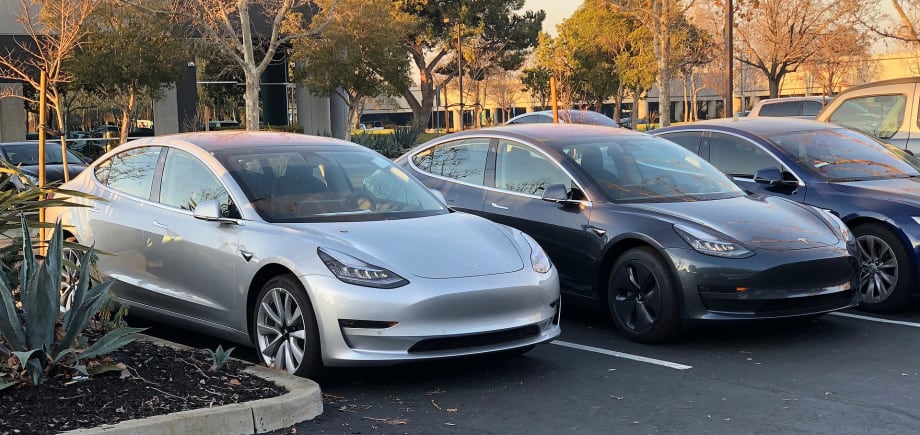
Photo via Wikipedia.
Since the inception of mass-produced electric vehicles in the late 2000s, individuals and fleet operators alike have been intrigued by the cost-savings of electric vehicles compared to their gas counterparts. However, most of the focus has been on urban mobility.
While EV’s overtime affords a significant economic advantage, the challenges of EV charging and user education around the subject can be complex to manage effectively, since most drivers are not experienced with charging realities.
It’s important to determine if the economic advantages of an EV in the fleet outweigh the management overhead. Often not taken into consideration is that the cost savings for EV’s highly correlate with the number of miles driven per month - on a per-mile basis. This means that the more miles you drive, the cheaper each mile becomes. Thus, the most economic use of a modern electric vehicle is realized when driving the car at high speeds as much as possible.
As a fleet operator, it is in your best interest to start adopting electric vehicles by using low cost, high-quality vehicles, like the Tesla Model 3 for long-distance routes with consistent traffic. In addition to the financial benefits, driver experience will be significantly improved, and travel satisfaction will increase.
300,000 Batteries
Electric vehicles hold a few key advantages over internal combustion engines. First, electricity is about two to three times cheaper than gas per mile. Second, the design of electric drivetrains is not as complex. This radically reduces the frequency and cost of maintenance while extending the lifespan of the vehicle. While early EVs had reliability issues, newer generation EVs (i.e.Tesla) have been engineered to last longer.
Tesla even states its new batteries drivetrains will likely last up to 1 million miles. The batteries currently push 300,000 miles.
With larger batteries, vehicle connectivity, fast-charging infrastructure, and increasingly capable autonomous features, the electric vehicle will become a disruptive force for highway routes.
Ensuring convenient charging ability has become the biggest challenge. The solution is to have chargers at endpoints of long-distance routes (i.e. in the parking lots of the buildings). Faster charging results in greater vehicle utilization. Despite Level 2 charging where you might add 25 miles/hour, this would easily enable two 150 miles routes per day per car, possibly more with a larger battery.
If the routes are less than the real-world range of the vehicle (i.e. 150 - 250 miles), then drivers will not need to worry about charging during their trip.
Designated charging points can be made in the event that a trip is longer. For Teslas, these charging points are becoming more ubiquitous and faster. It’s possible now that a v3 Tesla charger can charge up to 120 miles of range in about 15 minutes.
Usage Scenarios
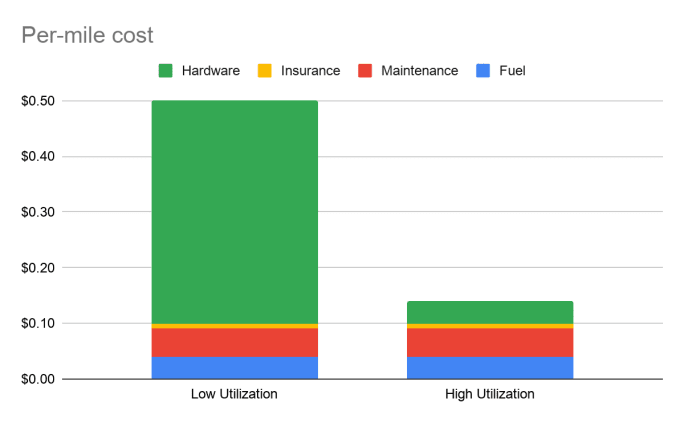
To quantify this, let’s compare two usage scenarios for a $40,000 EV, low utilization vs. high utilization. Some per-mile costs, such as fuel, maintenance, and insurance, are fixed. However, the per-mile hardware cost (purchase price amortized over the vehicle’s lifespan) is variable and depends on how many miles are driven.
In the first scenario, the vehicle is used for driving around the city, averaging 10,000 miles per year. The car lasts for 10 years or 100,000 miles, resulting in a $0.40/mile vehicle cost. Fully loaded, this comes out to about $0.50/mile.
In the second scenario, the vehicle is used for driving between cities, averaging 100,000 miles per year. The car lasts for 10 years or 1,000,000 miles, resulting in a $0.04/mile vehicle cost. Fully loaded, this comes out to about $0.14/mile.
[EMPTY CREDIT]
AAA states that the average fully loaded cost of an ICE medium sedan is around $0.55/mile. When compared to gas, the cost savings of electric for a low-utilization vehicle is $0.05/mile. However, the cost savings of electric for a high-utilization are very significant, at $0.36/mile.
[EMPTY CREDIT]
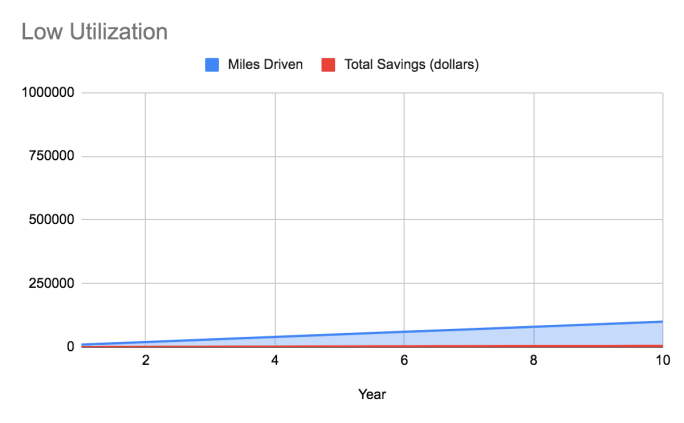
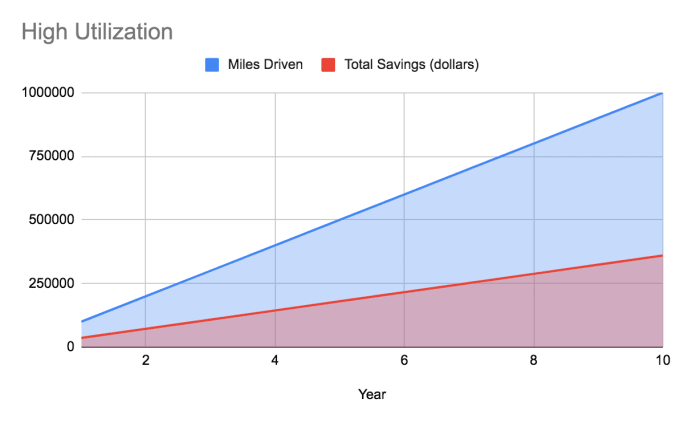
Therefore, if you’re converting a low utilization vehicle to electric, the total dollar savings over the vehicle’s lifespan will be just a few thousand dollars. But if you’re converting a high utilization vehicle to electric, it’s possible to save hundreds of thousands of dollars over the vehicle’s life. It’s often stated that the inflection point for EVs is when they cost less than gas cars to own.
While switching costs can make converting low utilization ICE cars a net neutral or even net negative activity, we have passed the tipping point for high utilization vehicles.
[EMPTY CREDIT]
Rolling Computers
Beyond the cost savings, there are other reasons why EVs are better purposed for high utilization.
You use up the car while it’s not technologically outdated. Cars are becoming rolling computers, which means they are progressing at a pace faster than ever. This could have a sizeable impact on the depreciation rate of new vehicles. Fully capturing the utility of the vehicle reduces your exposure to risk. And, likely, that this depreciation will significantly accelerate on gas vehicles that are not software updateable of the new few years.
You care about active and passive safety more on long distance. EVs are at the forefront of autonomous technology, which is rolling out today for highway scenarios. As autonomous technology has proven to reduce the collision rate, it makes sense to leverage this safety benefit where it works today and has the biggest impact.
Beyond safety, a car like the Tesla Model 3 with the FSD autopilot package will significantly lower stress for its drivers on the highway, as it can navigate, make lane changes, take exit ramps, accelerate and brake on its own. This means your passengers will arrive in a much more pleasant state, than if they were navigating hours of traffic themselves.
You care about physical car comfort and passenger experience more on long distance. As the hardware cost becomes a small fraction of the cost structure, it may be reasonable to purchase higher quality vehicles. If you’re going to be driving for multiple hours, comfort becomes more important than if you were to drive for just a few minutes. And since the EV cost savings are so significant, more luxurious cars are still cheaper to run at high miles.
Adapt Quickly
As the EV industry matures, fleet operators will need to quickly adapt to the new world.
While this simplified economic breakdown and analysis does not account for the myriad factors that will influence your reality, the takeaway is clear. If your fleet has any vehicles that are constantly being driven at high speeds, they are the first vehicles that should be converted to electric.
This is the best path towards adopting new technology and improving your business’s bottom line.
Haydn Sonnad is the co-founder of Tesloop, a SoCal based company focused on regional transportation Teslas. Tesloop has eight out of 10 highest mileage Teslas in the world, including a Model S with over 450,000 miles.
More Fleet Forward

What Fleets Want: FFC Panel to Examine the Future of the Fleet-OEM Relationship
Fleet and OEM leaders will tackle how connected vehicles, embedded telematics, and data are changing the relationship between commercial fleets and automakers.
Read More →
2026 Fleet Manager of the Year Finalists Announced
Who are the 2026 Fleet Manager of the Year finalists?
Read More →
John Rossant to Deliver Opening Keynote at 2026 Fleet Forward Conference
The CoMotion founder will draw on developments across Europe, China, the Middle East, and other international markets to identify trends that could influence how U.S. fleets plan for the coming decade.
Read More →
How to Build Custom Fleet Tools With AI and Vibe Coding [Webinar]
A new Automotive Fleet webinar explores how fleet managers are using AI and vibe coding to automate routine work and create simple operational tools without traditional programming skills.
Read More →
Is Fleet Ready for Its New Disruptors?
Three emerging leaders from a corporate fleet, public fleet, and the automotive supply chain will bring new ideas and a willingness to challenge industry norms to the Fleet Forward Conference stage.
Read More →
NAFA Announces 2026 Fleet Safety Symposium Education Program
Register for NAFA’s Fleet Safety Symposium and save $200 on your Fleet Forward Conference registration.
Read More →
Fleet Managers Take the Lead in Hands-On AI Workshop at FFC
The fleet manager-led session will show how to use “vibe coding” to build practical fleet tools without a traditional programming background.
Read More →
NETS Crash-Cost Data and CoolSys’ 80% Loss Reduction Take Center Stage at FFC
NETS will present findings from its latest Cost of Crashes research, then CoolSys safety leader and author Shawn Martinez will explain how the company built a safer driving culture across 3,500 employees.
Read More →
Is Your Grey Fleet Creating an Unmanaged Safety Risk?
NCR Atleos Fleet Manager Jose Rocha will join Cardata and SambaSafety experts at Fleet Forward Conference to examine how fleets can extend safety oversight to every employee who drives for business.
Read More →
Agentic AI Session at FFC Will Help Fleets Turn Data Into TCO Action
Mike Albert Fleet Solutions and Motorq will show how agentic AI can uncover maintenance, fuel, and utilization savings buried across disconnected fleet data.
Read More →