




Related: Buying & Selling Used Trucks in 2020
Fleets Face 7 Factors in a Challenging Year Ahead
Next year, small fleets will face increased order-to-delivery times, supply and product availability issues, and rising costs. What can you do to prepare?
by Daryl Lubinsky & Chris Brown
December 17, 2020
Jeb Lopez, founder and CEO of Wheelz Up, says new Ford Transits and Ram ProMasters are scarce during peak delivery season. There are few discounts, they’re harder to spec, and service lanes are clogged with competitors’ vans needing repairs.
Photo courtesy of Wheelz Up.
8 min to read
Increased order-to-delivery times. Supply and product availability issues. Rising equipment costs and the need for creative funding. These are some of the many concerns that smaller business fleets are facing on their paths to confront the challenges of the coronavirus pandemic.
Six fleet professionals — two from fleet management companies, a consultant, an automaker’s fleet dealer rep, and a commercial and government fleet operator — share their perspectives on what to expect in the immediate future and how to prepare for another disruptive year for fleets.
Utilization varies by use case.
Kevin Myose, fleet manager for San Joaquin County in California, is seeing severely decreased utilization for his pool vehicles because of to COVID-19 risks — though he’s realizing the benefit of lower operating costs due to less miles driven. “Unfortunately, many of the underutilized cars are in our electric fleet, which will slow the exposure and integration of EV technology,” he says.
Meanwhile, other internal customers are experiencing increased utilization and are adding more vehicles, mainly to provide adequate distancing. “To compensate for upticks in utilization, most notably our Public Works, we held off selling older units and made them available to our work crews,” Myose says.
Jeff Perkins, vice president of operations for fleet management company Motorlease, has seen case-by-case vehicle usage patterns too. “In certain parts of the country things never really shut down, and in other places usage is up because people are driving more than they’re flying right now,” he says, adding that working remotely is a mitigating factor.
Though he hasn’t seen many drivers placed on furlough, Perkins says many of the ones who were — particularly in the retail sector — were allowed to hang onto their cars.
OTD increases affect all sectors of fleet.
“Overall, we’re definitely seeing order-to-delivery times increase, and this will certainly be felt by small fleet operators,” says Ted Davis, vice president, North American supply chain for ARI, a fleet management provider. “We’re already seeing extended lead times for production across most OEMs.”
Because of that, the industry might see order cutoff dates being pulled forward, he says. Factors influencing order-to-delivery time, such as licensing and delivery, are still recovering from the impacts of COVID-19, which will further extend the overall order-to-delivery timing.
For Myose, OTD might only be an issue for specialized vehicles such as the county’s patrol car fleet. “This is a niche market, with several municipalities competing for similar goods,” he says.
“We had to cancel an order last year for 10 Dodge Chargers due to transmission supply shortages, and that was pre-COVID-19. I would expect prices to rise for these products as well.”
Myose is also seeing prices rise, especially for heavy-duty trucks. “A dump truck we bought last year was $135,000; the same truck now is $165,000.”
Inventory will be sparse.
Manufacturer shutdowns in early 2020 severely limited product availability. This had a significant impact at the dealership level, where smaller fleets acquire most of their vehicles.
Traditional fleet-spec’d vehicle inventory is sparse while most manufacturers focus on reestablishing an adequate supply of retail vehicles for their dealerships across the country. “This will undoubtedly have a negative impact on the availability of fleet units,” Davis says.
Perkins says that the mentality of the small fleet segment is, “Drive it until it doesn’t go anymore,” though small fleets still want to be able to walk onto a dealer lot and buy another one. “They’re going to find that’s going to be very challenging for them.”
Davis adds that as small fleet operators develop their cycling strategy for 2021 and beyond, they should carefully consider when they will need the vehicle to support their business. “The earlier an organization can determine its needs and place vehicle orders accordingly, the better off they’ll be,” he says.
Large fleets traditionally develop “robust” cycling strategies early in the year to ensure orders are submitted in a timely fashion. “And as larger fleets begin to adjust to the current economic environment and begin to place orders, there will be additional pressure on availability,” Davis says.
Often, however, budget approvals delay their ability to place orders. “With that in mind, small fleet operators should capitalize on their agility and place orders as soon as possible,” Davis says.
Perkins expects that with production delays, new vehicle orders would probably not arrive until late spring or early summer of 2021. “Anything they’re anticipating needing over the next six months, I really suggest that they start to cycle those fleet vehicles out today,” he says.
Some are forced to extend replacement cycles.
Rick Longobart, a principal for Longobart Ross Full Fleet Solutions, says that this economic downturn — a bigger financial hurdle than the Great Recession — will put even more strain on replacement needs this time around.
“Fleets will need to look at various ways of replacing equipment — from the conventional wisdom of debt allocation, to leasing, financing, and seeking grant funds to offset the financial cutbacks,” he says.
Ivan Boykin, Ford general manager, Commercial Vehicle Centers North America, says Ford understands that fleets have extended their replacement cycles longer than under normal circumstances. However, “For those businesses that can afford to maintain their cycle times, we recommend not putting off replacement vehicle purchases as supplies tighten,” he says.
Perkins of Motorlease agrees, noting that some fleet clients are attempting to extend the leases on their fleet vehicles, and they have asked Motorlease for advice on how to handle the situation.
“What might work for one group might be different from another,” Perkins says. “For the most part I tell our clients to get their orders in as early as possible.”
Fleets must manage the consequences of extended cycles.
For fleet operators that need to delay replacement for budgetary reasons, Longobart cautions that deferment could result in additional maintenance cost, lack of technicians to maintain older vehicles, increased downtime, and lower resale values.
Boykin notes that Ford’s Commercial Vehicle Center dealer network is boosting its support for small businesses to improve vehicle uptime as their vehicles age. This includes the expansion of Ford dealers’ mobile service offerings, which brings the technician to the vehicle instead of requiring the fleet to drive the vehicle to a dealership, Boykin says.
Boykin encourages small fleets to take advantage of telematics, which can help reduce downtime and protect their drivers and vehicle assets. “It can show you in real time where every vehicle in your fleet is and provide insights into fuel consumption, driver behavior, and vehicle health,” he says.
The silver lining to extended replacement cycles? While the supply chain has suffered over the past six months, the downturn of replacing equipment will allow the supply chain and upfitters to keep up with demands, Longobart says.
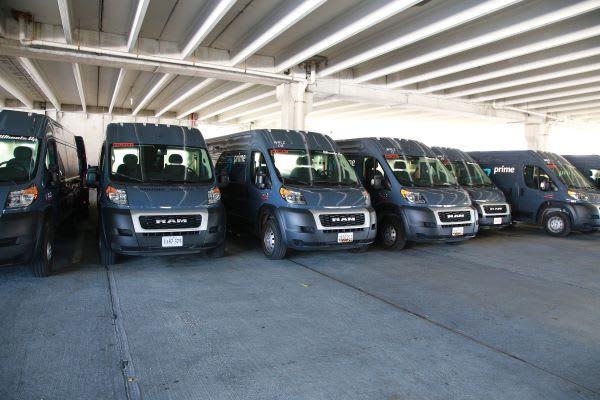
Manufacturer shutdowns in early 2020 severely limited product availability, which had a significant impact at the dealership level as manufacturers focus on reestablishing an adequate supply of retail vehicles. With delays to new vehicle orders, small fleets need to plan their next cycle today.
Photo courtesy of Wheelz Up.
Commercial vans are scarce.
With “unprecedented demand” for home delivery of goods and services, according to Boykin, demand is strong for the trucks and vans used to make those deliveries.
As of late October, GM was running three shifts a day to meet van demand, according to Perkins. Other manufacturers “are pretty much at capacity,” he adds. “Manufacturers are doing everything they can to produce as many (vans and trucks) as they can.”
Jeb Lopez, founder and CEO for courier company Wheelz Up, agrees. Wheelz Up, which operates more than 200 Ford Transit, Ram ProMaster, and Nissan NV models, has contracts with both Amazon and FedEx.
Lopez says new Transits and ProMasters are hard to come by, while the Nissan NV and NV200 are due to be discontinued after the next model year. “There are hardly any discounts now for fleets because the units are scarce,” he says. “And it’s harder to get the unit you want.”
Coming into peak delivery season, Lopez needs to rent vans to cover additional routes. At the truck rental agencies, it’s a scrum to get vehicles. “Hey man, whoever comes here first in the morning gets it,” Lopez says of the attitude between the rental operation and other delivery fleet customers.
Peak season also means vans needing repairs are facing crowded service lanes at dealers, which increases downtime. Lopez references warranty work that is needed on a Ram ProMaster. “They’re so backlogged that my wait time for service is nine days,” he says.
Prices for parts such as tires and brakes are rising too. Lopez is looking to source some parts in cheaper bulk quantities to have on hand.
Electric commercial vehicles are (almost) here.
A consequence of this 100-year economic and business disruption, our fleet prognosticators say the wave of electric vehicles — specifically commercial electric vehicles — has almost arrived, with electric pickups, vans, and models in the Class 3 to 6 range coming to market in the next one to two years.
Boykin of Ford says all-electric vehicles are “absolutely” an option for small fleets. “Electric vehicles, including electric F-150 and E-Transit, require significantly less maintenance than a typical gas engine, creating more than 40% savings for their lifetime total cost of operation,” he says.
Longobart says fleets should be aware of greatly fluctuating charging costs. “Fleets need to fully understand demand charges, as some fleets have been surprised by peak demand charges that have washed out all savings, making internal combustible engines seem cheaper,” he says.
To Longobart’s point, “Public charging stations are typically not feasible for these larger vehicles, sometimes costing more than the price of gasoline and require downtime while parked at a location, which affects productivity,” says Davis of ARI.
Charging larger commercial vehicles will require a depot-style charging network at a significant capital investment, though smart charging infrastructure can help to control charging rates.
Davis adds that although electric vehicles will have higher initial costs, grants and state rebates for alternative fuel vehicles can significantly offset their higher acquisition costs. “These credits are not always easy to obtain but are worth looking into,” he says.
Originally posted on Work Truck Online
Subscribe to Our Newsletter
More Operations

Sponsored•October 14, 2026
A buyer's guide to fleet management software in 2027
Buying fleet management software in 2027 means looking beyond features and price. As fleet operations, technology and expectations evolve, this guide explores what today’s fleet professionals should consider when choosing a system that can deliver value now and adapt to what comes next.
Read More →
What Will Shape the Next Era of Fleet Management?
EVs, AI, and autonomous vehicles are reshaping fleet management. Discover what’s ahead—and how fleet leaders can prepare for the next era.
Read More →
How Fleets Can Recruit and Train Veterans for Technician Roles
Here's how the technician shortage has affected uptime for fleets, and what to do about it.
Read More →

Avis Budget Group Deploys Neology Toll Management Technology Across Major Brands
Neology’s neoFleet platform will manage toll transactions and toll-authority operations for vehicles across Avis, Budget, Payless, Budget Truck and Zipcar.
Read More →
Fleet Personal-Use Charges Edge Higher in 2026
Nearly eight in 10 surveyed fleets allow personal use of company vehicles, while just over half of respondents report charging employees for the privilege.
Read More →
The Future of Fleet + What’s Changing Right Now | AF News Recap
Could developments overseas offer a preview of what’s coming for U.S. fleets? This week, we’re looking at the future of AI, autonomy, and electrification, plus Ford Pro’s new certified pre-owned program, smarter vehicle offboarding, and a new way for fleets to manage toll expenses.
Read More →
How to Handle Vehicle Offboarding
What do fleet managers need to do when a driver leaves?
Read More →
Sponsored•October 1, 2026
Fleet Manager’s Ultimate Playbook: Navigating the New Standard in OEM Connectivity
Rising operating costs, driver safety concerns, and unplanned downtime are putting unprecedented pressure on modern fleets. Discover how fleet managers use embedded OEM connectivity and real-time vehicle data to cut TCO, prevent downtime, and protect drivers without aftermarket telematics hardware.
Read More →
U.S. Bank Adds Verra Mobility Toll Management to Voyager Fleet Platform
The integration allows U.S. Bank Voyager fleet customers to manage toll payments and violations alongside fuel, EV charging and maintenance expenses.
Read More →
ADAS Prevents Crashes. But Repairs Cost More | AF News Recap
ADAS-equipped vehicles may crash less often, but they can cost more when they do. This week, we’re breaking down what that tradeoff means for fleets, plus Subaru’s first Forester Wilderness Hybrid, Nissan’s new e-POWER Rogue, and why Calstart has become Catalyst Mobility.
Read More →