




Ed Bobit's Publisher's Page
We can save some 700,000 barrels of oil each day with the 55 MPH speed limit.


"We ought not to be over-anxious to encourage innovation, in cases of doubtful improvement, for an old system must ever have two advantages over a new one; it is established and it is understood." - Caleb Colton.
One of my closest friends has that unique ability to be the devil's advocate in the most beautiful way. He extracts one's thinking process to its ultimate. He, on occasion, plays a game called "What If?" It turns me on and shakes the cobwebs out of the dark places. For one month play it with me.

We all should be well aware of the energy crisis, or energy rip-off, as I would prefer to call it. It has touched all of our lives. To review a few of our news items we can see that the 55 MPH speed limit is essential. Supporting this is ...
John Sawhill, and old friend from CCIC, and now FEO major-domo, tells us that we can save some 700,000 barrels of oil each day with the speed limit. He said this in front of a lot of his friends at NAFA in April. He also told the same group that you can 'plan that summer vacation' and 'take that personal trip' as there would be enough gas for that purpose this summer. Yesterday, he was quoted on an even larger amount of Arab oil reaching us shortly taking out even more of the threat of shortage.
Vince Tofany, the National Safety Council's new president, (you remember him from New York in the Vehicle Commission) tells us that 8,500 lives will be saved annually by sticking to 55; some 230 lives per week. Darn sobering statistics.
All to his credit, Vince had his crew develop the critical statistics. Specifically, the traffic stix for 31 turnpikes across the U.S. in the first two months of this year showed a nearly 60% reduction in fatalities and only an 18% reduction of travel, vs. the same period in '73. He also notes that their stix show that accident severity increases dramatically above 50 miles per hour. They show that the chances of death or serious injury in a traffic accident double for each 10 mile per hour speed increase over 50. Wow!
Depending where you get your statistics, you can pretty well document that fatal accidents are down about 25% over the first three months. No question about this.
These are solid and documented data.
So where am I with my "What If" game?
My intention was to say that the average fleet driver has to travel about 28,000 miles per year compared to the average driver who goes just over 10,000.
I was going to quote the fact that some 70% of all the accidents occur within a 25 mile radius of your home. I was going to quote McGrawHill's last study which shows that the average sales call in 1971 cost a company $57.71. At today's highly inflated costs it has to be $70. And a sales guy has just got to miss at least a call a day when he is travelling the longer routes.
There is also the question of efficiency of the diesel trucks that operate more efficiently at speeds above 55. Truck drivers are screaming because of their lost time at the slower speeds.
I was convinced that there should be someone calling for the freedom and liberty to travel the inter-states and the limited access highways at higher speeds. The cars are built for it; it looks like we have the fuel. Many like me just cannot get used to a 55 top when they have nothing but clear countryside ahead of them.
So reluctantly, I succumb to the "agree" or rather the "agree-ee" in my "What If" game. Saving over 200 lives each month is something that has to go with the flag, mother and apply pie. The Senate reflected that in definite manner last week when the vote came up to repeal or extend the speed limit. So be it. I seem to have failed similarly with those darn buzzers and bothersome seat belts.
Won't it be some satisfaction, in years hence, to have a dialogue with our kids and discuss how enjoyable it used to be to drive a car.
More Safety

Nexar-Nauto Merger Aims to Give Fleets Better Safety Intelligence Through Larger Driving Dataset
Stefan Heck tells Automotive Fleet that combining more than 10 billion miles of driving history with Nexar's AI models will give fleets deeper insights into driver risk and roadway conditions than either company could provide independently.
Read More →
Don't Wait for a Crisis: 5 Ways to Build Mental Health Into Your Fleet Safety Program
For Suicide Prevention Month, fleet and safety leaders have an opportunity to put mental health where it belongs: at the center of workplace safety.
Read More →
How Camera Data Can Strengthen a Fleet’s Insurance Renewal
Insights from a commercial insurance carrier and a broker show how fleets can turn video telematic data, driver coaching, and improved claims results into a stronger case at insurance renewal.
Read More →
The Safest Fleets Aren’t the Ones with the Most Technology
You’ve made the telematics investment. Here’s how to capture the other half of its value and build the safest fleet on the road.
Read More →
Hidden in Plain Sight: Fleet Compliance Risks
Fleet compliance isn't just about having policies — it's about consistently enforcing them. This practical guide reveals six hidden compliance risks common in public sector and shared fleet operations and outlines proven strategies to improve visibility, accountability, and audit readiness
Read More →
NETS Sets 2026 Fleet Safety Benchmark Conference for Indianapolis
The Sept. 15–17 program will feature fleet benchmarking data, case studies, emerging technologies, and implementation strategies while running alongside the NSC Safety Congress & Expo.
Read More →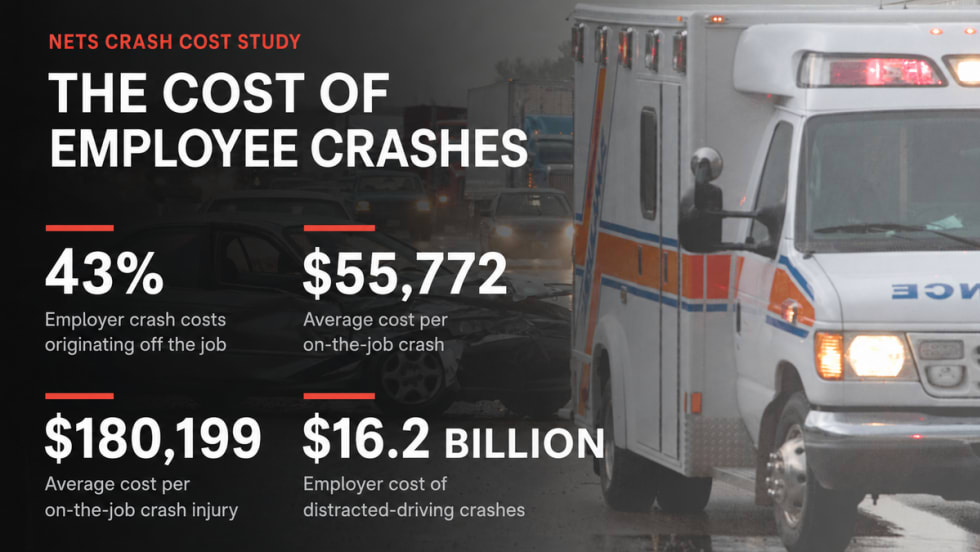
Off-the-Job Crashes Account for 43% of Employers’ $61.7 Billion Crash Burden
NETS quantifies costs dispersed across fleet, risk, HR, and other departments while providing new per-crash benchmarks for employers.
Read More →
Ram Recalls More Than 1.27 Million 1500 Pickups for Seat Belt Anchor Issue
The recall affects certain 2019-2026 Ram 1500 pickups that may have improperly attached second-row seat belt buckle anchors.
Read More →
How Better Visibility Cut Speeding Violations by 48%
Fleet leaders don't need more data, they need clearer visibility into what the data is saying. This case study explores how one utility replaced speeding-event counts with a single metric — miles driven in violation — to strengthen safety and significantly reduce speeding violations.
Read More →
Operation Safe Driver Week: Why the Industry's Oldest Safety Campaign Still Matters to Fleets
A look at how a 2007 enforcement initiative became one of the most consequential weeks on the fleet safety calendar, and what it means for your drivers in 2026.
Read More →