




Ecolab Cuts Preventable Accidents by 15%
Since its development and implementation in 2003, Ecolab’s comprehensive driver safety program has also reduced total employee driver-involved crashes by 13 percent, even as the company’s fleet has grown in size.

With more than $6 billion in global sales, Ecolab is a global leader in cleaning, sanitizing, food safety, and infection prevention products and services. The company operates a 7,500-vehicle fleet in the U.S., supporting nine business units.
In 2003, Ecolab's management decided to implement a formal and consistent driver safety program. Over the next 12 months, the company developed a uniform driver's safety program across all business units, consolidating separate sets of procedures and policies.
"It was important for us to get a consistent set of standards and practices across our entire fleet," said Ryan Rebman, director of corporate safety.
Ecolab's corporate risk management group manages the driver safety program and develops the program's safety procedures. Each business unit provides input for policies and procedures and is responsible for implementation.
Individual Profiles Created
Ecolab utilizes the CEI fleet risk management and driver safety services program, DriverCare, to help create and update individual profiles for every fleet driver hired by the company. Drivers are assigned points for certain incidents, similar to the point systems states use for a variety of violations. In addition, Ecolab set its own point standards and statistics for measuring drivers, emphasizing accident and motor vehicle violation prevention. Feedback is gathered from other motorists who call a 1-800 line to comment on Ecolab employee driving behavior.
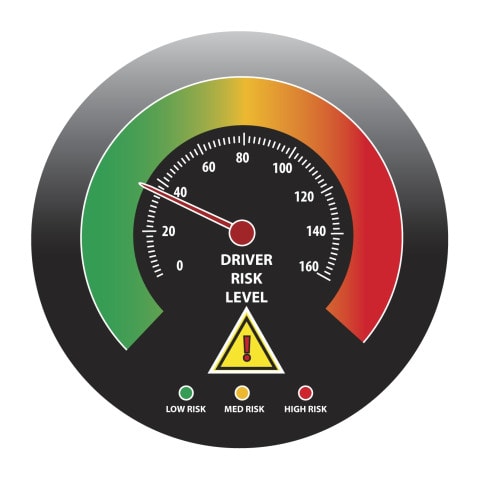
"This helps us comprise a risk profile and assign a risk level that is then maintained over a rolling 24-month period," Rebman said.
Ecolab policies charge drivers cited for reckless driving, traveling 35 mph over the speed limit, or other similar dangerous actions with "critical events." Twice a year, the company runs MVRs on anyone who uses a fleet vehicle to ensure drivers maintain a good driving history.
A required self-reporting policy distinguishes Ecolab's driver safety policy from many others. Failure to report an accident can have serious consequences for an individual employee.
Risk Defined in Four Levels
Each Ecolab driver is defined by four risk levels. Drivers with a Risk Level 0 have incurred no citations or infractions over the previous 24 months. Risk Level 1 requires a driver to undergo online remedial training. A Risk Level 2 driver must take online training and participate in a ride-along with his or her immediate supervisor. Drivers at Risk Level 3 are assigned more specific coaching and must attend an eight-hour class that combines classroom time and behind-the-wheel training. Advanced Driver Training Services (ADTS) provides the classroom instruction, conducted by current and former law enforcement officers.
All new managers also must attend at least one ADTS class to help better enforce Ecolab's driving program, both from a driver's perspective and a management strategy.
Much of Ecolab's risk assessment is performed before a potential new employee is hired. In addition, MVRs are run on all pre-hire candidates. A pre-hire candidate at driver Risk Level 3 is not eligible for hire.
"We want to hire good drivers up-front," Rebman said. "Pre-screening job applicants has made a huge difference."
Currently, Ecolab is updating its driver's safety handbook for the fourth time in the last five years, Rebman said. The handbook now outlines a number of specific roles and responsibilities to which each driver should adhere on a daily basis.
Program Results Impressive
Ecolab's driver safety program has produced impressive results. From 2003 to 2008, total accidents per million miles dropped 13 percent and preventable accidents per million miles fell 15 percent. The declines occurred even as the number of vehicles increased 23 percent and miles driven rose 14 percent, Rebman said. Ecolab uses the National Safety Council's definition of preventable accidents as part of this metric.
Ecolab's employees have become accustomed to the company's driver safety requirements, recognizing the program and its stringent guidelines are designed to help protect and keep them safe on the road, according to Rebman.
"When we started with this program, we proactively communicated with our employees and showed them how the changes would benefit them personally," he said. "In the end, I think they understood the changes were made to further protect them, as well as reduce the overall expenses for the organization."
NETS Provides Benchmarking
Just as important, Ecolab makes sure its insurance companies and underwriters also understand and recognize the benefits of the driver safety program. To further emphasize its commitment to driver safety, Ecolab joined the Network of Employers for Traffic Safety (NETS).
An employer-led public/private partnership, the NETS mission is to improve the safety and health of employees, their families, and communities by preventing traffic crashes that occur both on and off the job.
At the annual NETS meeting and conference, members participate in a large benchmarking exercise that helps measure program results. The measurements allow companies to set fleet driving policies and best practices.
"NETS allows us to better understand how Ecolab compares to other fleet organizations," Rebman said. "The benchmarking exercise has been especially helpful in allowing us an apples-to-apples comparison of our policies against other industry leaders. What we've learned has helped guide our in-house policy changes as we try to look for more ways to increase safety for our employees."
More Safety
IIHS Crash Avoidance Tests Reveal Safety Gaps in Cargo Vans and Work Trucks
New crash-avoidance ratings from the Insurance Institute for Highway Safety reveal inconsistent performance among commercial vehicles, with several popular cargo vans and heavy-duty pickups struggling to avoid collisions with other vehicles and pedestrians.
Read More →
What’s Next for Fleet? Safety, AI & Industry Recognition | AF News Recap
Could your company's culture be encouraging distracted driving? This week, we're exploring how workplace expectations affect driver safety, what AI, EVs, and autonomous vehicles could mean for the future of fleet management, and how fleet professionals can strengthen their award nominations.
Read More →
Does Your Fleet's Culture Encourage Distracted Driving?
What happens when the people responsible for enforcing safety rules are the ones setting the wrong example? The answer may reveal why some of the biggest risks to fleet drivers have little to do with what's written in the employee handbook.
Read More →
Fleet Manager’s Ultimate Playbook: Navigating the New Standard in OEM Connectivity
Rising operating costs, driver safety concerns, and unplanned downtime are putting unprecedented pressure on modern fleets. Discover how fleet managers use embedded OEM connectivity and real-time vehicle data to cut TCO, prevent downtime, and protect drivers without aftermarket telematics hardware.
Read More →
From Driver Well-Being to EV Charging | AF News Recap
Mental health belongs in the fleet safety conversation. This week, we’re looking at five ways fleets can support employee well-being before a crisis, plus Holman’s expansion in Mexico, new one-day Fleet Forward passes, and why EV charging demand is outpacing infrastructure growth.
Read More →
Nexar-Nauto Merger Aims to Give Fleets Better Safety Intelligence Through Larger Driving Dataset
Stefan Heck tells Automotive Fleet that combining more than 10 billion miles of driving history with Nexar's AI models will give fleets deeper insights into driver risk and roadway conditions than either company could provide independently.
Read More →
Don't Wait for a Crisis: 5 Ways to Build Mental Health Into Your Fleet Safety Program
For Suicide Prevention Month, fleet and safety leaders have an opportunity to put mental health where it belongs: at the center of workplace safety.
Read More →
How Camera Data Can Strengthen a Fleet’s Insurance Renewal
Insights from a commercial insurance carrier and a broker show how fleets can turn video telematic data, driver coaching, and improved claims results into a stronger case at insurance renewal.
Read More →
The Safest Fleets Aren’t the Ones with the Most Technology
You’ve made the telematics investment. Here’s how to capture the other half of its value and build the safest fleet on the road.
Read More →
Hidden in Plain Sight: Fleet Compliance Risks
Fleet compliance isn't just about having policies — it's about consistently enforcing them. This practical guide reveals six hidden compliance risks common in public sector and shared fleet operations and outlines proven strategies to improve visibility, accountability, and audit readiness
Read More →