





Related: Chevrolet Benefits from Reorg of GM South American Operation
Commodity Prices & Exchange Rates Impact Fleet Market in Chile
Fleet vehicles represent approximately 20-25% of annual new-vehicle sales in Chile. Top buyers of fleet vehicles are in the telecommunications and mining industries, along with political subdivisions, police departments, and military.
February 8, 2018
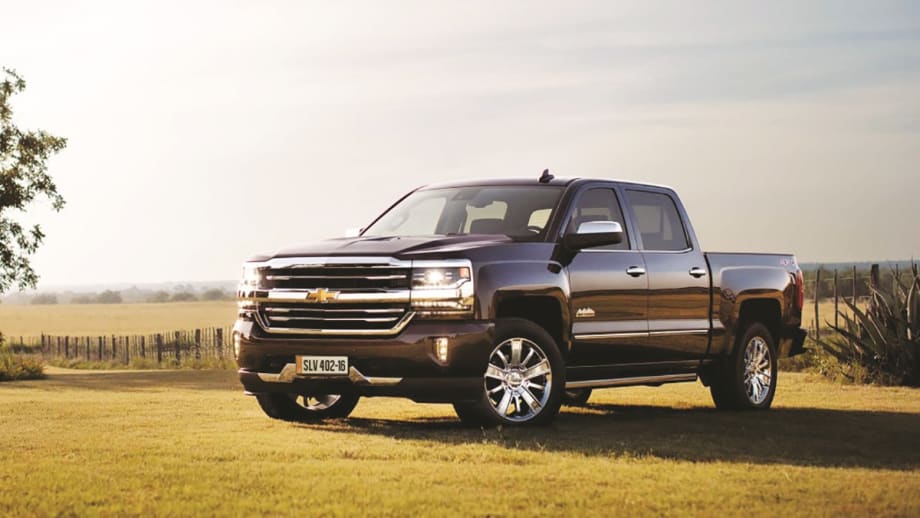
The Chevrolet Silverado is available in Chile with five available versions. Photo: GM.
8 min to read

This view of Santiago, the capital of Chile. It is also the largest city in Chile and has a population of over 5 million. It is located in the country’s central valley. Photo courtesy of istockphoto.
Vehicles are one of Chile’s largest imports. The country has no domestic production so it imports 90 different brands from 27 countries, including Korea, China, and Japan. The top-selling car brands in Chile are GM’s Chevrolet, Hyundai, and Kia. The total number of vehicles in Chile (including private fleet) is 4,263,084 for a population of 18,173,984.
Chile does not manufacture vehicles domestically, which means that 100% of the vehicles sold in Chile are imported. Vehicle sales in Chile are heavily influenced by foreign exchange rates. When the Chilean peso weakens, new-vehicle prices increase.
Starting in September 1999, the Chilean peso was allowed to float freely against the U.S. dollar for the first time. Chile’s Central Bank; however, it reserved the right to intervene, which it did on two occasions to counter “excessive depreciation.”
One saving grace is that imports are not heavily taxed as in other countries. As a result, Chile has a very new and diverse fleet, since vehicle imports are not taxed.
“The main customers are located in the miner, forest, fishing and service areas. Also the rent-a-car companies are an important player in the Chilean fleet industry, demanding all kind of models from Car-A up to SUV-D, and renewing their fleets each year,” said Marcelo Tezoto, Senior Manager - Fleet Sales for General Motors.
“Other important actors are public entities such as police, armed forces, hospitals and city halls,” said Tezoto.
Chile is very dependent on resource and mineral extractions to be sold in the export market, which has witnessed a decline in demand from the slowdown in the Chinese economy and subsequent softening of commodity prices. But commodity prices, in particular copper, are starting to strengthen.
There has been an increase in pickup segment sales, due to the decrease in the economic activity in the mining sector.
The Chilean government strongly supports foreign investment in the mining sector and has modified its laws and regulations to create a favorable investing environment for foreign companies.
Fleets consist primarily of LCVs and pickups, due to the Andean nation’s industrial and mining heritage. LCVs (light commercial vehicles) and pickups comprise over a quarter of total sales to corporate customers and these are bought mainly by mining, logistics, and utility companies.
“Pickup-D segment is the most demanded type of vehicles, due to our dependence on commodities exports such as copper, fruits, and wine. Also pickups receive a fiscal credit for the companies who buy them, so they are highly demanded by all types of business. That product segment represents almost half of the Chilean fleet sales. The second most important segment is van-B, representing almost a 20% of total fleet sales and which are mainly used by service companies,” said Tezoto.
“Three years ago, the government stablished a new tax for people and companies who buy new cars, which depends on fuel efficiency, NOx emissions, and the vehicle price. But this tax doesn’t apply for companies who buy new trucks, vans, and pickups up to 2,000 kg payload capacity or any closed van,” said Tezoto.
Another factor driving fleet sales is the country’s tax policies.
“Pickups receive a fiscal credit for the companies who buy them, so they are highly demanded by all types of business. No other light vehicle than pickups receives a fiscal benefit for companies, so that incentivizes this type of product,” said Tezoto.
Fleet Funding
The operating lease has been popular in Chile historically because it makes the acquisition and operation of vehicles less expensive. However, the fact that most vehicles are imported (using over 15 different currencies) makes them expensive overall. OL suppliers used to have their own service structure but this is changing. The market is open and there are no barriers to importation so fleet sales in Chile are supported now by dealers. In the past few years, two important developments have affected a change in the industry: 1) the advent of multi-brand dealers and 2) the development of products and services specifically aimed at fleets. OL providers no longer need their own structure or service facilities, they can get this through dealers.
Meanwhile, full service leasing is well-developed in Chile and popular in the mining industry where the full cost of operating commercial vehicles is tax deductible. Despite there being no tax incentives for cars, fleet customers are beginning to recognize the advantages of full service leasing for benefit cars as well. It is still in early development but is showing signs of growth.
“Many companies are using operational leases instead of buying their own vehicles, so leasing companies are also one of the big players in our local industry,” said Tezoto.
The economy is undoubtedly growing in Chile and this is fueling new practices, services and products aimed at the fleet sector. Fleet customers are also becoming more sophisticated, professional and open to the new international standards being applied by specialist companies such as ALD and Arval Relsa.
Fuel Trends
“Fuel prices is an important matter for almost all fleet customers. In Chile, diesel fuel has a lower tax than gasoline, so for those customers who give a high usage to their fleets, they mostly prefer diesel engines,” said Tezoto.
Used-Vehicle Market
In 2017. Chile’s new-vehicle segment saw gains nearing 20%. The country’s used-vehicle segment; however, was not as prosperous.
“In Chile, when the new-vehicle sales increases, the used-cars sales decreases. This year that statement hasn’t changed. As new-car sales are increasing almost 20%, used-car sales are decreasing almost 4%, even though the used-vehicle market is an important player in the Chilean automotive industry, where for each new car sold, three used cars are being sold. This market is large because of the easy access to finance options, the penetration of smart buy (most people are changing their new cars between three or four years, increasing the used-car park) and issues with public transport, which make people look for alternatives such as buying a used car,” said Tezoto.
Fleet Market Forecast
The forecast is that between 320,000 and 330,000 total new vehicles will be sold in Chile in the 2018 calendar-year.
“In Chile we don’t have official information about fleet market, but our estimation is that it is around a 20-25% of total car industry sales. For next year we expect to grow our fleet sales, leveraged by an increase of the total car sales, a better copper price and a stabilized exchange,” said Tezoto.
Chile Economic Conditions
The economy of Chile is ranked as a high-income economy by the World Bank, and is considered one of South America’s most stable and prosperous nations. It has a gross domestic product (GDP) of US$240.216 billion
However, current economic conditions are putting a drag on overall growth in Chile. One headwind slowing economic growth in Chile is low consumer confidence and a depreciation of the Chilean peso versus the U.S. dollar, which has driven up the cost of imported goods, in particular automobiles. Chile does not manufacture vehicles domestically.
One silver lining offsetting the slowness in the Chilean economy has been low oil prices, which has helped to keep the current-account deficit manageable.
The mining sector in Chile is one of the key pillars of the Chilean economy. Chile has huge copper reserves, producing more than one-third of all global copper output. Chile is very dependent on resource and mineral extractions to be sold in the export market, which has witnessed a decline in demand and subsequent softening of commodity prices.
In terms of the retail automotive market, the middle class is growing fast in Chile and this is having strong bearing on new car sales.
The Chevrolet Silverado is available in Chile with five available versions. Photo: GM.
The Chilean automotive market enjoyed a mini boom at the beginning of 2017 with total vehicles sales up by 13.2% (7.3% in April alone). It performed better than expected and beat the rate of economic recovery. Chevrolet, Hyundai, and Kia topped the charts in terms of sales (with sales increases of 15.2%, 13.5%, and 7.8%, respectively). Nissan enjoyed the biggest increase (over 20%) but only managed fourth place in the league tables.
Chile has a market-oriented economy characterized by a high level of foreign trade and a reputation for strong financial institutions and sound policy that have given it the strongest sovereign bond rating in South America. Exports of goods and services account for approximately one-third of GDP, with commodities making up some 60% of total exports. Copper alone provides 20% of government revenue. From 2003 through 2013, real growth averaged almost 5% per year, despite the slight contraction in 2009 that resulted from the global financial crisis. Growth slowed to an estimated 2.3% in 2015.
Chile is more stable this year. It’s true that there is a real slowing down of the economy in Chile. Due to its strong trade with China and the slowdown in the Chinese economy, copper prices have softened and has a direct impact on the economy for Chile.
A continued drop in copper prices prompted Chile to experience its second consecutive year of slow growth, elevated inflation, and a depreciating currency.
The outlook for 2018 is around 1%, which is very low compared to the historic data of Chile, which has been around 4% to 5%. But, all in all, it is a very safe and stable country
Chile deepened its longstanding commitment to trade liberalization with the signing of a free trade agreement with the U.S., which took effect on Jan. 1, 2004. Chile has 22 trade agreements covering 60 countries including agreements with the EU, Mercosur, China, India, South Korea, and Mexico. In May 2010, Chile signed the OECD Convention, becoming the first South American country to join the OECD.
Economic Forecast
GDP growth is projected to strengthen to around 3% in 2018-19, supported by improving external demand, a more accommodative monetary policy and mining investment. As exports and investment pick up, the labor market will strengthen, reducing income disparities and stimulating private consumption. Increasing aggregate demand and a stabilizing exchange rate will bring back inflation towards the target set by Chile’s central bank.
Monetary policy has eased since the end of 2016, supporting growth and inflation. Fiscal consolidation is set to be appropriately gradual in 2018 and 2019 and should remain progressive to raise room for investments in health, education and infrastructure over the medium term. Tackling labor market disparities, and streamlining licensing procedures and regulations, would boost productivity, while reducing inequalities.
The financial system has been resilient to a sharp depreciation and a prolonged growth slowdown. However, continued monitoring of increasing household and corporate vulnerabilities is needed as financing costs could increase.
Subscribe to Our Newsletter
More Global Fleet

GeoFencing Adds to Your Truck Security Arsenal
Geofencing is a familiar fleet tool today, but its early adoption marked a major shift in vehicle tracking, route monitoring, and the debate over employee privacy.
Read More →
Holman Takes Full Ownership of ARIZA in Mexico
Holman is bringing its Mexican fleet management operation fully under its own brand after more than 30 years as a joint venture. The change gives multinational fleet customers a single Holman operation across the U.S., Canada, and Mexico.
Read More →
5 Tire Maintenance Tips to Help Prevent Work Truck Downtime
Regular tire checks can do more than extend tread life. These five maintenance practices can help work truck fleets catch problems early, reduce costs, and prevent downtime.
Read More →

Proven Ways to Reduce Work Truck Downtime
The age-old problem of downtime will always be a reality, but with new strategies at hand, fleets have more ways to keep trucks on the road longer.
Read More →


Cameras, Safety and Insurance: From Reactive Claims to Real-Time Prevention (Part 2 of 2)
Part Two: Commercial auto remains one of the most challenging and costly lines of coverage for fleet operators and insurers alike. Continue learning more about how to effectively address these issues from Onur Aksan, Enterprise Business Development Executive, Geotab
Read More →
Cameras, Safety and Insurance: From Reactive Claims to Real-time Prevention
Commercial auto remains one of the most challenging and costly lines of coverage for fleet operators and insurers alike. Learn more about how to effectively address these issues from Onur Aksan, Enterprise Business Development Executive, Geotab.
Read More →
Fleet Costs Are Rising: Here’s How Leaders Are Responding
Fleet leaders are under pressure to reduce costs, adapt to economic uncertainty, and make smarter decisions. See how peers across North America are responding with real data, proven strategies, and forward-looking insights. Download the 2026 Market Pulse Report to benchmark your strategy and uncover where you can gain an edge.
Read More →
Enterprise Fleet Management Surpasses 900,000 Vehicles in U.S. & Canada
Enterprise Mobility connects with mobility solutions around the globe
Read More →