




Clean Air! Clean Air! Rah! Rah! Rah! Dispatch from the College Clean Air Car Race of 1970
The automotive industry gave money and cars to work with, and other industries gave comparable support, but there should be no doubt about it-the Clean Air Car Race was a U.S. college student-founded, planned and executed event.
The automotive industry gave money and cars to work with, and other industries gave comparable support, but there should be no doubt about it-the Clean Air Car Race was a U.S. college student-founded, planned and executed event.
For better or worse, the youths set out from Cambridge, Mass. on August 24 in 43 vehicles designed to meet or better the Federal exhaust emission standards set for all new cars in 1975. The goal was to make the best time, while releasing the least emissions, to Pasadena, Calif. The entrants were to follow a route that touched into Canada, cut through the midwest and traversed the southwest through Oklahoma, Texas, Arizona and Southern California.
It's tempting to report, "When the smoke had cleared-," but, in reality, there wasn't that much smoke -or pollution. It probably will be some time before all of the results are analyzed and the various power systems re-examined, but after three days of scoring, according to a pre-set mathematical equation, the overall winner of the race was Wayne State University of Detroit, Mich.
The entire Wayne team, captained by Richard A. Jeryan, included John Karol, Brian Geraghty, Alden Raquepau, Lawrence P. Wagle, Dan Harmon and Mike Riley. Their car was a 1971 Mercury Capri with a 302-cubic inch V8 internal combustion engine. It was equipped with an automatic transmission and used unleaded gas. The fuel system consisted of an electric fuel pump, insulated lines and a temperature-sensing carburetor. Emission controls included exhaust gas recirculation, catalytic reactors for NOx and air injection and two catalytic reactors for HC and CO.
The National Air Pollution Control Administration believes the Wayne State car may meet the standards they are setting for 1980 and wants to bring it, and other winners, into the Federal Clean Car Incentive Program to examine as possible alternatives to the present day passenger car.
At a victory luncheon in their honor, 50 representatives from the university and Ford Motor Company gave recognition to the four-man driving team and three-man support team. Certificates of recognition were presented by Norman O. Stockmeyer, chairman of WSU's board of governors, expressing appreciation for having made a substantial contribution to pollution abatement.
In modifying the Capri, the Wayne team installed an electric "in-tank" fuel pump, a spark delay valve, a controlled environment carburetor air cleaner and dual Englehard catalytic converters, an exhaust gas recirculation system.
The car also was made lighter by using different wheels, stripping the interior and installing fiberglass doors and hood. The Capri, which burned lead-sterile-even purer than unleaded gas-compiled this record while on the road:
It topped all entrants with 797 of a possible 1,000 points in a performance test in Cambridge covering acceleration braking, noise level and simulated urban driving conditions. The car scored 943 of a possible 1,000 points on fuel economy, averaging more than 23.5 miles-per-gallon while being tested between Ann Arbor and Oklahoma City. It also earned 997 of a possible 1,000 points for driving each of the seven legs within the allotted elapsed race time specified by the Clean Air Race rules committee.
According to a Wayne spokesman, the car did exceptionally well in "hot cycle" emissions testing in Cambridge and Pasadena, where hydrocarbons, carbon monoxide and nitrogen oxides were sampled from the exhaust while the engine was warm.
The car did not fare well in "cold cycle" testing in Detroit during a constant volume sampling (CVS) from a cold engine because team members inadvertently pulled out the choke too far for about 20-seconds, which can be critical in such fine testing, the spokesman said. However, the team convinced the judges that the Detroit results were not a true reflection of the car's abilities, and two subsequent CVS tests in Pasadena proved the contention.
In all, 28 American and two Canadian universities were represented in the race with some type of car or cars. Of the other cars using internal combustion engines, the winners were Worcester Polytechnic Institute with a Chevrolet II Nova using LPG, and Stanford University's 1970 Gremlin using methyl alcohol for fuel.
The WPI winner in the ICE class was dubbed "The Propane Gasser." It had the high score of 3636 points based on emissions, performance, elapsed time, and thermal efficiency or fuel economy. The car's emission factor was 1.70. It had a 350-cubic inch Chevrolet V-8 engine which operated on a fuel ratio of 23 to 1 with richening to 19.5 to 1 after 4,000-rpm. It was equipped with a variable venturi propane carburetor with two barrel mounting on a factory manifold. The 35-water gallon capacity propane fuel tank was mounted in the trunk of the car. The WPI driving team claimed fuel mileage of 18 to 19.5 MPG and a range of about 535 miles-per-tank of fuel.
Stanford's Gremlin obtained about 200-miles from each 21-gallon tankful of alcohol. It used a conventional engine and was equipped with exhaust gas recirculation, water injection and a catalytic reactor.
Although the National LP-Gas Association was, rightfully, impressed with the "Gasser's" performance in the LP area, Southwest Factories, of Oklahoma City, who supported the entry, felt that the car should have figured higher in the standings.
According to a spokesman for Southwest, a valve was tightened too much before the race with the result that from that point on each emission test found some unburned fuel slipping by a valve and showing up in the exhaust as unburned hydrocarbons. The carbon monoxide tests were invariably extremely low, said Southwest, far below the 1980 "clean air" level. The nitrogen oxides emissions, they said, were quite good through all the tests, being appreciably better than the 1975 standards, but the unburned hydrocarbons were a problem all the way through.
In the Turbine-powered car class, Massachusetts Institute of Technology's '70 Chevrolet placed first and Cornell's '70 EFP sedan won in the electric division. Electric hybrids entered by Worcester Polytechnic and the University of Toronto tied in that section. Steam-powered cars failed at the start.
Coming at a time when many campus disruptions have been monopolizing the news, it seems almost as though the inspiration and example set by the very idea of the College Clean Air Car Race-and the enthusiasm of its participants-have already begun to conquer another type of pollution.
More Operations
Fleet Meets: Eric Kilgore
This edition of the Fleet Meets series features one of the industry's best leaders driving multi-market and national operations.
Read More →
Why Reactive Fleet Management Is Becoming Too Expensive to Sustain
Research highlights a growing need for proactive management strategies to address rising costs in fleet operations effectively.
Read More →
What Your Fleet KPIs Aren’t Telling You
Tracking fleet metrics is only useful when the data leads to better decisions. This guide helps fleet leaders assess cost, utilization, and downtime more accurately, identify performance gaps, and prioritize the actions that can improve operational results.
Read More →

Hidden in Plain Sight: Fleet Compliance Risks
Fleet compliance isn't just about having policies — it's about consistently enforcing them. This practical guide reveals six hidden compliance risks common in public sector and shared fleet operations and outlines proven strategies to improve visibility, accountability, and audit readiness
Read More →
Turning Fleet Payment Data into Executive Insights
Does data alone drive results in operations?
Read More →
Automotive Fleet Opens 2026 Personal Use Survey for Commercial Fleet Managers
Commercial and corporate fleet managers are invited to share how their organizations handle company vehicle personal-use policies, charges, and driver eligibility.
Read More →
Gary Van Orden Retires After Nearly Four Decades in Commercial Fleet
From answering customer calls at Ford Motor Company to leading fleet sales across multiple OEMs and a fleet management company, Gary Van Orden's career reflects nearly four decades of leadership in commercial fleet.
Read More →
How Stellantis Plans to Get Ahead of Fleet Downtime
Vehicle acquisition may grab the headlines, but fleet uptime increasingly determines operating success. Darren Bradshaw of Mopar North America gives the details.
Read More →
Hyundai Releases 2027 Commercial Program Incentives
The 2027 Model Year "Fleet Street Incentives" are available to commercial and government fleets.
Read More →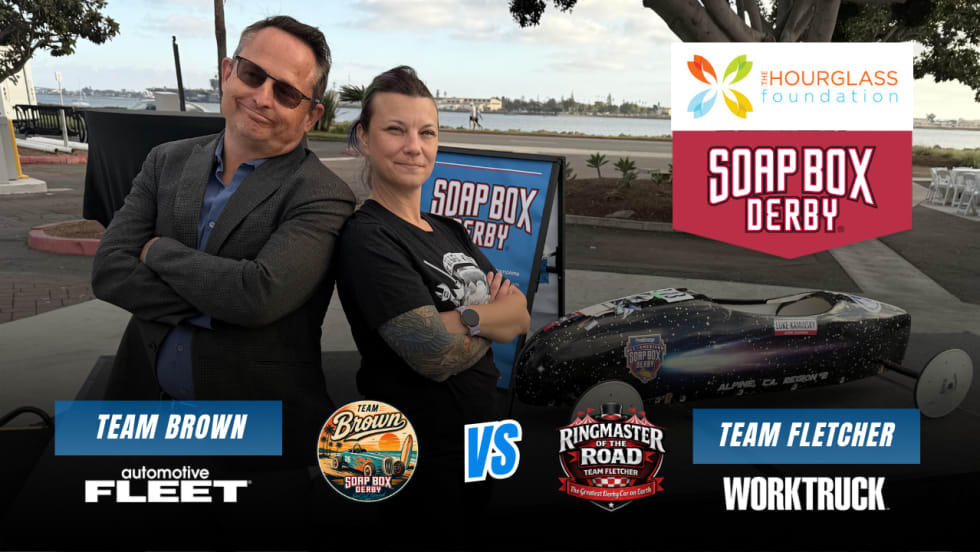
It's All Downhill from Here! Fleet Industry Raises $22,000 for Skilled Trades Scholarships
Work Truck’s Lauren Fletcher and Automotive Fleet’s Chris Brown turned a friendly racing rivalry into $22,000 for automotive technology and skilled trades scholarships.
Read More →