




Charging a Truck: Understanding Third-Party Infrastructure Models
In world of high-power charging for trucks, As-a-Service models and providers are proliferating to meet the need.
January 16, 2025

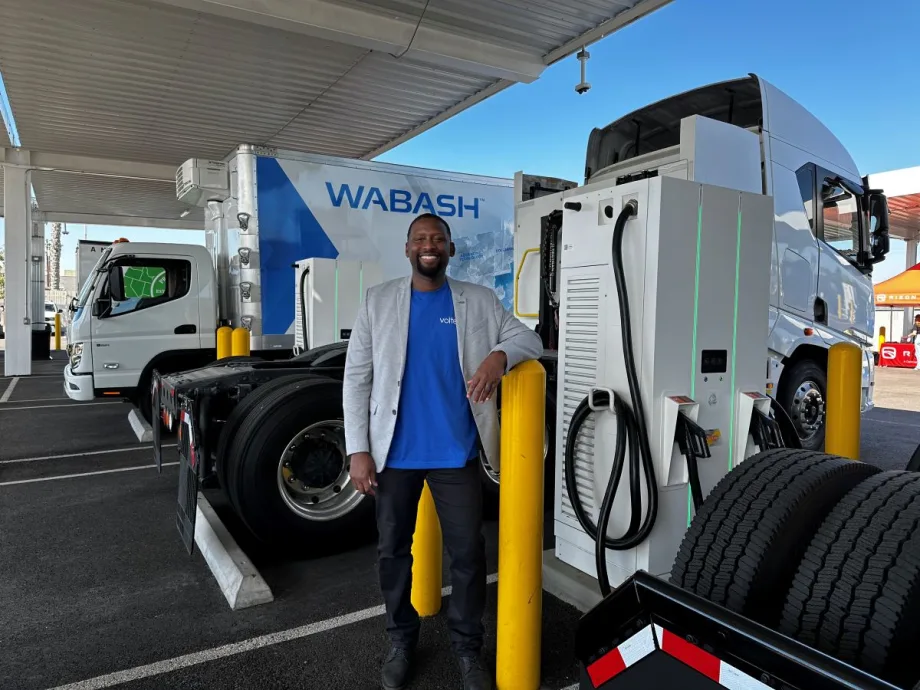
Voltera's Jonathan Colbert stands amongst the company's high-capacity chargers at its Lynwood, California facility.
Photo: Chris Brown
9 min to read
EV charging infrastructure is not one size fits all, particularly for truck fleet operators.
When incorporating EVs, truck and trucking fleets face a wider initial cost gap between traditional gas or diesel trucks and electric trucks. Electric trucks also require greater on-site power, requiring a more costly and elaborate charging infrastructure buildout.
But the pressures to electrify are acute, particularly in California. As of Jan. 13, 2025, the California Air Resources Board (CARB) rescinded its EPA waiver application to implement its Advanced Clean Fleet (ACT) rule, which had called for most commercial vehicle types (including drayage fleets) in California to transition to ZEVs, with all acquisitions ZEV by 2036. drayage fleets to add only zero-emission vehicles (ZEVs) as of 2024.
However, CARB’s Advanced Clean Trucks (ACT) regulation, which requires manufacturers of medium- and heavy-duty vehicles to sell an increasing percentage of zero-emission vehicles (ZEVs) in California, is still in effect.
According to Matt Schrap, CEO of the Harbor Trucking Association, 75% of heavy-duty drayage fleets will have to charge using third-party sites because of funding challenges, construction delays, and landlords’ pushback to break concrete on their land.
As a result, numerous charging infrastructure companies have come online. They help fleets with compliance without forcing them to sink millions into an on-site depot.
With funding from government programs, federal grants, corporate investment, private equity, and venture capital funds, these infrastructure companies have broken ground on numerous sites in the last four years, mostly in California, with scores more coming online in 2025.
Their charging sites feature Wi-Fi, food and beverage services, and rest areas for drivers. They also connect to software for fleet managers and drivers to make charging reservations, monitor charging activity, and manage charging schedules.
But beyond the amenities, service models vary. They’re generally divided into two types:
Infrastructure-as-a-Service (or Charging-as-a-Service): Provides access to third-party depot charging. Within each, there are nuances of available services in bundled payment plans.
Truck-as-a-Service (or Fleet-as-a-Service): Includes the truck and access to charging infrastructure in a bundled payment.
Here’s a snapshot of companies and the services they offer in California and beyond:
Voltera: Infrastructure-as-a-Service (IaaS) for Dedicated Fleets
The model for Palo Alto-based Voltera, a developer, owner, and operator of charging infrastructure, is to develop sites in conjunction with fleets’ needs and then give them access to charging and other services.
VP of Marketing Jonathan Colbert described Voltera’s model as Infrastructure-as-a-Service. “We own the land, develop it, and bring all the infrastructure to bear, allowing fleets to focus on their operations,” he said in an on-site interview with Automotive Fleet.
“We’re not fleet as a service, because we do not provide vehicles.”
In March 2024, Voltera opened a site in Lynwood, California, to serve drayage fleets accessing the Ports of Los Angeles and Long Beach. The site has 65 stalls that accommodate electric Class 8 trucks, charging up to 200 vehicles a day. The 7.7-megawatt station has the capacity to grow to 11 megawatts.
The site was initially developed to serve the needs of Swedish transport company Einride, which specializes in sustainable freight transportation. Einride routes electric trucks out of the Ports of LA and Long Beach for Maersk, the Danish shipping giant.
Voltera has recently opened availability on the site to other fleets, highlighting another aspect of their business model that they call “co-location.” Like the business of an apartment building, fleets lease one or more stalls and share access to amenities on-site. “We are not a public charging network,” Colbert said. “We’re building dedicated hubs for our fleet customers closest to the ports to serve the drayage use case.”
In addition to Lynwood, Voltera has a site under development in Wilmington, which also serves the Port of Long Beach, and another near the Port of West Sacramento. Some 17 sites are in various stages of development in Texas, Arizona, Florida, and Georgia. Many of these sites will come online in the first half of 2025.
“The portfolio today is on a two to three-year timeline (bringing sites online along the way),” Colbert said. “We’ll continue to keep buying sites as we’re developing.”
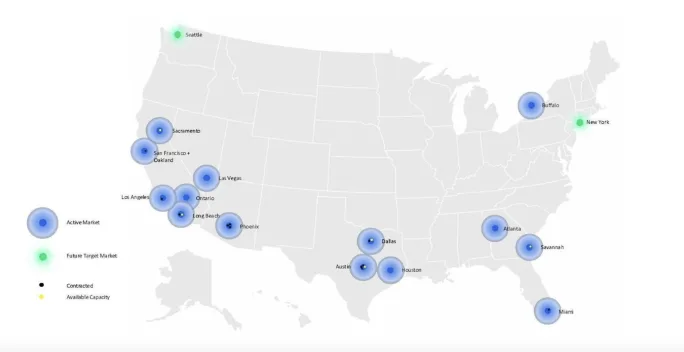
Voltera's planned charging sites will initially serve drayage fleets with an Infrastructure-as-a-Service model.
Source: Voltera
Greenlane: Infrastructure-as-a-Service for Freight Corridors
Formed in 2022, Greenlane also employs an Infrastructure-as-a-Service model to charge medium- and heavy-duty electric trucks but offers publicly accessible, pay-as-you-go chargers.
Unlike Voltera’s concentration on ports, Greenlane places sites along major freight corridors, such as the 280-mile stretch on Interstate 15 between Long Beach and Las Vegas, to service port vehicles and long-haul operations. The company plans to have sites online along the I-15 in Colton, Barstow, and Baker, California, with the Colton site expected to be complete by Q1 2025.
Greenlane has done predictive modeling to determine the number of chargers necessary to meet regional demand in the 1-15 corridor.
“Our findings indicated that placing the three stations approximately 60 to 90 miles apart would maximize uptime for day-cab drivers by enabling shorter charging sessions at each stop and ultimately allowing customers to move freight confidently without any limitations,” said Patrick Macdonald-King, CEO of Greenlane, in a press statement.
WattEV: Truck-as-a-Service (Taas) & Public Charging
Long Beach-based WattEV offers a TaaS model, providing fleets access to Class 8 electric trucks along with maintenance support, insurance, and charging across the entire network.
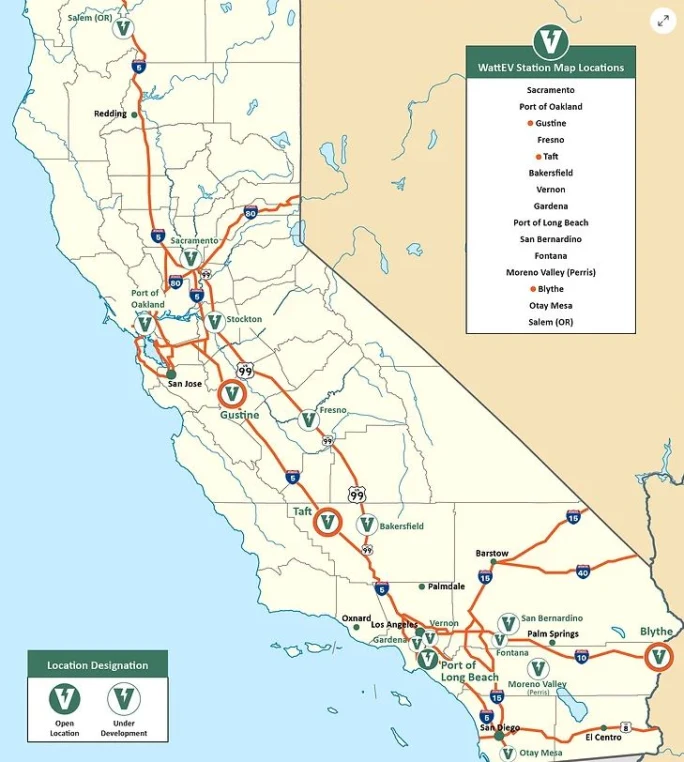
WattEV's initial freight corridor buildout will be along Interstate 5 from Southern California through Seattle, Washington.
Source: WattEV
The goal of the TaaS model is to minimize capital investment by providing access to electric trucks at a per-mile or per-route rate nearly on par with diesel, which includes the vehicles and costs around charging infrastructure, installation, and maintenance.
WattEV also offers charger access to fleets that bring their electric trucks.
In July 2023, WattEV opened an electric charging depot for medium and heavy-duty trucks at the Port of Long Beach. With 5 megawatts of power, the site’s 13 dual-cord fast chargers can charge 26 trucks concurrently.
In May 2024, WattEV opened its fourth site in Bakersfield, California, with a solar-powered microgrid and battery energy storage system.
Like Greenlane, WattEV plans to build networks along freight corridors. Its first targets are locations along Interstate 5 from Southern California through Seattle, Washington.
Forum Mobility: Truck-as-a Service & Charging-as-a-Service (CaaS)
In May, San Francisco-based Forum Mobility broke ground on a charging depot at the Port of Long Beach. Now operational, the 9-megawatt site has 44 charging stalls and can accommodate 200 electric drayage trucks daily for multiple fleet operators.
Forum Mobility offers a flexible service model in which operators can bring their vehicles to charge, as well as a truck leasing option bundled with charging services.
“If bundling a truck with charging— just like you get a cell phone bundled with your cell phone plan — is easy for you, great,” said Matt LeDucq, CEO of Forum Mobility, during an interview with Automotive Fleet at the site’s groundbreaking ceremony in May 2024. “You can choose what works.”
The company is opening new sites in Compton, Inland Empire, Oakland, and Stockon to serve drayage routes.
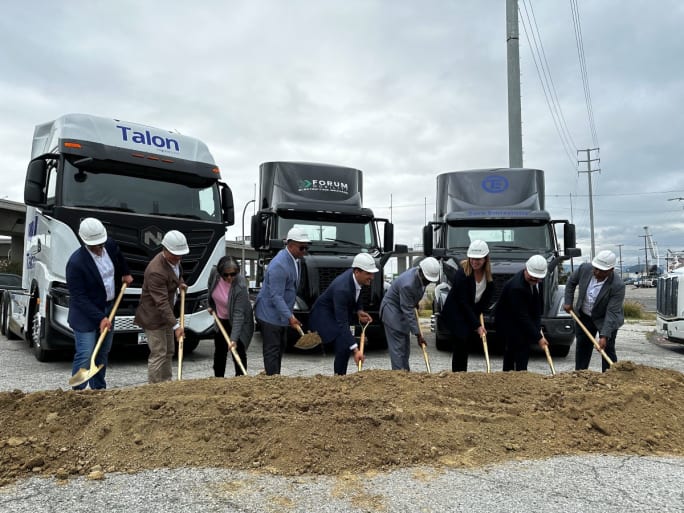
Forum Mobility executives, fleet executives, and local politicians break ground of the Forum Mobility Charging station at the Port of Long Beach, California in May 2024.
Photo: Chris Brown
Zeem Solutions: Transportation-as-a-Service & Charging-as-a-Service
One of the “grandfathers” of truck charging, Zeem Solutions opened its first EV charging depots near Los Angeles International Airport (LAX) in 2021. The adjacent depots have 10 megawatts of total power for 78 DC fast-charging ports, 53 Level 2 chargers, and the capacity to charge and store more than 200 medium- and heavy-duty vehicles on-site.
Targeting transportation hubs, ports, airports, and distribution centers, Zeem is currently developing depots in the ports at Long Beach, Newark, N.J., and Savannah, Georgia. The Long Beach project will feature 84 DC fast charger ports with a 15-megawatt capacity that can serve 500 trucks a day.
Zeem Solutions’ CEO Paul Gioupis calls the model Transportation-as-a-Service or E-Fleet-as-a-Service.
Fleets can lease electric trucks, park and charge day or night at Zeem’s depots, and receive routine maintenance, inspections, and cleaning services for a monthly fee. Drivers are also offered secure parking for private vehicles and a lounge.
Zeem also provides CaaS for fleets that require access to charging infrastructure without vehicle leasing, such as rideshare, last-mile delivery, and car rental operations.
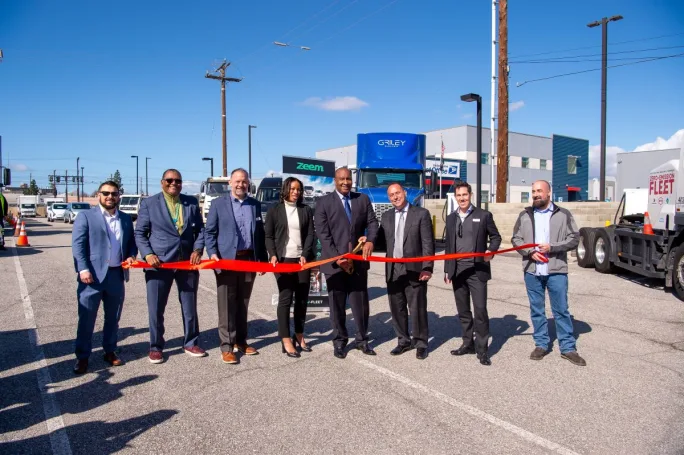
James T. Butts, the mayor of Inglewood, California, cuts the ribbon during the opening of Zeem Solutions' LAX depot. Zeem CEO and cofounder Paul Gioupis stands to the right of Butts.
Photo: Zeem Solutions
Power: The New Gold Rush
The power demands of Level 2 depot or home charging are trifling compared to the needs of larger truck fleets, which require enough juice to power a skyscraper or a small town. How much power can be delivered to a site depends on substation capacity, grid upgrades, utility approval processes, environmental permits, and lead time for equipment such as switchgear.
Existing charging companies have first-mover advantages: While Voltera’s Lynwood site was up and running in 18 months, and WattEV’s Bakersfield depot took only 16 months, new players — whether public or behind the fence — may face much longer timelines.
“Some fleets in Los Angeles are waiting up to five years for the necessary power upgrades,” said Michelle Brown of Pioneer eMobility during a seminar on charging at the 2024 Fleet Forward Conference (FFC).
“It’s like a gold rush right now, to try to get into the queue as fast as possible,” said Voltera’s Colbert. “No two utilities operate in the same way. It’s really challenging to bring that (power) online.”
This raises the opportunity for these companies to arbitrage energy to newcomers. “We will be entering a phase where those with a substantial amount of power will have a wonderful asset,” said LeDucq of Forum Mobility.
Voltera expects the Lynwood site will be able to provide power for public charging network providers.
Temporary Charging & Grid Resiliency
During elongated timelines, temporary charging infrastructure can bridge the gap.
Pioneer eMobility’s natural-gas-powered “microgrids on a skid” can be deployed until grid power can be established, or it can remain on-site as a resiliency against outages.
Solar is another off-grid option. WattEV’s Bakersfield depot features a solar-powered microgrid with a battery energy storage system. Zeem is planning on solar for its LAX depot. Out of the site’s 10 megawatts of available grid power, an array of solar canopies could provide half to three-quarters of a megawatt of juice to charge vehicles.
“Temporary charging products can often become permanent solutions as the market matures,” said Zeem's Gioupis during the FFC seminar.
Megawatt Rapid Charging — a Game Changer?
In some applications, such as defined sales-and-service routes and last-mile deliveries using electric commercial vans and smaller medium-duty trucks, electrification makes financial sense.
But with present battery technology, the current crop of electric Class 8 trucks must charge about every 200 miles to operate within a 10% to 80% battery capacity band. That makes drayage’s shorter duty cycle the least disruptive from an operational standpoint.
As battery technology develops incrementally, Megawatt Rapid Charging (MCS) can help. MCS can bring trucks’ dwell times down from hours to less than 30 minutes for a full charge.
The WattEV site in Bakersfield offers MCS charging with three 1,200kW rapid chargers that draw power from the site’s solar array. When operational, Greenlane’s Colton station will accommodate MCS.
Allen Nielsen of Greenlane said during the FFC seminar that the company plans to integrate more MCS by 2027 or 2028, though he noted that current technology still limits rapid, high-capacity charging.
Even with MCS, stopping every 200 miles during long-haul cycles doesn’t make sense.
“Over time, we need a massive shift in technology to accommodate the longer routes,” Colbert told AF. “We’re going to get closer and closer. It’ll go from drayage to middle-mile, and then you’ll start seeing more of the long-haul use cases. That’ll be a five- to 10-year timeline to make sense.”
Power Needs Growing Exponentially
Power needs are only increasing. According to the California Energy Commission, California will need about 157,000 chargers for medium and heavy-duty electric trucks to comply with CARB's Advanced Clean Fleets mandate by 2030.
Yet while the fleet and transportation industries require massive power, they have stiff competition from the data farms coming online to serve e-commerce, social media, AI, and cryptocurrencies.
“People think we (infrastructure companies) are going to take a lot off the grid,” said LeDucq. “We’re just a ‘flea on the side’ compared to what Meta is building.”
Subscribe to Our Newsletter
More Fleet Forward
Erin Gilchrist Receives Mike Antich Spirit of Fleet Award
Last week at AFLA in Vegas, Erin Gilchrist received the inaugural, brand-new Spirit of Fleet Award.
Read More →
Dominika Leja Named the 2026 Fleet Manager of the Year
The AstraZeneca associate director of fleet was recognized for her leadership in fleet electrification, cost savings, and operational transformation.
Read More →
Jamie McKay Named the 2026 Fleet Visionary Award Winner
The Aptive Pest Control fleet manager was recognized for her approach to operations, data, lifecycle management, and driver needs.
Read More →
Fleet Forward Conference Introduces One-Day Passes for 2026
New one-day registration gives fleet professionals the flexibility to attend Tuesday, Wednesday, or Thursday, with passes available for $199 through Sept. 18.
Read More →
Vibe Coding: When Fleet Managers Become Software Builders
Five fleet professionals — none with programming skills — discuss how they’re using AI to build fleet solutions in-house and in a fraction of the time.
Read More →
Fleet Forward Conference Tackles Fleet Industry’s Growing Leadership Gap
This session will examine succession planning, knowledge transfer, and the skills the next generation of fleet leaders will need as veteran professionals leave the industry.
Read More →
2026 Fleet Manager of the Year Finalists Announced
Who are the 2026 Fleet Manager of the Year finalists?
Read More →
John Rossant to Deliver Opening Keynote at 2026 Fleet Forward Conference
The CoMotion founder will draw on developments across Europe, China, the Middle East, and other international markets to identify trends that could influence how U.S. fleets plan for the coming decade.
Read More →
How to Build Custom Fleet Tools With AI and Vibe Coding [Webinar]
A new Automotive Fleet webinar explores how fleet managers are using AI and vibe coding to automate routine work and create simple operational tools without traditional programming skills.
Read More →
Is Fleet Ready for Its New Disruptors?
Three emerging leaders from a corporate fleet, public fleet, and the automotive supply chain will bring new ideas and a willingness to challenge industry norms to the Fleet Forward Conference stage.
Read More →