




Cars and Sales: A Research Study on Cost of a Car As a Sales Tool
One of the most perplexing problems confronting the fleet operator with a large sales force is what type of fleet operation is best for his company. Should he use company-owned or leased cars and absorb all of the costs? If so, how should he handle the use of the cars when the salesmen are not working?
One of the most perplexing problems confronting the fleet operator with a large sales force is what type of fleet operation is best for his company.
Should he use company-owned or leased cars and absorb all of the costs? If so, how should he handle the use of the cars when the salesmen are not working? Or should he let the salesmen operate their own cars and reimburse them? If so, how much? Or should he completely ignore the problem and make a car a condition of employment without any reimbursement?
Obviously, there is no clear-cut answer. What might be ideal for one fleet operator may not necessarily be right for another fleet operator. Even within the same company, circumstances may dictate different modes of operation.
There have been hundreds of surveys on salesmen operated cars and the only conclusion that cannot be denied is that wheels make the sales go around. A car is a vital-almost necessary-sales tool and if used properly can greatly increase earnings. If used improperly, a car can be a great drag on a company's resources.
One of the most recent surveys on the use of cars in business was conducted by the Research Institute of America Inc., a New York-based research firm. A poll of the institute's sales members revealed that 99 per cent of the respondents used a car in their work.
While a survey of this type cannot possibly tell a fleet operator what is best for him, it does provide a yardstick which can be used to measure his policies against those employed by other companies. The diverse methods of payment and the number of miles piled up each year indicate the immensity of the problem.
Fifty five per cent of the salesmen responding said they were driving a 1962 or 1961 car. Twenty-eight per cent were using a 1960 model; 12 per cent were in a 1959 model. The remaining five per cent drive older cars.
On the subject of ownership, 42 per cent of the salesmen said they use their own car in their work while 27 per cent said they used a company-owned car. Leased or rented cars were used by 31 per cent of the responding salesmen.
Reflecting the growing trend away from unreimbursed expenses for auto use, only eight per cent of the salesmen said they were not compensated for their driving expenses. Fifty-three per cent had their actual expenses paid and 39 per cent were paid by mileage. Mileage payments ranged from a low of 2 cents per mile to a high of 11 cents per mile with the average amounting to 7 cents per mile. In place of mileage, some salesmen said they received lump sums each month ranging from $100 of $160, or a combination of mileage and the monthly payment.
Further indication that surveys, while useful as a yardstick are not conclusive, is evidenced by the number of miles driven annually by the salesmen responding to the Research Institute of America survey.
Two per cent said they drive less than 10,000 miles per year; 9 per cent drive 11,000 to 15,000 miles per year; 16 per cent drive 16,000 to 20,000 miles per year; 19 per cent drive 21,000 to 25,000 miles per year; 21 per cent drive 26,000 to 30,000 miles per year; 13 per cent drive 31,000 to 35,000 miles per year, another 13 per cent drive 36,000 to 40,000 miles per year; and 7 per cent put on more than 40,000 miles per year.
This tends to support findings by Automotive Fleet that the average fleet car travels more than 28,000 miles a year.
Chevrolet was the most popular car in the RIA survey. Thirty-two per cent of the salesmen said they drove a Chevrolet. Ford was next in line with 20 per cent, followed by Plymouth with 12 per cent, Buick, 8 per cent, Pontiac, 7 per cent, Dodge, 6 per cent, Rambler 4 per cent, Oldsmobile, 4 per cent, Mercury, 3 per cent and Chrysler 2 per cent. Of the remaining 2 per cent, the makes most frequently mentioned were Cadillac, Volkswagen and Studebaker.
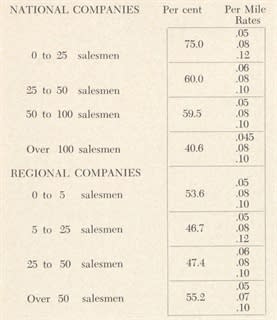
Another survey on the cost of salesman cars was recently developed by the Dartnell Corp. of Chicago. This survey dealt only with salesman-owned cars. The results indicated that the flat rate method of payment was the most popular method of payment to salesmen operating their own cars on company business. More than half-53.7 per cent-of the companies responding to the Dartnell survey said they pay their salesmen on a flat rate basis. The figure most frequently given was 8 cents per mile with the low at 4.5 cents and the high a 12 cents per mile.
Dartnell broke its survey down to include both national and regional companies. National companies with 0 to 25 salesmen scored the heaviest in favoring flat rate payments with 75 percent stating they use this method. Regional companies with 5 to 25 salesmen had the lowest percentage-46.7 per cent- in flat rate payments.
Following is a breakdown of the Dartnell survey with the percentages of flat rate payments and the high, low and mode figures:
It should be readily clear from the above figures that the problem of reimbursing salesmen for the use of their cars is confusing to say the least. It should be equally clear that because of varying conditions under which cars operate, it is foolish to set an arbitrary flat rate method of payment. Such a method overpays the high mileage driver and underpays the low mileage driver.
The Dartnell study pointed out that fleet authorities generally agree that the flat-rate plan for reimbursing salesmen generally costs a company more than a sliding scale of mileage allowances, and in turn, this plan is more costly than one that reflects regional differences in operating costs and that segregates fixed from variable expense.
It is interesting to analyze the pattern that develops in the Dartnell study. The larger the company the less likely that it uses the flat-rate method of reimbursing salesmen. In those national companies with sales forces of fewer than 25 salesmen, 75 per cent reimburse by the flat rate. In the next size category-companies with from 25 to 50 salesmen-the percentage drops to 60. In the next category-companies with from 50 to 100 salesmen-the figure drops to 59.5 per cent. In companies with 100 or more salesmen, only 40.6 per cent use a flat mileage rate.
Dartnell drew the following conclusion from the results:
"It would probably be hasty to conclude that large nationwide companies are more cost-conscious and better managed than average companies in other categories, although such qualities doubtless are factors in establishing the pattern discernible in the responses. Probably more influential in setting such policies is the fact that in large companies the sums involved are substantial enough to be a matter of concern; so an effort is made to determine the most economical method, and it is worth the extra effort required to calculate mileage allowances on a sliding scale."
Dartnell notes that in smaller companies, the number of salesmen and the amount of miles driven are not large enough to justify using the more complicated system. It is convenient merely to multiply the number of miles a salesman has driven by an unchanging factor.
"When salesmen drive a large number of miles per month, however, it probably pays a company to use a sliding scale in calculating the amount of money a salesmen is to be reimbursed. That factor, rather than number of salesmen, appears to be the most important single consideration." Dartnell said.
No clear cut pattern can be drawn from the regional companies that responded to the Dartnell survey. The size of the sales force in regional companies has no direct bearing as to whether the flat-rate method is used. In companies with five salesmen or fewer, 53.6 per cent used the flat rate method. In companies with more than 50 salesmen, the percentage using the flat-rate method was 55.2-higher than any other category.
One of the strongest advocates of the flexible payment method-whether it be for leased, company-owned or salesman-owned cars is Runzheimer & Co. of Chicago. While this is understandable, since the company is in the business of determining car allowances for clients, it has plenty of good arguments against a uniform flat allowance:
"When there are difficulties in driver-owned fleets they usually result entirely from the use of the same kind of uniform flat allowances which were in vogue when cars were first driven on business fifty years ago. Since then, cars have been completely redesigned, streamlined and improved to meet present day needs."
"The same thing must be done with car allowance control plans; the methods of fifty years ago simply are not good enough today. Look carefully at car expenses and you will find that they are not static, but fluctuate from month to month. They also vary sharply from one driver's territory to the next. Simple differences in yearly mileages make a big difference in what each driver should receive. Therefore, your car allowance plan, too, must be modernized and designed to reflect flexibly and accurately these ever-changing costs and conditions in each driver's territory. In this way you will get all of the important advantages inherent in driver-owned operation mentioned previously."
Automotive Fleet fully agrees with the Runzheimer statement. There is also another strong argument that can be used against a flat-rate payment. Today, when morale and fringe benefits are becoming more and more of a sales factor, what happens when the salesmen who is being reimbursed at six cents per mile meets a competitor who is receiving nine cents per mile? The answer is obvious-he feels he is being treated unfairly and it is bound to reflect in his work.
Peterson, Howell and Heather, Baltimore-based fleet management firm believes that the soundest approach to take with a employee who has to use his own car on company business is to pay the employee what it actually costs him to operate his car while on business.
"To do this accurately-expenses should be figured on a per-mile basis for per-mile costs . . and on a fixed basis for fixed costs." PHH says. Here is their formula:
Per mile costs: PHH suggests 3½ cents per mile as the proper amount to reimburse for running expenses-gas, oil, tires, minor repairs, etc. This is an accurate approximation of those costs which change in almost direct proportion to the number of miles driven.
Fixed costs: PHH suggests a flat $2.75 per day, (or proportionate amounts for weeks or months), as proper reimbursement for standing expenses-insurance, depreciation, license fees, tax fees. etc. Here "car time" is purchased; miles make no difference. (If more liberal reimbursement for standing expenses is considered, the company may wish to repay on the basis of a five-day business week . . . regardless of how many days the car is actually used for business).
Incidental costs: PHH suggests direct reimbursement for incidental expenses-tolls, parking, etc . . . . since these are outright costs, like meals and hotels, and are not affected by mileage or time.
PHH suggests that a salesman who drives his own car for business purposes be reimbursed at a total of the following rates: 3½ cents for every business mile driven, $2.75 for every business day the car is in use; the exact amount for the incidental expenses incurred.
The 3½ cents is based on "composite" running costs . . . (which, in 1961, amounted to 3.01 cents per mile). The $2.75 is based on "composite" standing expenses, excluding rental or interest on investment . . . (which, in 1961, amounted to $2.37 per day, assuming a 30-day month). The difference between these actual (average) figures, and its suggested reimbursement figures compensates salesmen for their inability to insure and operate their own cars as efficiently and economically as a company operates a fleet car.
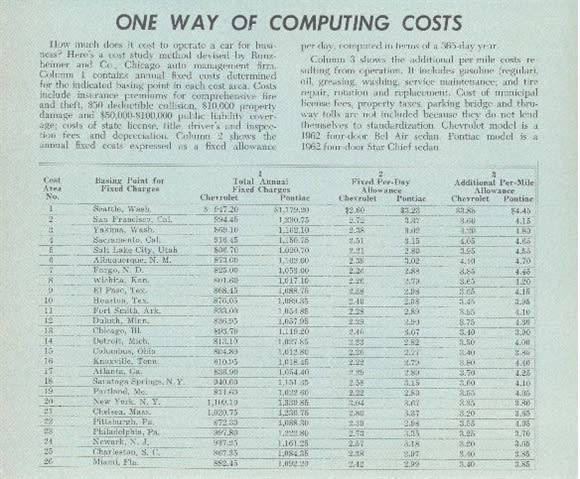
One Way of Computing Costs
How much does it cost to operate a car for business? Here's a cost study method devised by Runzheimer and Co., Chicago auto management firm. Column 1 contains annual fixed costs determined tor the indicated basing point in each cost area. Costs include insurance premiums for comprehensive fire and theft, $50 deductible collision. $10,000 property damage and $50,000-$100,000 public liability coverage: costs of state license, title, driver's and inspection fees; and depreciation. Column 2 shows the annual fixed costs expressed as a fixed allowance per day, computed in terms of a 365-day year.
Column 3 shows the additional per-mile costs resulting from operation. It includes gasoline (regular), oil, greasing, washing, service maintenance; and tire repair, rotation and replacement. Cost of municipal license fees, property taxes, parking bridge and thru-wav tolls are not included because they do not lend themselves to standardization. Chevrolet model is a 1962 four-door Bel Air sedan. Pontiac model is a 1962 four-door Star Chief sedan.
More Operations

Avis Budget Group Deploys Neology Toll Management Technology Across Major Brands
Neology’s neoFleet platform will manage toll transactions and toll-authority operations for vehicles across Avis, Budget, Payless, Budget Truck and Zipcar.
Read More →
Fleet Personal-Use Charges Edge Higher in 2026
Nearly eight in 10 surveyed fleets allow personal use of company vehicles, while just over half of respondents report charging employees for the privilege.
Read More →
The Future of Fleet + What’s Changing Right Now | AF News Recap
Could developments overseas offer a preview of what’s coming for U.S. fleets? This week, we’re looking at the future of AI, autonomy, and electrification, plus Ford Pro’s new certified pre-owned program, smarter vehicle offboarding, and a new way for fleets to manage toll expenses.
Read More →
How to Handle Vehicle Offboarding
What do fleet managers need to do when a driver leaves?
Read More →
Fleet Manager’s Ultimate Playbook: Navigating the New Standard in OEM Connectivity
Rising operating costs, driver safety concerns, and unplanned downtime are putting unprecedented pressure on modern fleets. Discover how fleet managers use embedded OEM connectivity and real-time vehicle data to cut TCO, prevent downtime, and protect drivers without aftermarket telematics hardware.
Read More →
U.S. Bank Adds Verra Mobility Toll Management to Voyager Fleet Platform
The integration allows U.S. Bank Voyager fleet customers to manage toll payments and violations alongside fuel, EV charging and maintenance expenses.
Read More →
ADAS Prevents Crashes. But Repairs Cost More | AF News Recap
ADAS-equipped vehicles may crash less often, but they can cost more when they do. This week, we’re breaking down what that tradeoff means for fleets, plus Subaru’s first Forester Wilderness Hybrid, Nissan’s new e-POWER Rogue, and why Calstart has become Catalyst Mobility.
Read More →
Moventum Fleet Management Names Mark Iorillo Head of Sales
Iorillo brings nearly 20 years of fleet management and sales experience to the role, including previous positions at Element Fleet Management, CEI, Donlen and Ryder.
Read More →
Fleet Has a Talent Pipeline Problem. What Comes Next? | AF News Recap
Where will fleet’s next generation of leaders come from? This week, we’re looking at the industry’s talent pipeline, what certification can add to a fleet career, how to build an award-worthy track record, and the return of Automotive Fleet’s Personal Use Survey.
Read More →
Smith System Launches Driver Risk Management Program
Fleets have more driver data than ever, but identifying risky behavior doesn't necessarily correct it. Smith System's new Driver Risk Management program combines monitoring, training, and follow-up coaching to help fleets connect risk signals with driver intervention.
Read More →