




Car Sharing: Grading the College Campus Market
Northcoast Research Partners’ report on adoption of car sharing at U.S. universities shows a yearly growth rate of 20-30 percent on a majority of campuses that start a program.
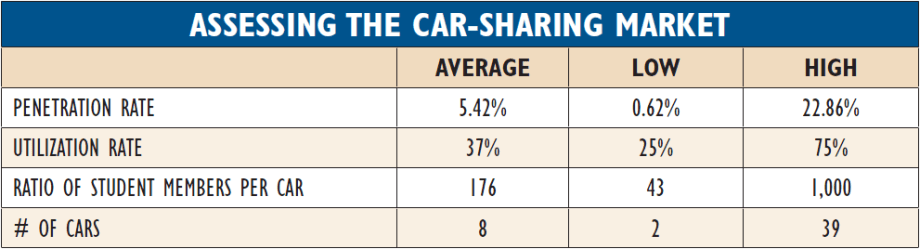
The 35 transportation directors and administrators that took the survey estimate an overall student body usage rate of about 5 percent on average, with the highest going up to almost 23 percent. The higher percentages correlated with the length of the program, with the longest-running programs reporting the highest amount of members. Almost half of respondents also reported that car sharing is becoming a more "mainstream" idea on campus.
Northcoast Research Partners recently completed a quantitative survey and conversations with 35 college transportation directors and administrators regarding the adoption of car sharing on their college campuses. Based on Northcoast’s research, the college campus market remains a small but emerging market for car-sharing operators.
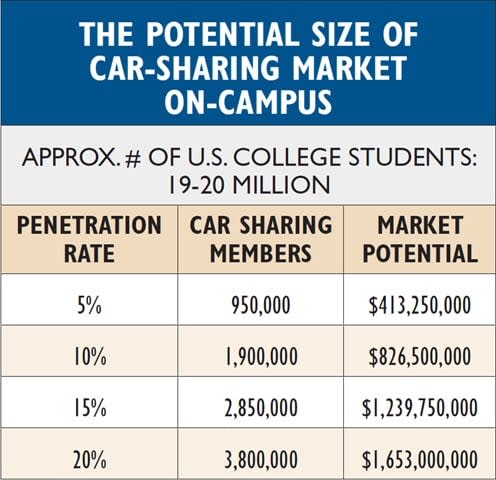
This is an estimated outlook of what the market would look like if penetration rates continue to rise with members utilizing the service at 40 hours per year at a $35 annual fee and $10-per-hour rental fee. With a U.S. student population of about 19-20 million, according to the National Center for Education Statistics, Northcoast estimates that if about 20 percent of students used the program at these same rates and fees, the industry could boast a market size upwards of $1.6 billion.
This research finds that most college campuses that start a program see sizeable growth rates in car sharing usage, growing 20-30 percent on a year-over-year basis. Colleges and universities with car sharing already “fully deployed” for two to three years are experiencing total student body adoption rates of about 10-15 percent.
Northcoast estimates that if all colleges and universities in the country deployed car sharing, the market size could evolve to $400 million to $1.65 billion in total revenues on the long term, assuming that membership fees and hourly usage rates remain consistent, and the penetration rate across the entire U.S. hovers around 5-20 percent.
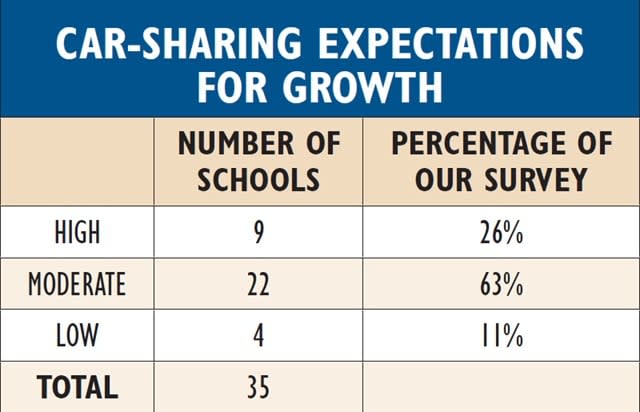
Schools expect the growth of members and fleet to approximate 20-30 percent in the near-future as offerings become better known and embraced by students.
College campuses are looking at car sharing as an integral component of student life and campus parking/transportation strategies. The proliferation of car sharing on college campuses is a result of the following factors: schools looking to reduce the number of cars on campus, students looking to fill transportation needs, increased flexibility by members to “go as they please” and overall efforts to be “green.”
Without question, car sharing is on its way to becoming mainstream in a number of top car-share markets and college campuses. In our opinion, 2011 and 2012 will stand as important years for the car-sharing market as we begin to learn more about consumer adoption and get a better view of competitors.[PAGEBREAK]
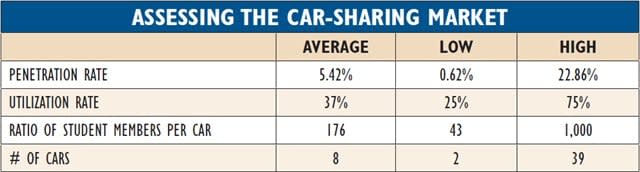
The 35 transportation directors and administrators that took the survey estimate an overall student body usage rate of about 5 percent on average, with the highest going up to almost 23 percent. The higher percentages correlated with the length of the program, with the longest-running programs reporting the highest amount of members. Almost half of respondents also reported that car sharing is becoming a more "mainstream" idea on campus.
Here are Northcoast’s key takeaways from our conversations with transportation directors:
● Universities appreciate the car-sharing model as it “cuts down” on the need for students to bring vehicles to school; it reduces issues with congestion and lack of parking — two issues that many schools encounter.
● Colleges and universities are marketing car-sharing offerings as a way to differentiate themselves to rival schools and also as a way “to promote environmental friendliness campaigns.”
● Schools with programs expect the growth of members and fleet will approximate 20-30 percent in the near future as the offerings become better known and embraced by students.
● Schools typically see car-sharing utilization rates highest on the weekends and lowest during the midweek — similar to car-sharing use in urban settings.
● The biggest complaint is in regards to vehicle shortages primarily on the weekend.
● Car-sharing gives way to additional innovation as “second generation” car-sharing initiatives begin to emerge, such as ride sharing and community vehicle programs.
● Two-way texting and use of mobile apps are popular and give students the ability to reserve vehicles on the go.
● Applications created by operators like Zimride, a carpooling/brokering community, provide for a “car-light” operating environment.
● There is an element of rising competition on college campuses as rental car companies begin to explore the market.
● Some transportation directors feel the future could bring multiple drop-off and pick-up locations for cars for better accessibility.
Car-Share Marketing
Our research suggests that colleges and universities are deploying additional marketing campaigns in an effort to increase the use of car sharing on campus.
The following are methods used by colleges and universities to market car sharing:
● Marketing campaigns during freshmen orientation programs.
● Regularly available marketing materials on campus.
● Monthly email campaigns to student bodies.
● On-campus car-sharing representatives during program launch.
● Campus signage (e.g. flyers, banners, and bus shelters).
While the competitive environment will likely get more crowded in time, increased attention from viable competitors has yet to have any meaningful impact on the near-term results of Zipcar, for example, the largest on-campus car-sharing provider and largest car-sharing company in the U.S.
The market as a whole remains fairly small at this time, but Northcoast believes the growth opportunity associated with cars on college campuses remains significant.
John Healy, a research analyst with Northcoast Research Partners, covers the car rental sector within his business services area of focus. Northcoast Research Partners is an institutional equity research firm that specializes in car rental, among many other industries.
Originally posted on Auto Rental News
More Global Fleet
Holman Takes Full Ownership of ARIZA in Mexico
Holman is bringing its Mexican fleet management operation fully under its own brand after more than 30 years as a joint venture. The change gives multinational fleet customers a single Holman operation across the U.S., Canada, and Mexico.
Read More →
Proven Ways to Reduce Work Truck Downtime
The age-old problem of downtime will always be a reality, but with new strategies at hand, fleets have more ways to keep trucks on the road longer.
Read More →
The Top 300 Commercial Fleets
The Top 300 Commercial Fleets: See the List
Read More →

Cameras, Safety and Insurance: From Reactive Claims to Real-Time Prevention (Part 2 of 2)
Part Two: Commercial auto remains one of the most challenging and costly lines of coverage for fleet operators and insurers alike. Continue learning more about how to effectively address these issues from Onur Aksan, Enterprise Business Development Executive, Geotab
Read More →
Cameras, Safety and Insurance: From Reactive Claims to Real-time Prevention
Commercial auto remains one of the most challenging and costly lines of coverage for fleet operators and insurers alike. Learn more about how to effectively address these issues from Onur Aksan, Enterprise Business Development Executive, Geotab.
Read More →
Fleet Costs Are Rising: Here’s How Leaders Are Responding
Fleet leaders are under pressure to reduce costs, adapt to economic uncertainty, and make smarter decisions. See how peers across North America are responding with real data, proven strategies, and forward-looking insights. Download the 2026 Market Pulse Report to benchmark your strategy and uncover where you can gain an edge.
Read More →
Enterprise Fleet Management Surpasses 900,000 Vehicles in U.S. & Canada
Enterprise Mobility connects with mobility solutions around the globe
Read More →
Automotive Fleet's Guide to Fleet Electrification
Unlock the secrets to a successful transition to electric fleets with Automotive Fleet's comprehensive Fleet Electrification Guide!
Read More →
Sumitomo Rubber Industries to Acquire Viaduct
Viaduct will join Sumitomo as an independent subsidiary. Partnership strengthens global reach and accelerates AI-driven innovation for fleets and manufacturing.
Read More →