





This article appeared in the 2021 Connected Fleet Guide, which offers resources to turn connected car data into actionable insights to foster safer and more efficient fleets.
Autonomous Technology: The Future Is Now
While the automotive and transportation sectors are embracing autonomous technologies, they’re also working to educate and entice future users.
November 9, 2021

A survey by Partners for Automated Vehicle Education, or PAVE, showed there is a great amount of skepticism surrounding this technology — almost 75% of respondents think AV tech is not yet ready to hit the streets.
Getty Images/metamorworks
6 min to read
What was once a technology seen mostly in movies portraying an idealized look at the future, autonomous vehicles are gaining momentum in all classes, from sedans to big rigs. In the Class 8 market, OEMs have been testing prototypes for five years or more, with Daimler Trucks North America leading the pack with its Inspiration Truck. This Level 3 autonomous truck is just one of a number of ongoing projects designed to further the acceptance of this technology.
Google, a pioneer in all things tech-related, initiated Project Chauffeur in 2008, which included seven self-driving cars traveling the country with a bit of secrecy. This evolved into an entirely separate company, Waymo, which is working on Waymo One, a ride-hailing service, and Waymo Via, a trucking and local delivery service that is being tested in and around Phoenix, Ariz.
And it’s not just vehicles that are getting the autonomous treatment. Delivery fleets have already been experimenting with everything from drones to four-wheeled robotic carts making their way to your front door. Grubhub is working with Russian self-driving startup Yandex to send food-delivery robots onto U.S. college campuses, which could amount to hundreds of four- or six-wheeled self-driving lunch boxes making their way around cities across the country.
Then there’s Halo, an startup that recently announced a fleet of electric vehicles that are autonomously delivered to customers, who then take over control of the car. When they are done, the vehicle is once again autonomously driven to the next destination. And this is not the only remote service that is available. Phantom Auto has created a solution allowing operators in one country to control warehouse equipment and even trucks in another.
For example, in the past two years, global logistics company Geodis has piloted its service that allows staff to control forklifts all over the world from its headquarters in France. Phantom Auto has also partnered with Texas-based ITS ConGlobal (ITSC). An intermodal services provider, ITSC addressed the restraints caused by the COVID pandemic by using Phantom Auto’s tech to train its yard truck operators to manually and remotely drive while remaining socially distanced.
Not Just for Startups
While startups are taking some of the limelight away from light-duty OEMs, the Big Four are not ignoring the writing on the wall. This past February, Ford announced it would invest $7 billion in autonomous vehicles through 2025. With an expected launch of 2022, Ford’s self-driving commercial business will use the Escape Hybrid crossover as a jumping point. The vehicles are being tested in partnership with Argo AI, a Pittsburgh-based start-up in which Ford and Volkswagen AG split an 80% majority stake in 2020. Ford will integrate these vehicles into test fleets in Austin, Texas; Detroit; Miami; Palo Alto, Calif.; Pittsburgh and Washington, D.C.
General Motors threw its hat into the ring, announcing this past May that it expects to offer self-driving vehicles to consumers later this decade. This announcement came on the heels of GM’s unveiling of a luxury autonomous shuttle vehicle, part of Cadillac’s Halo Portfolio, during CES in January. While the Halo is only a concept vehicle, and its production — if it happens at all — is a while away, the presentation showed the automaker’s interest in autonomous tech. And if anyone is doubting the OEM’s commitment to this emerging technology, GM granted AV developer Cruise a $5 billion line of credit to begin production of its Origin autonomous shuttle.
And there’s more on Ford’s autonomy efforts, as the OEM announced a partnership with Argo AI and Lyft to create an autonomous ride-hailing service. The self-driving Ford vehicles — along with human safety drivers — will be released on the Lyft network in Miami in late 2021 and in Austin in 2022. Over the next five years, the companies look to deploy a minimum of 1,000 autonomous vehicles on the Lyft network across several markets.
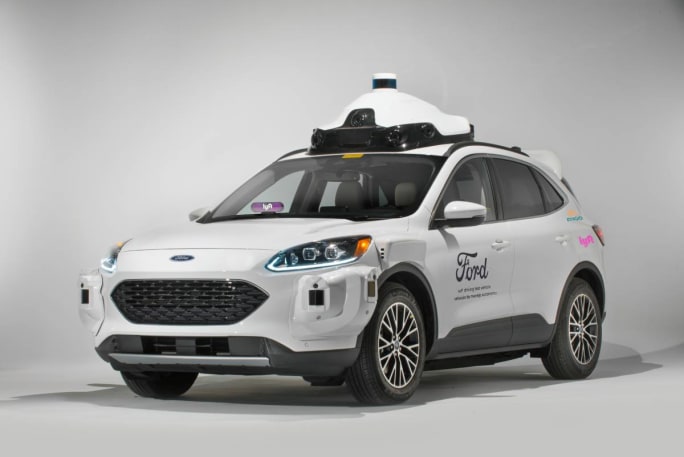
Argo AI and Ford will deploy Ford self-driving cars with safety drivers on the Lyft network, with passenger rides beginning in Miami later this year and in Austin starting in 2022. This initial deployment phase will lay the groundwork for scaling operations, with the aim to deploy at least 1,000 autonomous vehicles on the Lyft network, across multiple markets over the next five years.
Photo courtesy of Ford Motor Co.
Priming the Autonomous Pump
There would be no AV tech without the baby steps it takes to get there. Advanced driver-assistance systems (ADAS) have been around for some time, starting in the 1950s with the adoption of anti-lock braking systems. From there, we’ve seen the addition of electronic stability control, blind spot information systems, lane departure warning, adaptive cruise control, traction control, and even automatic emergency braking.
Along the way, ADAS have been categorized into different levels, based on the technologies used, through a scale created by the Society of Automotive Engineers. While level 0 simply provides information for the driver to interpret, such as parking sensors and lane departure warnings, levels 1 and 2 provide some decision-making control to the driver. In levels 3 to 5, the amount of control the vehicle has increases, with level 5 being fully autonomous. From the most basic level of autonomy to the highest, the industry is only getting started.
Regulations, Anyone?
With all the hype surrounding autonomy, there seems to be a missing component. Whether state or federally mandated, autonomous vehicle regulations will steer where the industry can venture in this regard. According to the Governors Highway Safety Association, 38 states and the District of Columbia have passed some form of legislation or executive order affecting autonomous vehicles.
Some states allow for the Level 5 deployment of a commercial motor vehicle as long as a driver is behind the wheel. Others have only approved testing of the technology on their roads. Altogether, five have approved studies on the technology to define key terms and state contacts or authorize funding within the state; 12 have approved testing; 16 states and the District of Columbia permit full deployment; and 18 allow for the testing or deployment of autonomous vehicles with no driver in the vehicle.
What About the Drivers?
While there might come a day when the commercial fleet is filled with fully autonomous vehicles, there will still be a need for experts solving the technical issues and, in many cases, a driver watching behind the wheel. If something in the system fails, drivers will need to be in the vehicle and ready to take control. In some cases, this tech could mirror the Phantom Auto game plan, with a driver controlling the vehicle in a separate location.
There is also the safety aspect to consider. According to a report from the Congressional Research Service, autonomous vehicles have the potential to bring major improvements in highway safety. The group also highlighted a study by the National Highway Traffic Safety Administration, which showed that 94% of crashes involve some form of human error. Could autonomous “drivers” cut these numbers drastically?
Public Perception vs. Public Acceptance
In terms of hindering the advancement of autonomous vehicles, public perception could not only stall its acceptance, but also derail it. A survey by Partners for Automated Vehicle Education, or PAVE, showed there is a great amount of skepticism surrounding this technology — almost 75% of respondents think AV tech is not yet ready to hit the streets. PAVE is made up of companies and associations dedicated to educating the public and policymakers about automated vehicles and the increased safety, mobility and sustainability. Such organizations can help dispel myths and create an open and honest forum for discussion on this technological topic.
PAVE is more about education than advocacy, with industry representatives, nonprofits, and academics offering policymakers, the media, and the public at large information on the advantages and challenges surrounding AV acceptance. One of the group’s survey results mirrors that message — 60% of respondents said they would trust this technology more if they better understood it.
Full autonomy is far from becoming a reality. While there are a number of test vehicles out on the roads, clocking more and more miles, there is a long road they need to run before they become commonplace. Vehicle makers, policy makers, and both consumer and commercial decision makers must first all come closer to an understanding of where this technology fits into the grand automotive landscape.
Subscribe to Our Newsletter
More Operations

Sponsored•October 14, 2026
A buyer's guide to fleet management software in 2027
Buying fleet management software in 2027 means looking beyond features and price. As fleet operations, technology and expectations evolve, this guide explores what today’s fleet professionals should consider when choosing a system that can deliver value now and adapt to what comes next.
Read More →
What Will Shape the Next Era of Fleet Management?
EVs, AI, and autonomous vehicles are reshaping fleet management. Discover what’s ahead—and how fleet leaders can prepare for the next era.
Read More →
How Fleets Can Recruit and Train Veterans for Technician Roles
Here's how the technician shortage has affected uptime for fleets, and what to do about it.
Read More →

Avis Budget Group Deploys Neology Toll Management Technology Across Major Brands
Neology’s neoFleet platform will manage toll transactions and toll-authority operations for vehicles across Avis, Budget, Payless, Budget Truck and Zipcar.
Read More →
Fleet Personal-Use Charges Edge Higher in 2026
Nearly eight in 10 surveyed fleets allow personal use of company vehicles, while just over half of respondents report charging employees for the privilege.
Read More →
The Future of Fleet + What’s Changing Right Now | AF News Recap
Could developments overseas offer a preview of what’s coming for U.S. fleets? This week, we’re looking at the future of AI, autonomy, and electrification, plus Ford Pro’s new certified pre-owned program, smarter vehicle offboarding, and a new way for fleets to manage toll expenses.
Read More →
How to Handle Vehicle Offboarding
What do fleet managers need to do when a driver leaves?
Read More →
Sponsored•October 1, 2026
Fleet Manager’s Ultimate Playbook: Navigating the New Standard in OEM Connectivity
Rising operating costs, driver safety concerns, and unplanned downtime are putting unprecedented pressure on modern fleets. Discover how fleet managers use embedded OEM connectivity and real-time vehicle data to cut TCO, prevent downtime, and protect drivers without aftermarket telematics hardware.
Read More →
U.S. Bank Adds Verra Mobility Toll Management to Voyager Fleet Platform
The integration allows U.S. Bank Voyager fleet customers to manage toll payments and violations alongside fuel, EV charging and maintenance expenses.
Read More →
ADAS Prevents Crashes. But Repairs Cost More | AF News Recap
ADAS-equipped vehicles may crash less often, but they can cost more when they do. This week, we’re breaking down what that tradeoff means for fleets, plus Subaru’s first Forester Wilderness Hybrid, Nissan’s new e-POWER Rogue, and why Calstart has become Catalyst Mobility.
Read More →