




Automated Driving Arrives
Automakers are preparing drivers for the future driving experience by prepping current and upcoming vehicles with new safety features.


Photo via istockpoto.com/000NE

Photo via istockpoto.com/000NE
When it comes to vehicle safety, the ideas of yesterday have become the safety systems of today and the not-so-distant future. Whether it is lane-departure warning systems or forward-collision avoidance systems, vehicles are taking the driver out of the equation and attempting to create a safer driving experience for everyone in the vehicle and on the road.
For many motorists, the thought of leaving the driving to a computer, such as the robot-powered taxis in the movie “Total Recall,” is a little unsettling. Google recently released a video showing people experiencing its self-driving car. While the participants seemed unnerved by the overall experience, what may not be realized by these “drivers” is that many vehicles are already using similar technology.
“Many of our current safety systems actually pave the way to autonomous driving,” said North Holbrook, manager of commercial sales at Volvo. “Our current systems for auto braking, lane keeping aid, and adaptive cruise control are great examples of the first steps that are currently available.”
Currently, Volvo’s auto braking technology, City Safety, is standard on all Volvo models, and, with more than 1 million cars on the road, the automaker is seeing the number of low-speed collisions reduced by 20 percent. The blind spot information system (BLIS) and cross traffic alert system both stepped away from the use of cameras and now are exclusively radar based, which allows for earlier and more accurate detection, according to the automaker.
As with Google and other vehicle manufacturers, Volvo is currently testing self-driving cars on public roads, particularly in Gothenburg, Sweden. The test cars are able to handle lane following, speed adaptation, and merging into traffic autonomously.
“This is an important step for us because, by 2017, we’ll have 100 autonomous vehicles able to drive the entire test route,” Holbrook said. “Autonomous driving is a crucial step in our Vision 2020, that by the year 2020 no one will be killed or seriously injured in a new Volvo. Allowing the car to act automatically is crucial when moving toward the vision that future cars will not crash.”
Volvo is also conducting research in areas such as driver sensors and even road magnets for accurate positioning of self-driving cars. Another area of focus the team is working on involves studying cloud-based communication to make driving safer. For example, if the car in front of you hits an icy patch, your car would be notified ahead of passing over the same slick spot.
Whether it’s Jean-Claude Van Damme straddling a pair of tractor-trailers or a self-driving car motoring willing participants down the road, more and more companies are using videos to show what is possible when it comes to creating safer cars.
Hyundai’s recently released video, “The Empty Car Convoy,” shows five stunt drivers testing the smart cruise control, lane keeping assist, and auto emergency braking features of the 2015 Genesis.
At times, seeing is believing. This is the case with the Mercedes-Benz Future Truck 2025, which was recently demonstrated in Germany for officials from 30 countries. The pilot vehicle, a Mercedes Actros tractor-trailer navigated the Autobahn near Magdeburg, Germany, at highway speeds without the driver controlling it.
No matter the direction, an increasing number of automakers are eyeing the future of transport, which could mean drivers will be transformed into passengers.
More Safety

Fleet Manager’s Ultimate Playbook: Navigating the New Standard in OEM Connectivity
Rising operating costs, driver safety concerns, and unplanned downtime are putting unprecedented pressure on modern fleets. Discover how fleet managers use embedded OEM connectivity and real-time vehicle data to cut TCO, prevent downtime, and protect drivers without aftermarket telematics hardware.
Read More →
From Driver Well-Being to EV Charging | AF News Recap
Mental health belongs in the fleet safety conversation. This week, we’re looking at five ways fleets can support employee well-being before a crisis, plus Holman’s expansion in Mexico, new one-day Fleet Forward passes, and why EV charging demand is outpacing infrastructure growth.
Read More →
Nexar-Nauto Merger Aims to Give Fleets Better Safety Intelligence Through Larger Driving Dataset
Stefan Heck tells Automotive Fleet that combining more than 10 billion miles of driving history with Nexar's AI models will give fleets deeper insights into driver risk and roadway conditions than either company could provide independently.
Read More →
Don't Wait for a Crisis: 5 Ways to Build Mental Health Into Your Fleet Safety Program
For Suicide Prevention Month, fleet and safety leaders have an opportunity to put mental health where it belongs: at the center of workplace safety.
Read More →
How Camera Data Can Strengthen a Fleet’s Insurance Renewal
Insights from a commercial insurance carrier and a broker show how fleets can turn video telematic data, driver coaching, and improved claims results into a stronger case at insurance renewal.
Read More →
The Safest Fleets Aren’t the Ones with the Most Technology
You’ve made the telematics investment. Here’s how to capture the other half of its value and build the safest fleet on the road.
Read More →
Hidden in Plain Sight: Fleet Compliance Risks
Fleet compliance isn't just about having policies — it's about consistently enforcing them. This practical guide reveals six hidden compliance risks common in public sector and shared fleet operations and outlines proven strategies to improve visibility, accountability, and audit readiness
Read More →
NETS Sets 2026 Fleet Safety Benchmark Conference for Indianapolis
The Sept. 15–17 program will feature fleet benchmarking data, case studies, emerging technologies, and implementation strategies while running alongside the NSC Safety Congress & Expo.
Read More →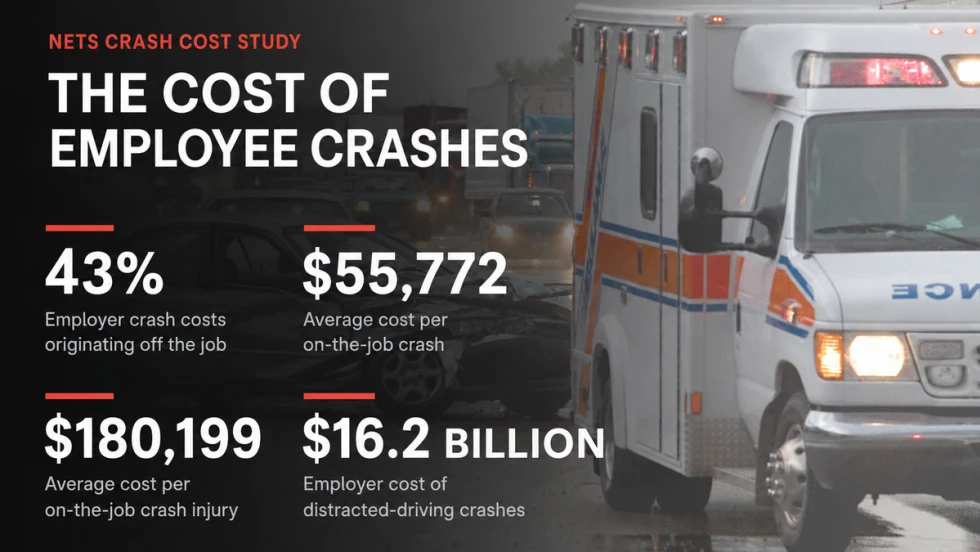
Off-the-Job Crashes Account for 43% of Employers’ $61.7 Billion Crash Burden
NETS quantifies costs dispersed across fleet, risk, HR, and other departments while providing new per-crash benchmarks for employers.
Read More →
Ram Recalls More Than 1.27 Million 1500 Pickups for Seat Belt Anchor Issue
The recall affects certain 2019-2026 Ram 1500 pickups that may have improperly attached second-row seat belt buckle anchors.
Read More →