




Assessing the True Impact of Delivery Robots on Driving Jobs
Forget autonomous trucking, for now, delivery drones and package-carrying robots will be a reality much sooner. To what extent will they take away traditional delivery driving jobs?

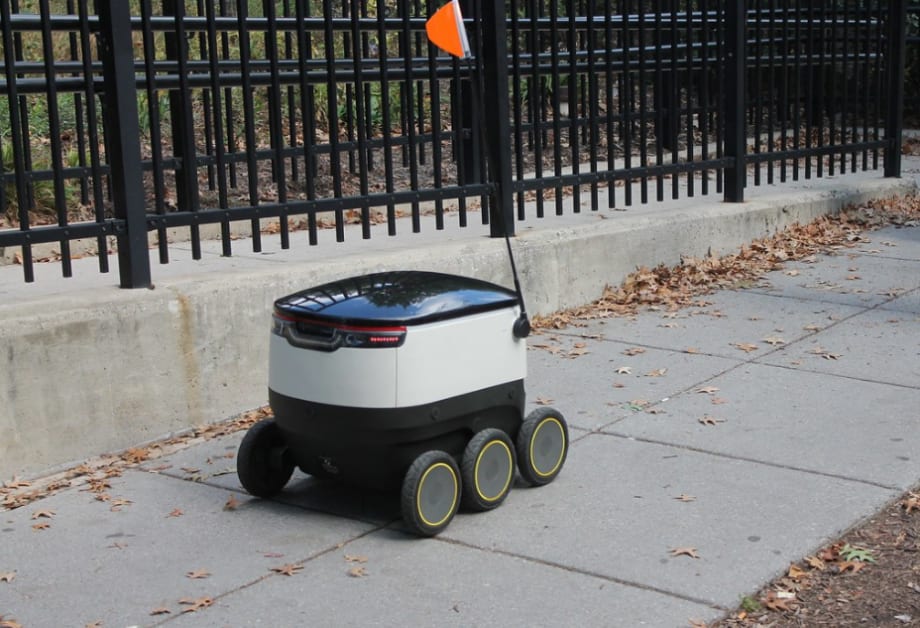
Most major delivery companies are testing drones and robots such as this to complete last-mile deliveries.
Photo via Flikr.
Ever since the discussion on autonomous vehicles went from “possible” to “inevitable,” we’ve argued about how and when driverless vehicles will take humans out of the equation.
However, the initial exuberance over autonomy has given way to the reality that full Level 5 driverless vehicles will take longer than we initially thought — giving those in over-the-road driving professions perhaps an extra decade of breathing room before considering a job in another field or taking early retirement.
But recent developments bring immediacy to the conversation when it comes to delivery driving jobs. Most major delivery companies — FedEx, Postmates, Amazon, UPS, and DHL — are actively testing to deploy drones and robots to complete last-mile deliveries.
While the mere mention of the word robot conjures up C-3PO and R2D2 in a galaxy far, far away, versions of them will arrive sooner than full autonomy because they’re already starting to make economic sense, and their societal and legislative path to deployment looks more direct.
Delivery drones, which generally can carry packages weighing up to 9 lbs., are relatively inexpensive and technologically feasible today. The biggest issue legislatively is the FAA’s line of sight rule; we’ll watch closely how the agency responds to UPS’s recent petition to allow drone flights of up to 7.5 nautical miles.
Four-wheeled autonomous robots have distinct advantages over human deliveries and autonomous versions of passenger cars. These appliances on wheels aren’t subject to stringent NHTSA crash tests and can, therefore, be made considerably cheaper and more cost-effective per delivery mile. Classified as low-speed vehicles, and without humans on board, they realize fewer liability exposures.
That’s not to say bot delivery vehicles won’t suffer the same fate as hundreds of electric scooters. Yet human resistance will only hamper — not stop — their permeation.
Drones and bots will permanently alter the local delivery market. To understand how they’ll affect jobs of humans making those deliveries today, let’s analyze how they’ll be deployed.
The ideal use of four-wheeled robots is for last-mile deliveries. In today’s method, a driver would make, say, 15 deliveries within a one- or two-mile radius. In an autonomous scenario, the driver would park and deploy five bots that make two deliveries each, while the driver would make the remaining five deliveries and return to the van in coordination with the bots.
The resulting optimization would shave a certain number of minutes off the driver’s workday, allowing him or her to potentially pick up and deliver a greater number of packages.
In this scenario, one bot doesn’t come close to replacing one driver. But if a driver making 100 deliveries a day is freed up to add 20 more, all things equal that reduces the need for other drivers by 20 deliveries.
Deliveries requiring greater human involvement would negate some of the efficiencies. These include the inability to optimize routes when larger packages are involved, inclement weather, or delivering on terrain not conducive to bot travel.
For some other delivery types, the logistics and economics don’t seem to make sense, yet. Can a bot deliver a pizza in a timely fashion and kept it hot? A floral delivery may not be as time-sensitive, but would the local shop owner be able to afford enough bots to satisfy peak delivery times (and still use a driver or two)?
Drone deliveries provide a more disruptive scenario. They hold the promise of costing less than $1 per delivery, and the market is huge — 86% of delivered ground packages weigh 5 lbs. or fewer.
If the FAA opens the floodgates and relaxes its line-of-site rule, we’ll see the major multinational courier delivery services divide and reposition their warehouses to within seven miles of most of the populations they serve and launch drones from there.
Drone flights still present issues surrounding weather, navigation, adequate drop zones, and package size. Would drones ultimately satisfy 15% of traditional deliveries or 50%? At this point, we don’t know.
Other variables that would slow the permeation of drones can be chalked up to the benefits of human interaction. UPS drivers are the pride of the company; indeed, they are a symbol of UPS’s customer service and a market differentiator. UPS has no doubt thought long and hard on the delivery circumstances that make sense to retain human contact with clients.
In sales-and-service deliveries, human interaction — from client handholding to on-the-spot upsells — is also an important customer retention and sales tool companies may not want to disrupt.
Of course, there are many sales-and-service scenarios in which drivers need skills that extend beyond the delivery, such as machine repairs — though those jobs face pressures themselves with over-the-air updates and diagnoses.
It’ll take a long time until some driving scenarios are taken over by autonomy, or maybe never. Those up to the task could thrive in business by exploiting those niches better than the rest.
Today, the jobs that involve performing a service and need driving only as a secondary requirement are more coveted, while those that don’t require a commercial driver’s license or unique training are not. This will only be exacerbated in the future.
Let’s face it, it’s hard to make a career from a non-skilled driving position today. Today and tomorrow, those open to learning new skills will ensure a greater level of job security.
Drones and robots need to be deployed, serviced, charged, and collected — certainly, drivers with technical prowess could acquire and market this experience. As well, the growth of online retail will continue to drive an expansion of last-mile deliveries that savvy entrepreneurs will be able to exploit.
At the very least, last-mile delivery jobs are still growing along with online retail, but the scales will soon tip into new ways to get goods where they need to go. Amazon’s drone delivery service, Amazon Prime Air, promises “packages in 30 minutes or less.” That unique selling point is too compelling to ignore.
More Fleet Forward

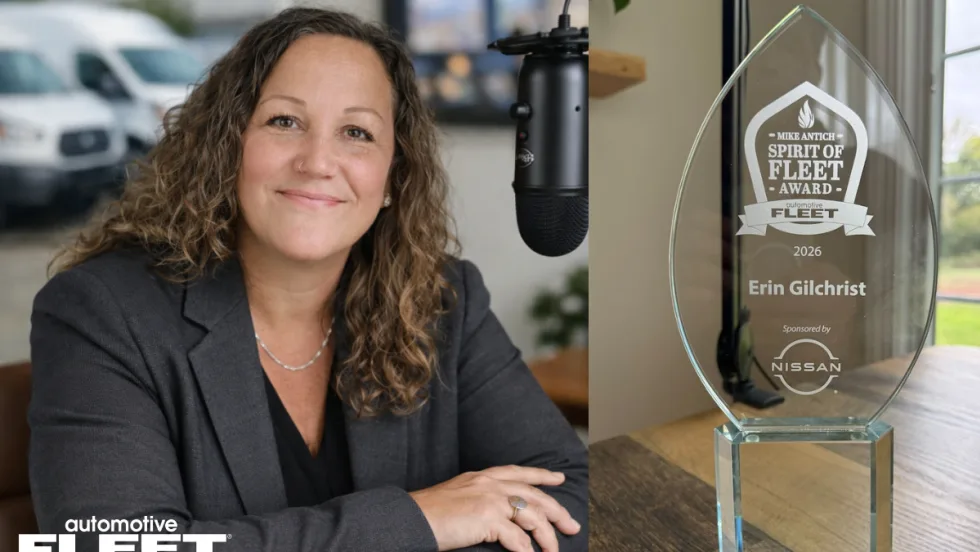
Erin Gilchrist Receives Mike Antich Spirit of Fleet Award
Last week at AFLA in Vegas, Erin Gilchrist received the inaugural, brand-new Spirit of Fleet Award.
Read More →
Dominika Leja Named the 2026 Fleet Manager of the Year
The AstraZeneca associate director of fleet was recognized for her leadership in fleet electrification, cost savings, and operational transformation.
Read More →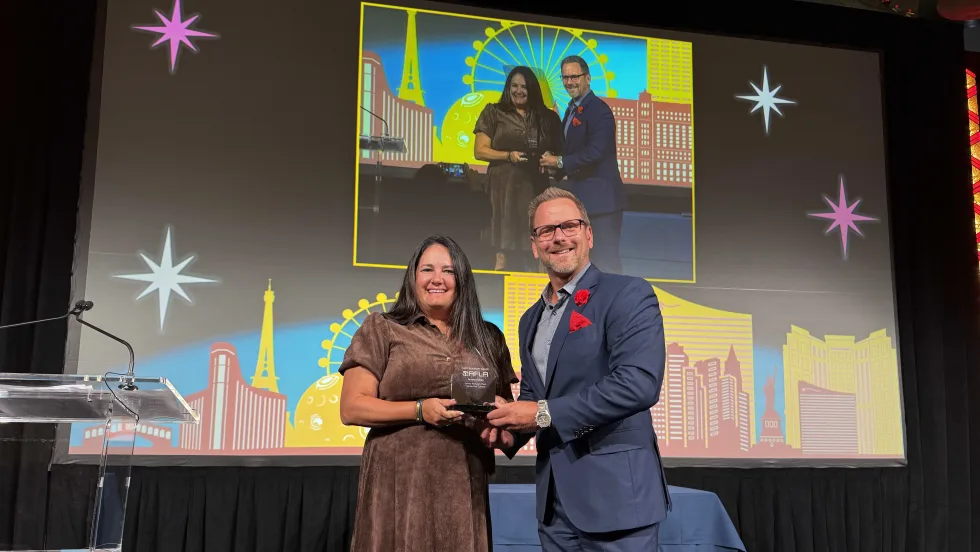
Jamie McKay Named the 2026 Fleet Visionary Award Winner
The Aptive Pest Control fleet manager was recognized for her approach to operations, data, lifecycle management, and driver needs.
Read More →
Fleet Forward Conference Introduces One-Day Passes for 2026
New one-day registration gives fleet professionals the flexibility to attend Tuesday, Wednesday, or Thursday, with passes available for $199 through Sept. 18.
Read More →
Vibe Coding: When Fleet Managers Become Software Builders
Five fleet professionals — none with programming skills — discuss how they’re using AI to build fleet solutions in-house and in a fraction of the time.
Read More →
Fleet Forward Conference Tackles Fleet Industry’s Growing Leadership Gap
This session will examine succession planning, knowledge transfer, and the skills the next generation of fleet leaders will need as veteran professionals leave the industry.
Read More →
2026 Fleet Manager of the Year Finalists Announced
Who are the 2026 Fleet Manager of the Year finalists?
Read More →
John Rossant to Deliver Opening Keynote at 2026 Fleet Forward Conference
The CoMotion founder will draw on developments across Europe, China, the Middle East, and other international markets to identify trends that could influence how U.S. fleets plan for the coming decade.
Read More →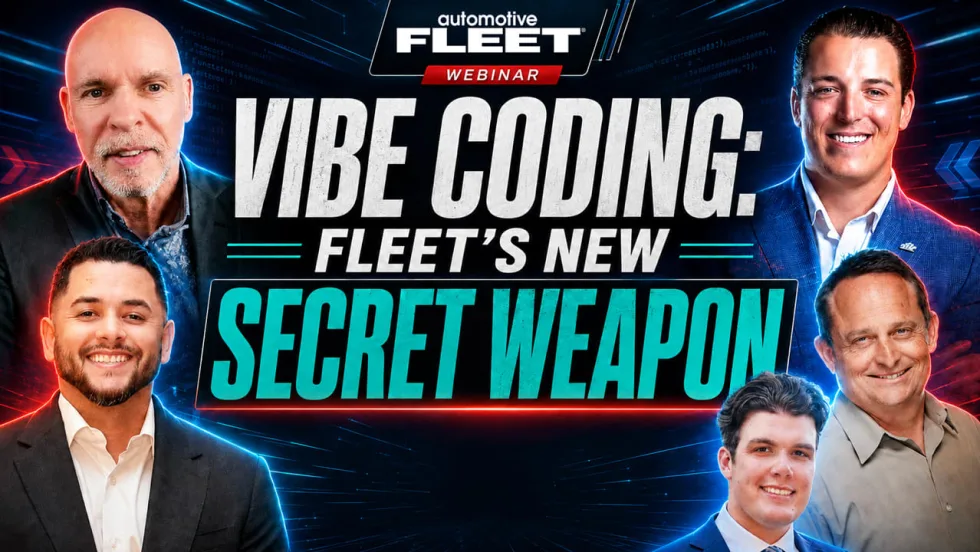
How to Build Custom Fleet Tools With AI and Vibe Coding [Webinar]
A new Automotive Fleet webinar explores how fleet managers are using AI and vibe coding to automate routine work and create simple operational tools without traditional programming skills.
Read More →