




An EV History Lesson for Overcoming EV’s Challenges Today
Electric vehicles’ short bout of success before gasoline engines became the mainstream gives us lessons for successful EV deployment in this new era.
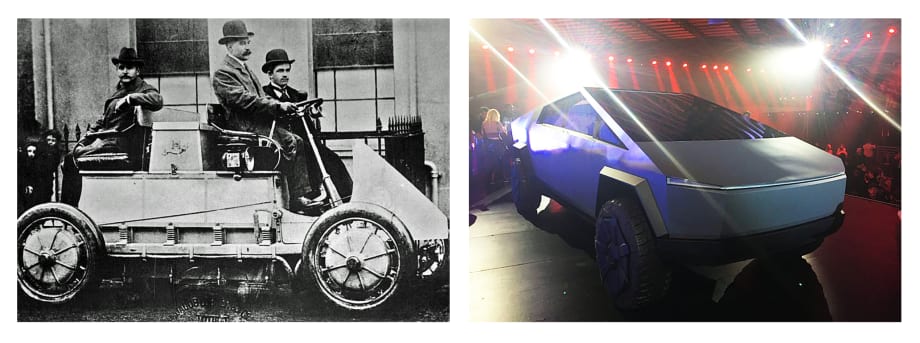
The old and the new: This all-electric Lohner-Porsche-Rennwagen from 1902 in Germany is juxtaposed with Tesla’s future Cybertruck model.
Photo via Wikimedia Commons/unknown author and Chris Brown.
While many of us would say electric vehicles (EVs) are a relatively new development, they actually first came on the scene in the early 1830’s. Interestingly, the internal combustion engine did not appear until 50 years after.
The original commercialization of EVs occurred in 1897. Back then, EVs had many advantages over their internal combustion engine (ICE) counterparts, many of which still hold true today: EVs produced no vibration, smell or noise and no gear changing was needed.
By the turn of the 20th century, more than a third of the cars in the U.S. were electric. This was possible after one of the major challenges of electric vehicles — the ability to charge them — was solved when many homes were wired for electricity.
What then caused electric vehicles to virtually disappear? As roads improved and cities were connected across the country, drivers demanded more range than could be provided by an EV. Importantly, the electric vehicle lacked the network of charging stations that could purpose it for long-range driving.
This gave an opportunity for ICE counterparts to fill that gap as gasoline companies built out fueling stations across the country, along with an extensive maintenance and repair network.
Driving ICE vehicles also became more cost effective, spurred by the discovery of oil in Texas which further reduced the price of gasoline. Mass production lines made the vehicles widely affordable, and the invention of the electric starter removed many operating hurdles in the ICE. These factors together helped propel gas and diesel mobility to its dominant role for most of the 20th century.
Challenges Today
Now fast forward to more recent times when focus on environmental issues and the impact of the oil and gas industry have re-introduced the appeal of electric vehicles. In the past two decades, a host of start-ups and corporations have invested in the development of EVs.
Even now, challenges are still abundant, many of which would be familiar to our historical counterparts: curtailing driver concerns about vehicle range, reducing battery cost and weight, and the need for more charging infrastructure. Early manufacturers reported high supply chain costs and difficulties in scaling that made it hard to produce EVs at a competitive price.
The good news for EV followers is that the economics are tipping in favor of electric.
Recent innovations in batteries, energy storage, and increased charging infrastructure penetration have led to increased viability of electric mobility. Along with a renewed focus on environmental responsibility and the development of near-zero and zero-emissions zones, these shifts will expedite the adoption of electric vehicles across consumer and commercial applications.
The lesson learned from history is that EVs extend way beyond just the vehicles themselves. Success of electric vehicles this time around will take a combined effort of vehicle manufacturers, battery suppliers, fleets, utilities, financiers, government and private organizations. This is no truer than in the commercial fleet space today.
Engage Early
Any fleet considering electric options should engage early with its local utility company to evaluate existing infrastructure and understand its charging needs.
Online resources like electrification planning calculators can help provide high level analysis of energy costs, infrastructure and environmental impact for individual fleets. These tools are available for anyone interested in learning more about EV total cost of ownership.
Fleets also need to be realistic about which applications are best suited for electric vehicles in the near term. Regional haul applications — 300 miles per day or less — could make the most sense to electrify first.
Also in this bucket are vehicles operating in an out-and-back model where they return to base at night and can be charged at the fleet location, employing smart charging software and services to manage energy and operations.
The success of electric vehicles will depend on vehicles that perform well, have a reasonable cost of operation, and having the infrastructure and charging network in place where the vehicles will be running.
The good news is science and technology have advanced tremendously since the advent of the first electric vehicle. We are already seeing and will continue to see EVs as a viable option for many fleets in the foreseeable future.
Joel Torr is head of business development and partnerships at Electriphi, a developer of software solutions and services for EV fleet and energy management.
Originally posted on Charged Fleet
More Global Fleet
GeoFencing Adds to Your Truck Security Arsenal
Geofencing is a familiar fleet tool today, but its early adoption marked a major shift in vehicle tracking, route monitoring, and the debate over employee privacy.
Read More →
Holman Takes Full Ownership of ARIZA in Mexico
Holman is bringing its Mexican fleet management operation fully under its own brand after more than 30 years as a joint venture. The change gives multinational fleet customers a single Holman operation across the U.S., Canada, and Mexico.
Read More →
5 Tire Maintenance Tips to Help Prevent Work Truck Downtime
Regular tire checks can do more than extend tread life. These five maintenance practices can help work truck fleets catch problems early, reduce costs, and prevent downtime.
Read More →

Proven Ways to Reduce Work Truck Downtime
The age-old problem of downtime will always be a reality, but with new strategies at hand, fleets have more ways to keep trucks on the road longer.
Read More →


Cameras, Safety and Insurance: From Reactive Claims to Real-Time Prevention (Part 2 of 2)
Part Two: Commercial auto remains one of the most challenging and costly lines of coverage for fleet operators and insurers alike. Continue learning more about how to effectively address these issues from Onur Aksan, Enterprise Business Development Executive, Geotab
Read More →
Cameras, Safety and Insurance: From Reactive Claims to Real-time Prevention
Commercial auto remains one of the most challenging and costly lines of coverage for fleet operators and insurers alike. Learn more about how to effectively address these issues from Onur Aksan, Enterprise Business Development Executive, Geotab.
Read More →
Fleet Costs Are Rising: Here’s How Leaders Are Responding
Fleet leaders are under pressure to reduce costs, adapt to economic uncertainty, and make smarter decisions. See how peers across North America are responding with real data, proven strategies, and forward-looking insights. Download the 2026 Market Pulse Report to benchmark your strategy and uncover where you can gain an edge.
Read More →
Enterprise Fleet Management Surpasses 900,000 Vehicles in U.S. & Canada
Enterprise Mobility connects with mobility solutions around the globe
Read More →