




Learn More: Caring for the Air System that Feeds Your Brakes
Air Dryer Cartridges: Insurance for Your Air System & the Components that Rely on It
Air dryer cartridges, and the air dryers that support them, play a key role in the truck’s operation.
by Chuck Brodie, ZF
February 22, 2021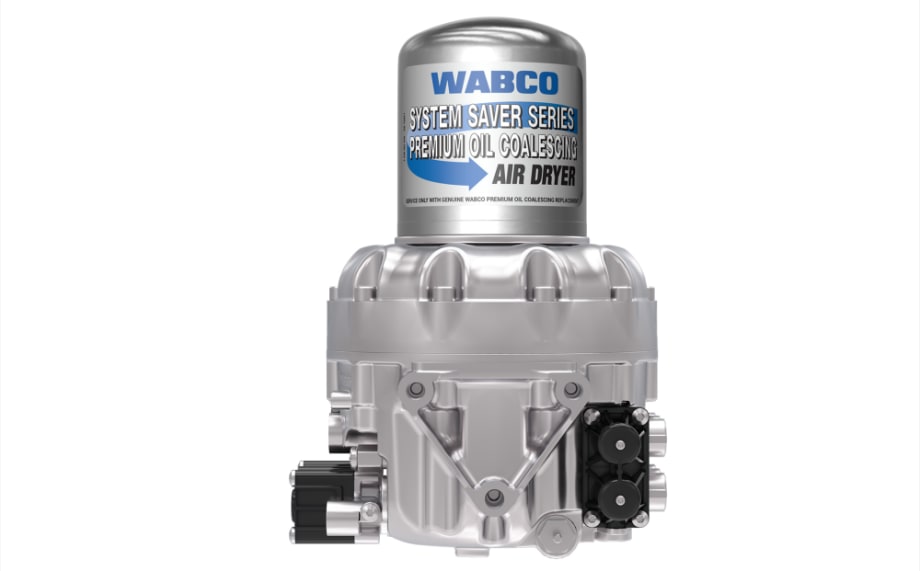
WABCO System Saver - Air Dryer 1200 plus air dryer with WABCO System Saver Series coalescing air dryer cartridge.
Photo: ZF
4 min to read
Anti-lock brakes and other components rely on the truck’s air system to properly perform. Air dryer cartridges, and the air dryers that support them, play a key role in the truck’s operation.
When air systems compress air, they also compress the moisture within that air. As the air cools, the moisture condenses and ends up as water in the system. Moisture is the enemy of an air system, where it can freeze, corrode, or damage valves, causing components to fail.
Unlike oil or fuel filters that screen out hard contaminants like metal shavings to keep them from entering the engine and causing damage, air dryer cartridges significantly reduce moisture from the air system, preventing it from reaching downstream components. Air dryer cartridges use desiccants, similar to those in the silica packets often tucked in consumer-packaged goods, to remove moisture from the air.
Air dryer cartridges come in two styles: coalescing, and standard or non-coalescing. Both styles use desiccants, but coalescing air dryer cartridges also contain a pad that resembles layered fabric that provides the added benefit of absorbing the small amount of oil that often enters the air system and prevents it from moving downstream where it can damage seals.
Coalescing or Non-Coalescing?
While standard air dryer cartridges are still used, coalescing cartridge use has steadily increased, especially as the popularity of automated manual transmissions has grown in late-model trucks. AMTs are especially sensitive to oil and moisture. In fact, using non-coalescing air dryer cartridges can void some AMT manufacturers’ warranties.
With coalescing cartridges providing the added protection against oil, why do some maintainers still use standard cartridges? Sometimes it’s because they don’t know the difference between the two, or they inadvertently grab the non-coalescing cartridge off the shelf. In other cases, with standard cartridges costing less than their coalescing equivalent, the choice is financial.
Cost is the only reason to use a standard cartridge. Keep in mind that a coalescing cartridge does not provide better moisture protection than a non-coalescing filter, but the added benefit of preventing small amounts of oil from moving downstream is worth the additional investment.
Pay More Now or Pay More Later
All air dryer cartridges are not created equal. Within the two air dryer cartridge styles there is a wide spectrum of options, from high-quality cartridges that use the best desiccants to low-cost budget cartridges that don’t.
With air systems, and the critical and often expensive components they support, air dryer cartridges are not the place to be thrifty. The risks of using the wrong or less expensive cartridge, or not changing the cartridge, range from unnecessary downtime to damaging the air system and the components that rely upon it. Saving a few bucks now costs a lot more later.
The best-case scenario when using a less expensive, low-grade air dryer cartridge is moisture passing downstream. Among other problems that creates is that moisture in a brake system can freeze, preventing air from passing though and not building up air pressure, thus creating a unit down issue.
The worst-cast scenario is much more troublesome: Desiccant in less expensive cartridges can degrade, leave the cartridge, move downstream and fill components, causing damage that requires repair or total component replacement.
When to Replace an Air Dryer Cartridge
In linehaul applications, coalescing air dryer cartridges can last one to two years while non-coalescing cartridges can last two to three years. Other applications can shorten cartridge life. As a general rule, follow the manufacturer’s recommended replacement intervals to get the best performance. In addition, replace the air dryer cartridge if you start seeing an increase in moisture in the wet tank.
Note that drivers and maintainers that see a sudden increase in moisture in the wet tank, or an increase in moisture short of the normally cartridge replacement time, often assume it’s a problem with the air dryer or cartridge. That may not be the case.
Dryers are designed to handle a certain amount of air. A misapplication of the vehicle that demands more air than the system was designed for, or a leak in the system, may cause air system demand that is higher than the dryer was designed for. A leak can be located and repaired, but a change in air demand may require an air system upgrade.
Some maintainers write the date on the air dryer cartridge when the install it, check the date during routine maintenance and replace the cartridge when it reaches or approaches its expected lifecycle. Others track the cartridge’s age on a maintenance log or simply replace it as part of every other preventive maintenance (PM) routine.
Selecting the Right Air Cartridge
Using the proper air dryer cartridge is very important. Use the cartridge from the same manufacturer that made the air dryer.
The air dryer is there to support the air dryer cartridge, so using the dryer and cartridge that were designed for each other ensures optimal performance.
About the Author: Chuck Brodie joined Wabco in 2011 and has held various positions in sales, service, and field training for the company. Wabco was acquired by ZF in May 2020 and renamed ZF’s Commercial Vehicle Controls Systems Division (CVCS).
Originally posted on Work Truck Online
Subscribe to Our Newsletter
More Global Fleet

GeoFencing Adds to Your Truck Security Arsenal
Geofencing is a familiar fleet tool today, but its early adoption marked a major shift in vehicle tracking, route monitoring, and the debate over employee privacy.
Read More →
Holman Takes Full Ownership of ARIZA in Mexico
Holman is bringing its Mexican fleet management operation fully under its own brand after more than 30 years as a joint venture. The change gives multinational fleet customers a single Holman operation across the U.S., Canada, and Mexico.
Read More →
5 Tire Maintenance Tips to Help Prevent Work Truck Downtime
Regular tire checks can do more than extend tread life. These five maintenance practices can help work truck fleets catch problems early, reduce costs, and prevent downtime.
Read More →

Proven Ways to Reduce Work Truck Downtime
The age-old problem of downtime will always be a reality, but with new strategies at hand, fleets have more ways to keep trucks on the road longer.
Read More →


Cameras, Safety and Insurance: From Reactive Claims to Real-Time Prevention (Part 2 of 2)
Part Two: Commercial auto remains one of the most challenging and costly lines of coverage for fleet operators and insurers alike. Continue learning more about how to effectively address these issues from Onur Aksan, Enterprise Business Development Executive, Geotab
Read More →
Cameras, Safety and Insurance: From Reactive Claims to Real-time Prevention
Commercial auto remains one of the most challenging and costly lines of coverage for fleet operators and insurers alike. Learn more about how to effectively address these issues from Onur Aksan, Enterprise Business Development Executive, Geotab.
Read More →
Fleet Costs Are Rising: Here’s How Leaders Are Responding
Fleet leaders are under pressure to reduce costs, adapt to economic uncertainty, and make smarter decisions. See how peers across North America are responding with real data, proven strategies, and forward-looking insights. Download the 2026 Market Pulse Report to benchmark your strategy and uncover where you can gain an edge.
Read More →
Enterprise Fleet Management Surpasses 900,000 Vehicles in U.S. & Canada
Enterprise Mobility connects with mobility solutions around the globe
Read More →