




8 Trends in Commercial Fleet Policies
The No. 1 priority for commercial fleets was risk and safety in 2015. The No. 2 priority was data management, whose dramatic spike in interest is attributed to the increased involvement by procurement and finance in fleet management.
Photo via iStockphoto.com.
Photo via iStockphoto.com.
Every two years, Element Financial’s fleet management business conducts a comprehensive policy survey among its client base to determine how companies manage their fleets, what’s most important to them, and to learn about the decisions they are facing. The survey data features insight from more than 130 clients, operating more than 151,000 total vehicles.
The survey included questions most often asked of Element employees and covered the following topics:
Fleet goals and priorities: The survey asked what are the top three goals for a fleet over the next 12-18 months. Fleet managers also shared their strategies for lowering costs or improving fleet programs.
Safety and accidents: Safety is an important priority for fleets. Survey respondents shared their practices around Snow Belt policies, motor vehicle record (MVR) checks, elements of their safety programs, training preferences, mobile phone use, and actions taken for violating safety policies.
Program management: In this section, fleet managers described their executive vehicle programs, reporting structure for fleet departments, vehicle selection (including treatment of driver paid options, drivetrain selections, which are the biggest influencers on vehicle selector), replacement parameters, and the resale process.
Business and personal use: Fleet managers shared who is permitted to drive a company-provided vehicle for personal reasons and how much companies typically charge for that perk.
Top Goals for Fleets
Source: Element
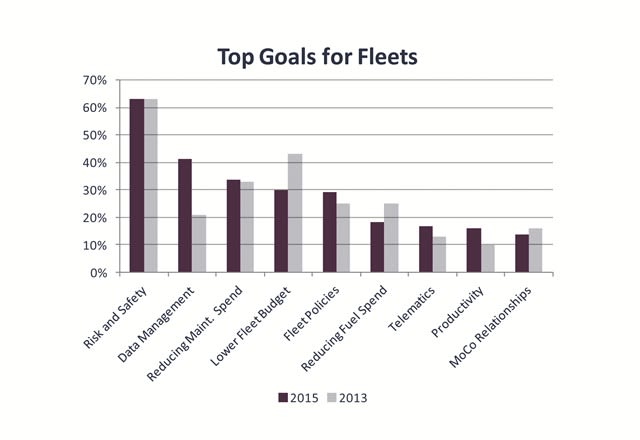
“Risk & Safety” continues to be the most often mentioned priority for most fleet managers. “Improving Data Management and Reporting” shot up to second place, most likely due to greater involvement by procurement and finance, and their reliance on data, in the fleet management function. In the 2013 survey, only 21% of respondents felt this was a top priority (spot No. 6 in 2013). Not surprisingly, “Concerns with Fuel Spend” decreased in popularity (No. 4 in 2013 to No. 6 in 2015) as fuel prices decreased at the end of 2014.
Top Strategies to Improve Fleet Program/Reduce Costs
Source: Element
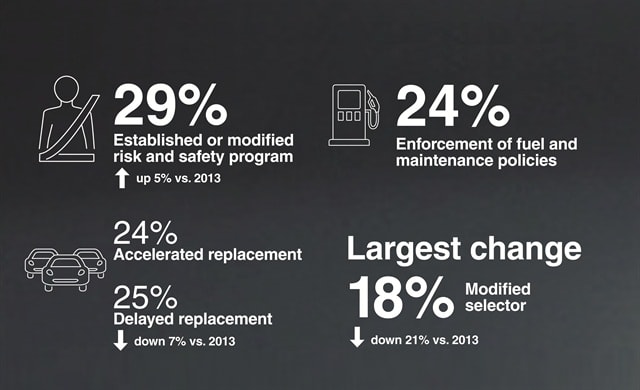
In 2015, 29% of fleet managers either established or modified a safety program in their fleets (up from No. 4 in 2013). Modifying the vehicle selector, which was the No. 1 cost-reduction strategy in 2013 (40%), fell to No. 5 in 2015 (18%). Depending on the situation, about a half of fleets either accelerated (24%) or delayed replacement (25%) of their vehicles. Fleet managers also increased their focus on enforcement of fuel and maintenance policies.
Departments to Whom Fleet Reports
Source: Element
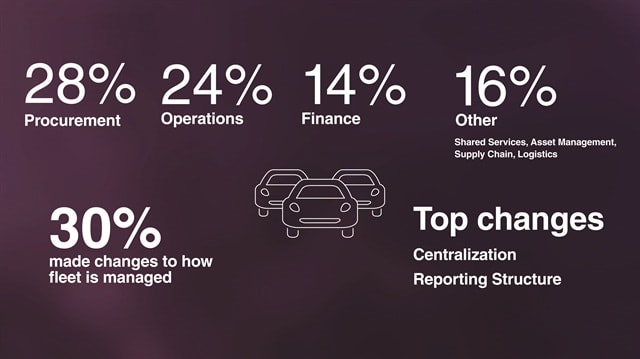
In the past 12 months, 30% of surveyed fleets made organizational changes. Most of these changes were related to centralization of fleet activities and changes in reporting structure. Fleets typically are part of the procurement department (28%), followed by operations (24%), finance (14%), human resources (6%), and facilities (5%). The remaining 16% of fleets were part of either shared services, asset management, supply chain, or logistics.
Personal Use
Source: Element
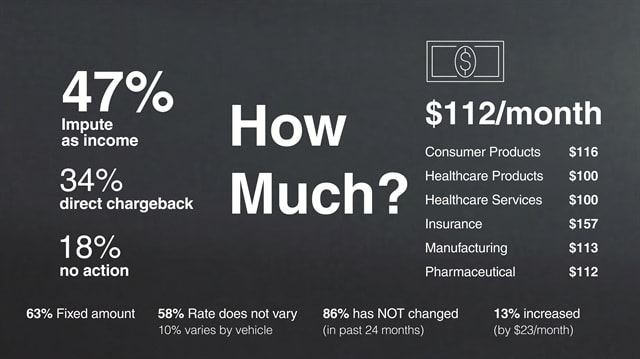
The overwhelming majority, 83%, of surveyed fleets allow their drivers to use company-provided vehicles for personal use. In addition, fleets allow drivers and their spouses (52% or 36% for domestic partners) to use a company provided vehicle. It is important to have a clearly defined and communicated personal-use policy as to who is eligible to drive a company vehicle. A risk-mitigation strategy restricts authorized usage of a company-provided vehicle to the employee.
However, this decision needs to be made based on the company’s corporate culture and commonly accepted industry practices and weighed against the potential risk. If use of the company-provided vehicle is allowed for other family members, motor vehicle record (MVR) checks should be performed on those authorized drivers. Fleets typically do not authorize family members under the age of 18 to utilize a company-provided vehicle.
Elements of a Safety Program
Source: Element
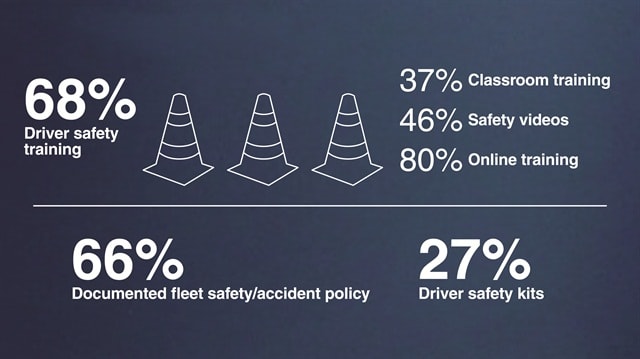
Of surveyed companies, 15% reported that they do not have any safety program. For those fleets that have a safety program, 68 percent offer driver safety training (80% use online training, followed by safety videos — 46%, and classroom training — 37%).
Of the fleets that have a safety program, 66% of them also have a documented safety and accident policy, and 27% offer driver safety kits. There are myriad methods used by companies to ensure that drivers understand the importance of safety. These range from awareness programs, online training and distributing safety handbooks to driver in-class and on-road training.
It’s important to build a program with both proactive (tips and trainings to avoid accidents with all drivers) and reactive components (specialized training, targeting certain behaviors for higher risk drivers based on different types of accidents or violations identified as part of driver MVR review).
Most Popular Actions for Offenses
Source: Element
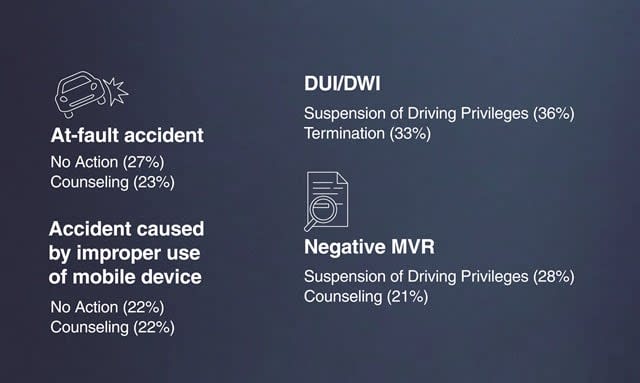
The fleet policy survey also gathered data regarding most popular actions taken against drivers responsible for some of the most common infractions and violations of policy. All levels of management within an organization must commit to making a culture of safety a priority.
Consider forming a safety committee that would be responsible for making decisions on policy changes/updates, policy interpretation, disciplinary actions (when needed) and conflict resolution. This committee typically consists of managers from business areas including safety, risk, human resources, fleet, and loss control. Taking this step will show drivers that the company has a strong stance on safety and it will take the burden of “making tough decisions” — such as suspending driving privileges or making drivers pay for behind-the-wheel training — off the fleet manager and place it on the company.
Factory-Installed Safety Options
Source: Element
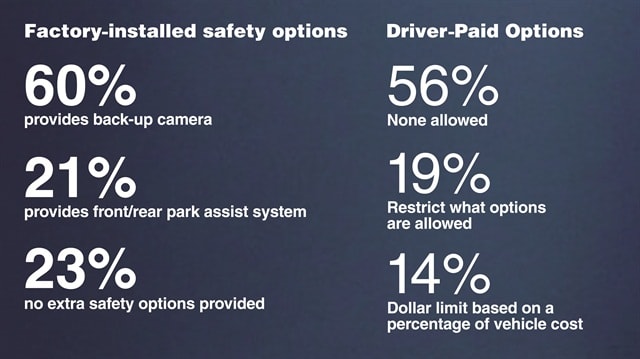
In 2014, NHTSA issued a rule that by May 2018, 100% of vehicles should have back-up cameras installed. NHTSA estimates that 78% of vehicles will have cameras installed voluntarily before the due date. Based on Element’s Policy Survey, 60% of fleets already provide back-up cameras to their drivers. Distant second, in terms of voluntarily installed safety equipment, is front/rear park assist system (with 21% of fleets offering that option), and blind spot monitoring systems are the third most popular safety equipment (15%). But 23% of fleets, do not provide any additional safety options.
Of the surveyed fleets, 56% do not allow any driver-paid options to be added to their selectors. Approximately 19% of fleets have a limited list of extra factory-installed equipment, which drivers may purchase at their own expense, permitted these options have a positive impact on the resale of the vehicle. About 14% of the surveyed fleets have instituted a dollar limit based on a percentage of vehicle cost.
Telematics Use
Source: Element
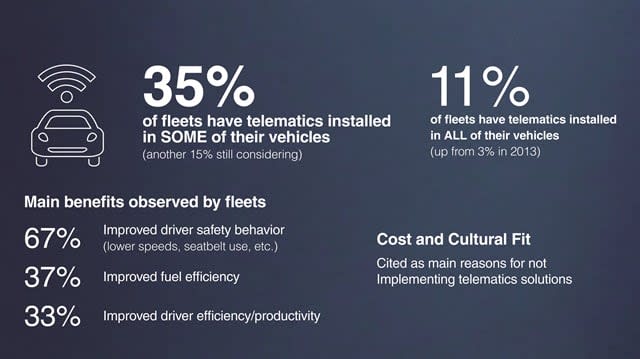
Approximately, 35% of the surveyed fleets have telematics devices installed in some of their vehicles (with 11% installed in all of their vehicles). The biggest benefit noticed by fleet managers is an improvement in driver safety behavior, followed by improved fuel efficiency and productivity. As with any new technology, “cost” and “cultural fit” are cited as main reasons for fleets that resist telematics solutions.
Here are three tips on how to gain internal buy-in to implement a telematics solution:
Concentrate on quick wins first: Fleet managers often focus on risk, safety, and fuel savings as projects that earn organizational support and deliver quick payback.
Leverage insight from quick wins to advance: Use quick wins as the springboard to gain valuable insights needed to advance to operational efficiencies.
Don’t over engineer the solution: The key to getting organizational buy-in for telematics is to keep objectives simple and manageable.
Editor's note: Marcin Michno is project manager of strategic consulting at Element’s fleet management business. He can be reached at mmichno@elementcorp.com.
More Safety

What’s Next for Fleet? Safety, AI & Industry Recognition | AF News Recap
Could your company's culture be encouraging distracted driving? This week, we're exploring how workplace expectations affect driver safety, what AI, EVs, and autonomous vehicles could mean for the future of fleet management, and how fleet professionals can strengthen their award nominations.
Read More →
Does Your Fleet's Culture Encourage Distracted Driving?
What happens when the people responsible for enforcing safety rules are the ones setting the wrong example? The answer may reveal why some of the biggest risks to fleet drivers have little to do with what's written in the employee handbook.
Read More →
Fleet Manager’s Ultimate Playbook: Navigating the New Standard in OEM Connectivity
Rising operating costs, driver safety concerns, and unplanned downtime are putting unprecedented pressure on modern fleets. Discover how fleet managers use embedded OEM connectivity and real-time vehicle data to cut TCO, prevent downtime, and protect drivers without aftermarket telematics hardware.
Read More →
From Driver Well-Being to EV Charging | AF News Recap
Mental health belongs in the fleet safety conversation. This week, we’re looking at five ways fleets can support employee well-being before a crisis, plus Holman’s expansion in Mexico, new one-day Fleet Forward passes, and why EV charging demand is outpacing infrastructure growth.
Read More →
Nexar-Nauto Merger Aims to Give Fleets Better Safety Intelligence Through Larger Driving Dataset
Stefan Heck tells Automotive Fleet that combining more than 10 billion miles of driving history with Nexar's AI models will give fleets deeper insights into driver risk and roadway conditions than either company could provide independently.
Read More →
Don't Wait for a Crisis: 5 Ways to Build Mental Health Into Your Fleet Safety Program
For Suicide Prevention Month, fleet and safety leaders have an opportunity to put mental health where it belongs: at the center of workplace safety.
Read More →
How Camera Data Can Strengthen a Fleet’s Insurance Renewal
Insights from a commercial insurance carrier and a broker show how fleets can turn video telematic data, driver coaching, and improved claims results into a stronger case at insurance renewal.
Read More →
The Safest Fleets Aren’t the Ones with the Most Technology
You’ve made the telematics investment. Here’s how to capture the other half of its value and build the safest fleet on the road.
Read More →
Hidden in Plain Sight: Fleet Compliance Risks
Fleet compliance isn't just about having policies — it's about consistently enforcing them. This practical guide reveals six hidden compliance risks common in public sector and shared fleet operations and outlines proven strategies to improve visibility, accountability, and audit readiness
Read More →
NETS Sets 2026 Fleet Safety Benchmark Conference for Indianapolis
The Sept. 15–17 program will feature fleet benchmarking data, case studies, emerging technologies, and implementation strategies while running alongside the NSC Safety Congress & Expo.
Read More →