Despite standard high-tech safety features, accident rates and severity are up – and so is the cost to repair them.
Jordan Wiklund・Former Senior Editor
May 18, 2022
The average soft cost of repairing a vehicle (plus parts and labor) was over $5,000 for many survey respondents.
Photo by Taras Makarenko from Pexels
7 min to read
It’s a cold, bleary day in Columbus, Ohio, and I’m atop a bar stool at Moran’s at a happy hour hosted by Fleet Response. I’ve quite literally stumbled into a conversation about – what else? – fleet safety and distracted driving as a gaggle of other fleet professionals bump elbows with friends and colleagues and try the chicken wings and local hazy IPA.
Ad Loading...
The irony is not lost on me; it is April and Distracted Driving Awareness month, after all. Good thing I walked.
Ad Loading...
“Every 10 miles per hour above 50, your chances of dying doubles,” says Phil Moser, vice president of customer development at Driving Dynamics. He’s chatting with Jeff Gates, regional sales manager at Fleet Response. I came looking for Jeff Fender (vice president of sales and marketing at Fleet Response) and stumbled upon the exact sort of intel I had hoped to find. The conversation pinballs around as the wind blows outside, and as more fleet professionals arrive to Moran’s, the clamor of the bar goes up. I lean in a bit more.
Moser says the pandemic created (or at worst, helped perpetuate) a mental health crisis as families were forced to change every aspect of their daily lives. Casual drinking and drug use accelerated, and as cars disappeared off the roads, so too did reasonable driving habits. Average speed increased. Moser was reminded of the debut of antilock brakes, which were supposed to prevent more accidents.
Instead, vehicular deaths went up. Gates mentions the documentary The Social Dilemma, and Moser mimics hurling his phone past the bar and out onto Vine Street, just north of the convention center where the annual National Association of Fleet Administrators (NAFA) convention is being held.
Moser is an ex-cop who used to recreate accidents after steel met steel on the road. His is a history of crumpled hoods, broken glass, and the lives of those involved destroyed or at least derailed by trauma. It’s dramatic, but it’s true, and it helps account for the statistics and decades-long histories of accidents, technology, and distracted driving stories he’s able to reel off the top of his head.
“Driving is a diminishable skill,” he says, “and the use of electronics is addicting! It’s not rocket science; drivers need to turn their devices off and keep their wits about them.”
Ad Loading...
“I began riding a road bike several years ago, and it made me such a more self-aware driver,” I say, “I think people who handle two wheels know what they’re doing on four.”
Yes, they both say. When you feel vulnerable, you develop a broader understanding of the road around you and are more prone to practice what you preach (and want to see) atop the road when you’re out there with nothing but a helmet and a prayer.
It feels like a small victory, mostly because it’s true.
Håll dig till Höger, Svensson!
(Stick to the Right, Svensson!)
The greatest automotive infrastructure story ever told (or at the very least, my favorite) occurred when Sweden changed from left-hand driving to right-hand driving overnight during H-Day in 1967.
Swedes were dying in automotive accidents at alarming rates compared to their northern neighbors when traveling abroad and the government finally decided to simply overrule the people in the name of safety. As reported by Bo Holmström, “the Swedish Tom Brokaw,” “It was great fun; there were very few cars out in Stockholm that night!”
When the sun rose on September 3rd, 1967, many Swedes who had driven one way to work for decades had no idea how to navigate the new roadscape to the places most familiar to them. On-ramps became off-ramps. Street signs had to be reversed and switched to the fresh dirt on the other side of the new-look roadway.
Check out the incredible story of H-Day and the 1967 national Swedish lane swap at the 99% Invisible, linked here. The 15-minute podcast is delightful and worth your time.
The New Blind Spot is Inside the Vehicle
I had spoken to Jeff Fender a few days via phone before the conference started. Fender explains that Fleet Response manages vehicular claims from larger automotive clients from cradle to grave and helps provide data and driving management tools and strategies to mitigate risks and increase safety. Our conversation jackknifed from why do people suck at driving? to the overall increase in repair cycle times and ballooning parts and labor costs due to the technician and supply shortages.
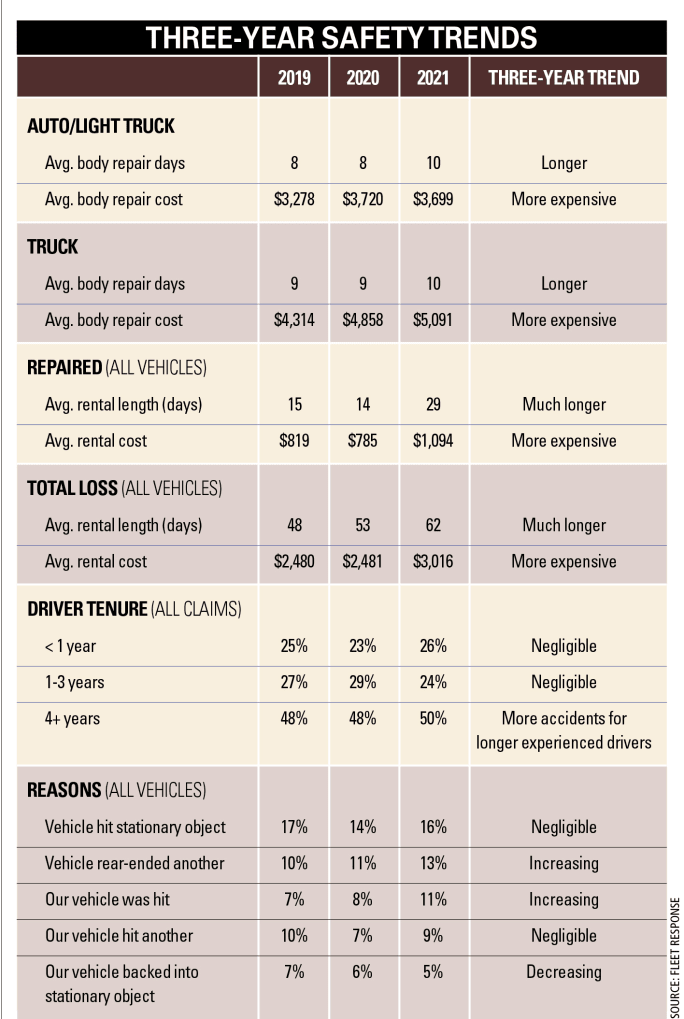
Three-year data from Fleet Response corrobates this year's fleet safety survey (and what most managers already know) - that prices are climbing.
Automotive Fleet
“Claim volume dropped about 50% in the first 3-4 months of COVID,” he says.
Ad Loading...
“The bottom fell out. People quit driving. Body and repair shops began laying people off, adding to the labor shortage. Jobs came up but shops didn’t have employees to match their efficiencies, so repair times increased. Then the supply chain issue exacerbated the problem, so as staffing came back, parts disappeared or were unavailable.”
Like Moser, Fender reiterated that drivers developed poor habits and accidents increased when the road began to more look like a speedway. Average speeds increased 7-10 mph faster than usual well above the posted limit. Sixty to 74 mph became 80 mph. It was the Drive to Survive Syndrome from Netflix made manifest on the urban and suburban streets across America.
“Drivers are beginning to ignore safety features,” he says.
“Car alarms used to be aftermarket conveniences. Now no one pays attention to them – they don’t even register. Is a car being stolen? Is it mine? Who cares? They don’t function as they’re intended because they’re ubiquitous. Newer vehicles equipped with lane departure warning systems that cause the driver’s seat to vibrate are being ignored or simply turned off.”
At the same time, Fender says people have become more reliant on cameras. Many don’t turn around and look out their windows, they simply stare at the camera or zone out and wait for a beep. Many times, they’re too late. They don’t look when switching lanes at 70 mph and find their blind spot is inconveniently occupied by a 5,000-pound vehicle.
Ad Loading...
“Right,” he says, “routine behaviors practiced while learning to drive are being undermined by technology. No one knows how to get where they’re going even though they’ve driven there before. Technology is great, but it’s adding to distraction. Even good music on a beautiful day is enough to miss your exit or forget where you’re going.”
As someone hitting his stride in dad-rock 20 years after high school, this point also hits home; I sometimes miss my turn by a block or two, especially since my family moved to the suburbs last September. It’s not a good look.
The Gamification of Fleet Safety
Before the conference, I also spoke with Heather Brown, commercial safety lead at The CEI Group. The CEI Group provides scalable tools and training to reduce accidents and improve driving.
I was curious if all the technology and telematics available is almost too much of a good thing for fleet managers and drivers; in other words, when do the available tools begin overtaking the common sense of driving (if at all?).
“While driver adoption of safety technology is high, there is some pushback from drivers on certain tech that’s out there, but that usually diminishes with proper communication to driver and training on the technology. Overall there are great opportunities for fleets, drivers, and managers to be safer,” she says.
Ad Loading...
Brown describes a new mobile safety solution and tool available from CEI called DriverCare CoPilot, which helps drivers self-manage their behaviors.
Three-year data from Fleet Response corrobates this year's fleet safety survey (and what most managers already know) - that prices are climbing.
Automotive Fleet
“It increases their awareness on the road and fosters friendly intrateam ‘competition’ to achieve high driver ratings,” she says. “Our team tested that product personally and considered ourselves safe drivers, and most of us were surprised by the scores we received; it increased our awareness of our own driving and assumptions about driving. It helped us focus on the road and was an eye-opening experience for the team.”
Brown says that like many drivers (this author included), the temptation to use the phone is ever present, but seeing her score and the impact on her own safety changed the way she approaches mobility.
“I don’t look at my phone when I drive anymore at all,” she says. “Though I didn’t text and drive there were other phone functions I used that had become such a habit. Another team member was speeding much more than they realized. Everyone fell victim to something they would have attested ‘no, not me’ to, and it confirmed our belief that the product could really change driver behavior.”
Brown says their team conversations today still include discussion about how each is doing with their driving behaviors.
Ad Loading...
“Our team huddles still begin with sharing tips that help us become better drivers. Just today our admitted speeder said he scored a perfect score for speeding by using his adaptive cruise control on a trip; it was the perfect blend of two pieces of safety tech that got our teammate home safely.
Brown has seen that if drivers have an opportunity to self-correct, they will, taking ownership of it themselves.
“Arming them with that information is valuable; we have found most drivers will self-correct if given the chance. And while violating fleet policies must have consequences, technology such as DriverCare CoPilot can help drivers change before they violate policies, or worse.
In other words, granting agency is empowering; it always has been.
“No one wants to be in an accident,” she says. “Managers want drivers to remain safe and accident-free on the roads. Drivers want to get home to their families at the end of the day. Their methods may be different, but the goals remain the same.”
Rising operating costs, driver safety concerns, and unplanned downtime are putting unprecedented pressure on modern fleets. Discover how fleet managers use embedded OEM connectivity and real-time vehicle data to cut TCO, prevent downtime, and protect drivers without aftermarket telematics hardware.
Mental health belongs in the fleet safety conversation. This week, we’re looking at five ways fleets can support employee well-being before a crisis, plus Holman’s expansion in Mexico, new one-day Fleet Forward passes, and why EV charging demand is outpacing infrastructure growth.
Stefan Heck tells Automotive Fleet that combining more than 10 billion miles of driving history with Nexar's AI models will give fleets deeper insights into driver risk and roadway conditions than either company could provide independently.
Insights from a commercial insurance carrier and a broker show how fleets can turn video telematic data, driver coaching, and improved claims results into a stronger case at insurance renewal.
Fleet compliance isn't just about having policies — it's about consistently enforcing them. This practical guide reveals six hidden compliance risks common in public sector and shared fleet operations and outlines proven strategies to improve visibility, accountability, and audit readiness
The Sept. 15–17 program will feature fleet benchmarking data, case studies, emerging technologies, and implementation strategies while running alongside the NSC Safety Congress & Expo.