


At a Glance
The Chevrolet Silverado 1500 was named Fleet Truck of the Year. It’s features include:
Fleet OnStar telematics vehicle data reporting.
A max payload of up to 2,250 lbs.
Three EcoTec3 engines.
 MENU
MENU SEARCH
The Silverado is available fleet specific-packages, including the Work Truck Convenience Package, the LT Fleet Convenience Package, and the LT Fleet Plus Package.


Photo courtesy of Chevrolet.
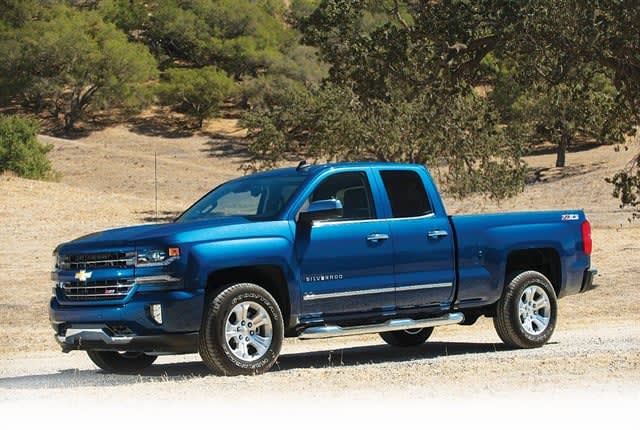
Photo courtesy of Chevrolet.
The Chevrolet Silverado 1500 has been named the 2017 Fleet Truck of the year. This is the second time the light-duty truck has been honored with the annual Automotive Fleet and Business Fleet award.
“Being recognized twice as Fleet Truck of the Year is a great accomplishment — it means we’re really delivering a Silverado that speaks to our customers’ needs,” said Ed Peper, U.S. vice president, GM Fleet. “The Silverados are designed to keep maintenance and fuel costs low, especially in real world driving when the trucks are loaded and being worked hard. Silverados are also known for their reliable powertrains, backed by our 5/100 warranty, and our durable steel bodies.”
Placing at No.1 out of a ballot of 39 trucks this year, since last being selected as the Fleet Truck of the Year in 2013 the Silverado 1500 has undergone many changes. And it’s these changes that have resonated with fleets and has ultimately earned its spot as truck of the year once again.
Indeed, the Silverado 1500 was recently given a mid-cycle refresh, which included an expanded use of eight-speed transmissions and support for Apple CarPlay and Android Auto.
“The Silverado 1500 is a vehicle fleets want to drive,” said Peper. “Drivers appreciate the efficiency features, from exceptionally quiet and comfortable ride to features like Apple CarPlay and Android Auto, standard Bluetooth and available Onstar 4G LTE Wi-Fi.”
Fleets have several choices in configurations that best suit their needs, which include regular, double or crew cab configurations, with a choice of 2WD or 4WD.
Under the hood of the Silverado 1500 are three available EcoTec3 engines.
These are a 4.3L V-6 SAE-certified with 285 hp and 305 lb.-ft. of torque, a 5.3L V-8 certified with 355 hp and 383 lb.-ft. of torque, and a 6.2L V-8 which offers 420 hp and 460 lb.-ft. of torque. Since the 2016 MY, the 5.3L V-8 has featured optional eAssist, which is a mild-hybrid system that delivers up to a 13% improvement in fuel efficiency.
The 4.3L and 5.3L engines come standard with a six-speed automatic transmission while an 8-speed transmission is standard with the 6.2L and available with the 5.3L.
Available trim levels include: WT (Work Truck), LS, Custom, LT, LTZ, and High Country.
Since it last won the Fleet Truck of the Year, the Silverado has continued to improve elements that are important to fleets, including improved towing capabilities.
Indeed, when equipped with the 6.2L V-8, it has a max towing capacity of 12,500 lbs., a 1,000 lb. improvement over its max offering in 2013. Also, in terms of towing, StabiliTrak with Trailer Sway Control technology helps prevent swaying trailers, and Hill Start Assist, gives drivers extra time to switch from braking to acceleration without rolling back under certain conditions.
Its payload capabilities also make it an ideal fleet asset, with up to 2,250 lbs. of maximum payload. In addition, the truck features 5-foot-8-inch, 6-foot-6-inch, and 8-foot beds, and an available EZ Lift and Lower Tailgate, which is an internal torsion bar that reduces the effort to raise and lower the tailgate.
The Silverado 1500 can also be ordered with fleet specific packages. Fleet managers can consider the packages when looking to for the best options for their operations.
Indeed, a Fleet Convenience Package that is available for the for the WT trim includes outside, heated power mirrors, a remote locking tailgate, keyless entry, and power windows.
Meanwhile, a LT Fleet Convenience Package includes a 10-way driver’s seat with bench seat, LED front fog lamps, rear-window defogger and 110-volt power outlet. Crew cab and double cab also include dual-zone climate control in the package. Also for the LT trim, the LT Fleet Plus Package includes universal home remote, power adjustable pedals, rear sliding window and rear window defogger.
Other notable features that are available on the 1500 include utility options such as an industry exclusive box delete option, under-rail LED cargo lighting, and a CornerStep rear bumper.
As always safety is a key focus for the Silverado as much as it does for fleet managers. Indeed, the Silverado 1500 can also be ordered with a Safety Belt Assurance System, which prevents the vehicle from being shifted out of park until the driver seat belt is fastened. Ten standard air bags and rear-view cameras are also now available across every model.
Speaking of cameras, Silverado’s EchoMaster Trailering Camera System adds up to four cameras to help eliminate blind spots and enhance the driver’s ability to line up his or her trailer and hitch when backing up.
As the world becomes more connected to technology, so do vehicles, and the Silverado 1500 is no exception.
Indeed, available connectivity features include Fleet OnStar telematics vehicle data reporting, with plans that include, but aren’t limited to, Automatic Crash Response, On Demand Vehicle Diagnostics, and Stolen Vehicle Assistance.
General Motors also has three fleet telematics solutions for fleets to consider: including Telogis Fleet for GM, Spireon’s FleetLocate, and GM’s proprietary Commercial Link tool. All offer web-based fleet management solutions to monitor vehicle and driver performance and use GM’s OnStar in-vehicle hardware.
Also available is an OnStar 4G LTE Wi-Fi Hotspot plan for fleet managers. Available Chevrolet MyLink connectivity allows drivers to organize and integrate their smartphones with their dashboard.
Clearly, the 2016 refresh was good because the 2016 Chevrolet Silverado 1500 was awarded the “Highest Ranked Large Light Duty Pickup in Initial Quality, Two Years in a Row” by J.D. Power, not to mention earning “Most-awarded commercial pickup truck in America” by Vincentric.
Buying fleet management software in 2027 means looking beyond features and price. As fleet operations, technology and expectations evolve, this guide explores what today’s fleet professionals should consider when choosing a system that can deliver value now and adapt to what comes next.
Read More →
EVs, AI, and autonomous vehicles are reshaping fleet management. Discover what’s ahead—and how fleet leaders can prepare for the next era.
Read More →
Here's how the technician shortage has affected uptime for fleets, and what to do about it.
Read More →
Neology’s neoFleet platform will manage toll transactions and toll-authority operations for vehicles across Avis, Budget, Payless, Budget Truck and Zipcar.
Read More →
Nearly eight in 10 surveyed fleets allow personal use of company vehicles, while just over half of respondents report charging employees for the privilege.
Read More →
Could developments overseas offer a preview of what’s coming for U.S. fleets? This week, we’re looking at the future of AI, autonomy, and electrification, plus Ford Pro’s new certified pre-owned program, smarter vehicle offboarding, and a new way for fleets to manage toll expenses.
Read More →
What do fleet managers need to do when a driver leaves?
Read More →
Rising operating costs, driver safety concerns, and unplanned downtime are putting unprecedented pressure on modern fleets. Discover how fleet managers use embedded OEM connectivity and real-time vehicle data to cut TCO, prevent downtime, and protect drivers without aftermarket telematics hardware.
Read More →
The integration allows U.S. Bank Voyager fleet customers to manage toll payments and violations alongside fuel, EV charging and maintenance expenses.
Read More →
ADAS-equipped vehicles may crash less often, but they can cost more when they do. This week, we’re breaking down what that tradeoff means for fleets, plus Subaru’s first Forester Wilderness Hybrid, Nissan’s new e-POWER Rogue, and why Calstart has become Catalyst Mobility.
Read More →