




2015 Mercedes-Benz Vehicle Showcase
Mercedes-Benz USA's 2015 model-year vehicles are more fuel efficient for the fleet executive and friendly to the environment.

Photo of 2015 GLA Class courtesy of MBUSA.

Photo of 2015 GLA Class courtesy of MBUSA.
Mercedes-Benz USA's 2015 model-year vehicles are more fuel efficient for the fleet executive and friendly to the environment.
2015 GLA-Class
All-new for the 2015 model-year and the first Mercedes-Benz vehicle in the fast-growing compact SUV segment is the GLA250 4MATIC and GLA45 AMG 4MATIC.
The 2015 GLA-Class is the first Mercedes-Benz SUV to be available with the new-generation all-wheel-drive system 4MATIC, with fully variable torque distribution. Featuring a 2.0L four-cylinder engine with turbocharging and direct injection, as well as an ECO start/stop function standard, the GLA250 4MATIC generates 208 hp and 258 lb.-ft. of torque. The engine is mated to a 7-speed dual-clutch automatic transmission.
The 2015 GLA250 4MATIC and GLA45 AMG 4MATIC will arrive in U.S. showrooms in fall of 2014. A front-wheel-drive model will be available in the U.S. in spring of 2015.
Standard Engine: GLA250 4MATIC - 2.0L, turbocharged four-cylinder, 208 hp, 258 lb.-ft. of torque; GLA45 AMG 4MATIC - 2.0L turbocharged in-line four-cylinder, 355 hp, 332 lb.-ft. of torque
Transmission/Drive: 7-speed dual clutch automatic
Wheelbase (in.): 106.3
Overall Length (in.): 173.9
Overall Width (in.): 71.0
Overall Height (in.): 60.0
Cargo Space (cu. ft.): 14.9
Fuel Tank Capacity (gallons): 14.8
EPA Fuel Economy (city/highway): 25/36 (Est.)
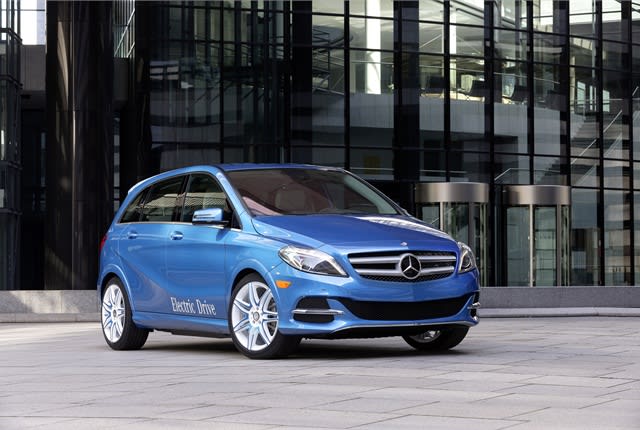
Photo of 2015 B-Class Electric Drive courtesy of MBUSA.
2015 B-Class Electric Drive
Based on the conventionally powered B-Class currently sold overseas, this zero-emissions variant boasts an advanced electric motor that delivers 174 hp with a maximum torque of 251 lb.-ft. and a range of up to 115 emission-free miles on a single charge.
The lithium-ion battery is accommodated in the "Energy Space" in the vehicle's underfloor for added crash protection. In addition, the vehicle is equipped with Collision Prevention Assist with Adaptive Brake Assist as standard. Additional available safety systems include Blind Spot Assist, Lane Keeping Assist, and Active Park Assist.
Available starting summer 2014 at authorized Mercedes-Benz dealers in select states, with nationwide sales in early 2015.
Standard Engine: Electric motor, front-wheel drive, 174 hp, 251 lb.-ft. of torque
Driving Range: 115 miles
0-60 mph: Less than 8 seconds
Charging Time: Range of about 60 miles in less than two hours; full charge in less than four hours with a 240v/40 amp power source
Wheelbase (in.): 106.3
Overall Length (in.): 171.6
Overall Width (in.): 70.3
Overall Height (in.): 61.3
Cargo Space (cu. ft.): 17.2
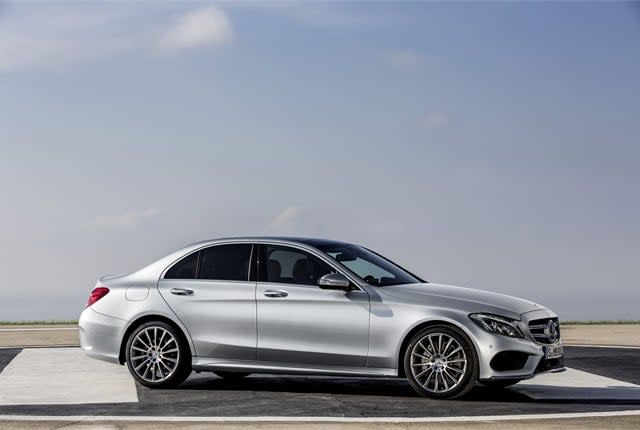
Photo of 2015 C-Class courtesy of MBUSA.
2015 C-Class
The top-selling model for Mercedes-Benz, the C-Class, is all-new for the 2015 model-year. It's 3.7-inches longer, 1.7-inches wider, and almost 220-pounds lighter than its predecessor — while improving fuel economy by 20 percent.
The C300 4MATIC features a 2.0L turbocharged direct injection in-line four-cylinder engine and the C400 4MATIC comes with a 3.0L turbocharged direct injection V-6. Engine output on the C300 4MATIC is 241 hp and 273 lb.-ft. of torque, while the C400 4MATIC produces 329 hp and 354 lb.-ft. of torque. A C63 AMG high-performance version will become available in early 2015.
The 4MATIC permanent all-wheel-drive system serves to improve traction and driving stability, while a newly designed four-link front axle plays a major part in the vehicle's agile handling characteristics.
Standard Engine: C300 4MATIC - 2.0L turbocharged in-line four-cylinder, 241 hp, 273 lb.-ft. of torque; C400 4MATIC - 3.0L turbocharged V-6, 329 hp, 354 lb.-ft. of torque
Transmission/Drive: 7G-TRONIC PLUS automatic transmission
Wheelbase (in.): 111.8
Overall Length (in.): 184.5
Overall Width (in.): 71.3
Overall Height (in.): 56.8
Cargo Space (cu. ft.): 17.0
Fuel Tank Capacity (gallons): 18.0
EPA Fuel Economy (city/highway/combined): TBA

Photo of 2015 smart courtesy of MBUSA.
2015 smart
The lineup of smart cars includes the pure coupe, passion coupe, passion cabriolet, and electric drive. The gasoline models all achieve 34 mpg city/38 mpg highway, while the electric drive model achieves 122 mpg city/93 mpg highway.
The pure coupe features a solid roof, while the passion coupe features a panoramic roof, and the passion cabriolet features an automatic convertible top with glass rear window. The electric drive is available in both coupe and cabriolet versions as well.
All models feature a tridion safety cell, an electronic stability program (ESP) with hill start assist, anti-lock braking system with electronic brake force distribution, and a number of additional power and comfort option packages.
Standard Engine: Gasoline - 1.0L in-line three-cylinder engine, 70 hp, 68 lb.-ft. of torque; Electric Motor - 74 hp, 96 lb.-ft. of torque
Transmission/Drive: Gasoline: smartshift 5-speed automated manual transmission; Electric: automatic transmission
Wheelbase (in.): 73.5
Overall Length (in.): 106.1
Overall Width (in.): 61.38
Overall Height (in.): 60.71
Cargo Space (cu. ft.): 7.8
Fuel Tank Capacity (gallons): 8.7
EPA Fuel Economy (city/highway): Gasoline: 34/38; Electric 122/93
More Operations

How Fleets Can Recruit and Train Veterans for Technician Roles
Here's how the technician shortage has affected uptime for fleets, and what to do about it.
Read More →
Avis Budget Group Deploys Neology Toll Management Technology Across Major Brands
Neology’s neoFleet platform will manage toll transactions and toll-authority operations for vehicles across Avis, Budget, Payless, Budget Truck and Zipcar.
Read More →
Fleet Personal-Use Charges Edge Higher in 2026
Nearly eight in 10 surveyed fleets allow personal use of company vehicles, while just over half of respondents report charging employees for the privilege.
Read More →
The Future of Fleet + What’s Changing Right Now | AF News Recap
Could developments overseas offer a preview of what’s coming for U.S. fleets? This week, we’re looking at the future of AI, autonomy, and electrification, plus Ford Pro’s new certified pre-owned program, smarter vehicle offboarding, and a new way for fleets to manage toll expenses.
Read More →
How to Handle Vehicle Offboarding
What do fleet managers need to do when a driver leaves?
Read More →
Fleet Manager’s Ultimate Playbook: Navigating the New Standard in OEM Connectivity
Rising operating costs, driver safety concerns, and unplanned downtime are putting unprecedented pressure on modern fleets. Discover how fleet managers use embedded OEM connectivity and real-time vehicle data to cut TCO, prevent downtime, and protect drivers without aftermarket telematics hardware.
Read More →
U.S. Bank Adds Verra Mobility Toll Management to Voyager Fleet Platform
The integration allows U.S. Bank Voyager fleet customers to manage toll payments and violations alongside fuel, EV charging and maintenance expenses.
Read More →
ADAS Prevents Crashes. But Repairs Cost More | AF News Recap
ADAS-equipped vehicles may crash less often, but they can cost more when they do. This week, we’re breaking down what that tradeoff means for fleets, plus Subaru’s first Forester Wilderness Hybrid, Nissan’s new e-POWER Rogue, and why Calstart has become Catalyst Mobility.
Read More →
Moventum Fleet Management Names Mark Iorillo Head of Sales
Iorillo brings nearly 20 years of fleet management and sales experience to the role, including previous positions at Element Fleet Management, CEI, Donlen and Ryder.
Read More →
Fleet Has a Talent Pipeline Problem. What Comes Next? | AF News Recap
Where will fleet’s next generation of leaders come from? This week, we’re looking at the industry’s talent pipeline, what certification can add to a fleet career, how to build an award-worthy track record, and the return of Automotive Fleet’s Personal Use Survey.
Read More →