




Related: The Importance of Fleet Safety Kits
The Value of a Fleet Accident Packet
The document provides fleet drivers with a method to effectively report details related to an automobile accident, which can help prevent issues regarding liability.

Andy Lundin・Former Senior Editor
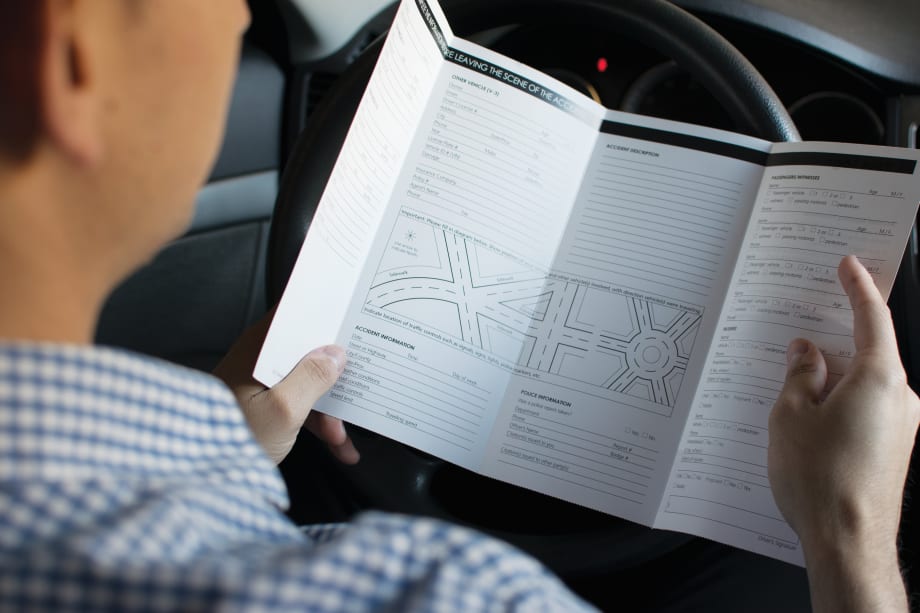
Photo courtesy of Eric Gandarilla.
3 min to read
Photo courtesy of Eric Gandarilla.
If there is one thing that fleets actively look to avoid in their day-to-day operations it’s having drivers get into crashes. Fleet safety programs and consistent driver training can help fleet managers prevent such an event from occurring, but fleets should always be prepared.
In the event of an accident, there is much for drivers to consider in the heat of the moment, including issues related to vehicle damage, injuries, etc. During such a distressing incident, it’s critical that drivers document as much about the incident as possible, and fleet safety packets can help them do this.
Fleet safety packets — which are normally designed as a pamphlet or a letter with a set of instructions — are a tool that drivers can use in the event of an accident. The packet may include sections where the driver can document details about where an accident took place, persons involved, and additional details about the accident. The document would also give details about what drivers should do at the scene of an accident and offer advice that is specific to a fleet, said Chris Villella, senior director of account management and special markets, The CEI Group.
The packet must be a simple and intuitive document. Robert Martines, chairman of Corporate Claims Management, Inc. (CCM), said the packets are straightforward and offer instruction that a driver should follow in case of an accident.
Villella of CEI echoed this sentiment.
“We’ve always tried to keep it as simple as possible with the ability to add some customization,” he said. “It’s not an elaborate document, it’s not 20 pages; it’s there to do its job and help the drivers.”
Following and filling out a fleet safety packet provided by a fleet safety organization in the event of an accident can accurately help in appropriately documenting the incident.
“Most times drivers are a bit frazzled after an accident or breakdown so we make it very easy to reach us,” said Martines. CCM provides a client specific letter that can fit within an envelope, he added
Indeed, having the packet tailored specifically to a fleet is a standard practice.
“Each customer is provided an accident kit based on their specific needs, but the framework of the accident kit is the same for everybody. It basically flows the way that we’re going to ask the questions,” said Villella of CEI. “We know that’s a stressful situation when you’re in an accident, and we want to make sure that we’re providing documentation that helps our customer’s drivers capture all the information they need to get.”
Keeping Drivers Educated
But, it is crucial that fleet managers stay involved in implementing and educating their drivers about the packets, as doing so can help streamline the accident process and reduce further complications, including issues related to liability.
Martines of CCM said that driver education is essential to utilizing the packets.
“Drivers typically are so busy that they do not always read emails from the fleet manager or their HR department. Repeated emails and a hard copy letter helps tremendously to make drivers aware of the company’s concern for their welfare and safety,” he said.
Subscribe to Our Newsletter
More Safety

Sponsored•October 1, 2026
Fleet Manager’s Ultimate Playbook: Navigating the New Standard in OEM Connectivity
Rising operating costs, driver safety concerns, and unplanned downtime are putting unprecedented pressure on modern fleets. Discover how fleet managers use embedded OEM connectivity and real-time vehicle data to cut TCO, prevent downtime, and protect drivers without aftermarket telematics hardware.
Read More →
From Driver Well-Being to EV Charging | AF News Recap
Mental health belongs in the fleet safety conversation. This week, we’re looking at five ways fleets can support employee well-being before a crisis, plus Holman’s expansion in Mexico, new one-day Fleet Forward passes, and why EV charging demand is outpacing infrastructure growth.
Read More →
Nexar-Nauto Merger Aims to Give Fleets Better Safety Intelligence Through Larger Driving Dataset
Stefan Heck tells Automotive Fleet that combining more than 10 billion miles of driving history with Nexar's AI models will give fleets deeper insights into driver risk and roadway conditions than either company could provide independently.
Read More →
Don't Wait for a Crisis: 5 Ways to Build Mental Health Into Your Fleet Safety Program
For Suicide Prevention Month, fleet and safety leaders have an opportunity to put mental health where it belongs: at the center of workplace safety.
Read More →
How Camera Data Can Strengthen a Fleet’s Insurance Renewal
Insights from a commercial insurance carrier and a broker show how fleets can turn video telematic data, driver coaching, and improved claims results into a stronger case at insurance renewal.
Read More →
The Safest Fleets Aren’t the Ones with the Most Technology
You’ve made the telematics investment. Here’s how to capture the other half of its value and build the safest fleet on the road.
Read More →
Sponsored•August 7, 2026
Hidden in Plain Sight: Fleet Compliance Risks
Fleet compliance isn't just about having policies — it's about consistently enforcing them. This practical guide reveals six hidden compliance risks common in public sector and shared fleet operations and outlines proven strategies to improve visibility, accountability, and audit readiness
Read More →
NETS Sets 2026 Fleet Safety Benchmark Conference for Indianapolis
The Sept. 15–17 program will feature fleet benchmarking data, case studies, emerging technologies, and implementation strategies while running alongside the NSC Safety Congress & Expo.
Read More →
Off-the-Job Crashes Account for 43% of Employers’ $61.7 Billion Crash Burden
NETS quantifies costs dispersed across fleet, risk, HR, and other departments while providing new per-crash benchmarks for employers.
Read More →
Ram Recalls More Than 1.27 Million 1500 Pickups for Seat Belt Anchor Issue
The recall affects certain 2019-2026 Ram 1500 pickups that may have improperly attached second-row seat belt buckle anchors.
Read More →