




4 Tips to Prepare Commercial Fleets for Winter Weather
It's amazing how quickly time flies by. Regardless of the time of year, changes in weather can have a significant impact on highway safety across the United States.

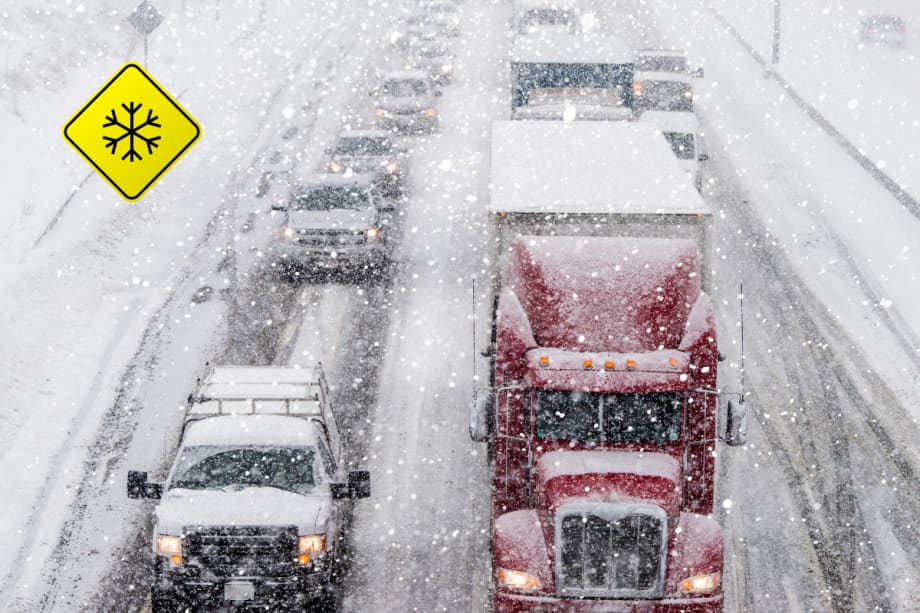
Before beginning or continuing with a run, it is important to monitor weather patterns in the regions drivers are traveling.
Photo: Work Truck
It's amazing how quickly time flies by. Regardless of the time of year, weather changes can significantly impact highway safety across the United States.
Although drivers in Northern Tier states are accustomed to dealing with a wide range of precipitation, such as rain, freezing rain, sleet, and snow, a sudden cold snap can catch even Southern locations off guard and leave them ill-equipped to handle icy roads.
1. Be Alert to Winter Driving Risks
Before beginning or continuing with a run, monitoring weather patterns in the region where drivers are traveling is important. Drivers and dispatchers should be in contact with one another to decide when it is no longer safe to proceed.
A driver should never risk their safety to meet an arrival time.
A challenge drivers experience all year, especially during bad weather, is fellow motorists. Even though professional drivers are likely trained in winter driving maneuvers, others may not be as confident or skilled. It is important to employ defensive driving techniques, including speed, space management, and increased stopping distance.
Remind drivers to carefully and smoothly accelerate, brake, and steer to minimize skids.
2. Equip Vehicles with the Right Equipment & Supplies
When the temperatures drop, drivers need the right equipment to be successful in their jobs. Practical items to have on hand include winter gloves, boots, and jacket; ice scraper/brush; shovel; sand; large, heavy-duty flashlight; and heavy hammer for freeing frozen brakes. In case of an emergency, it may be wise to have extra clothing, survival rations, first-aid supplies, and a blanket in the vehicle.
Drivers must be aware of traction device requirements — such as tire chains or cables — for each state where they operate their commercial motor vehicle.
3. Help Drivers Stay Safe and Avoid 'Running out of Time'
Most carriers and drivers have heard of the “adverse driving conditions” exception. For some, it may be confusing when a driver can use it. Specific criteria must be met to take advantage of this provision. You must look at what is defined as adverse driving conditions.
According to Section 395.2, adverse driving conditions “means snow, ice, sleet, fog, or other adverse weather conditions or unusual road or traffic conditions that were not known, or could not reasonably be known, to a driver immediately prior to beginning the duty day or immediately before beginning driving after a qualifying rest break or sleeper berth period, or to a motor carrier immediately prior to dispatching the driver.”
If the threat of bad weather and questionable road conditions were known before the driver started their route, you would be unable to use this exception. If the forecast did not hint at the potential hazard — and the conditions prevent the driver from completing the run within the hours-of-service (HOS) limits — the driver may add up to an additional two hours to complete the run or find a safe place to park the vehicle.
It is a good best practice to instruct a driver to always dialog with dispatch for permission to use this additional drive time. This may be accomplished through your company safety policy and driver training.
4. Prepare for Emergencies: Understand Emergency Declarations
When a major storm hits a region, “emergencies” are often declared. These official decrees give some a misperception they are given a “pass” on safety regulations.
Unlike the adverse driving exception, an emergency — caused by the weather, an earthquake, or other natural or man-made event — threatens human life or public welfare. This may be an interruption in essential services (e.g., utilities, medical care) or supplies (e.g., food, fuel).
It takes a declaration by state or federal government officials, including Federal Motor Carrier Safety Administration Field Administrators, to be deemed an “emergency.” The declaration will spell out what regulations are being suspended temporarily and for what duration.
These breaks in compliance only apply to motor carriers and drivers engaged in emergency relief efforts. In other words, providing “direct assistance” such as immediate restoration of utilities and communications or providing food, water, or fuel. It does not include transportation related to long-term recovery efforts and routine commercial deliveries after the initial threat has passed.
Editor's Note: This article was originally published in November 2016 and has been updated with changes to definitions for "adverse driving conditions" and verified for continued relevancy.
Originally posted on Work Truck Online
More Global Fleet
GeoFencing Adds to Your Truck Security Arsenal
Geofencing is a familiar fleet tool today, but its early adoption marked a major shift in vehicle tracking, route monitoring, and the debate over employee privacy.
Read More →
Holman Takes Full Ownership of ARIZA in Mexico
Holman is bringing its Mexican fleet management operation fully under its own brand after more than 30 years as a joint venture. The change gives multinational fleet customers a single Holman operation across the U.S., Canada, and Mexico.
Read More →
5 Tire Maintenance Tips to Help Prevent Work Truck Downtime
Regular tire checks can do more than extend tread life. These five maintenance practices can help work truck fleets catch problems early, reduce costs, and prevent downtime.
Read More →

Proven Ways to Reduce Work Truck Downtime
The age-old problem of downtime will always be a reality, but with new strategies at hand, fleets have more ways to keep trucks on the road longer.
Read More →


Cameras, Safety and Insurance: From Reactive Claims to Real-Time Prevention (Part 2 of 2)
Part Two: Commercial auto remains one of the most challenging and costly lines of coverage for fleet operators and insurers alike. Continue learning more about how to effectively address these issues from Onur Aksan, Enterprise Business Development Executive, Geotab
Read More →
Cameras, Safety and Insurance: From Reactive Claims to Real-time Prevention
Commercial auto remains one of the most challenging and costly lines of coverage for fleet operators and insurers alike. Learn more about how to effectively address these issues from Onur Aksan, Enterprise Business Development Executive, Geotab.
Read More →
Fleet Costs Are Rising: Here’s How Leaders Are Responding
Fleet leaders are under pressure to reduce costs, adapt to economic uncertainty, and make smarter decisions. See how peers across North America are responding with real data, proven strategies, and forward-looking insights. Download the 2026 Market Pulse Report to benchmark your strategy and uncover where you can gain an edge.
Read More →
Enterprise Fleet Management Surpasses 900,000 Vehicles in U.S. & Canada
Enterprise Mobility connects with mobility solutions around the globe
Read More →