




GM's Jeff Haag Discusses Fleet and Commercial Division Plans and Upcoming Products
In June 2011, General Motors appointed one of its veteran employees, Jeff Haag, to the position of director of national accounts for GM Fleet and Commercial Operations (FCO). Automotive Fleet interviewed Haag about his plans and goals for GM’s FCO division.

By Greg Basich
In June 2011, General Motors appointed one of its veteran employees, Jeff Haag, to the position of director of national accounts for GM Fleet and Commercial Operations (FCO). Automotive Fleet interviewed Haag about his plans and goals for GM’s FCO division.

Haag is now responsible for overseeing nationwide U.S. and global fleet sales as well as all General Services Administration (GSA) sales. He reports to Brian Small, general manager, Fleet and Commercial Operations. Haag has been with GM for more than 27 years. He began working at the company in customer assistance for Chevrolet, and from there progressed steadily through the company, including customer service, district sales, advertising, promotions, marketing, trucks, and most recently, commercial and fleet sales.
Haag most recently served as a fleet account executive (FAE) for GM’s North Central Region. He worked in that position for six years, was one of top three FAEs for all six years, and was the top FAE for three out of his six years. In the new role, Haag said he intends to build on the foundation his predecessor Bill Gibson put in place.
“The job is not changing that much directionally from what Bill Gibson did,” Haag said. “Obviously we’re going to maintain the focus on the customer. That’s by far the most important thing we’ve done. My role involves global sales and, obviously, sales within North America. My focus is also on maintaining our relationships with the fleet management companies. Then there is also a piece of the role that involves a global IT system. That IT system is involved basically with everything I’ve mentioned. My role is all customer-based and involves working with large, national customers.”
Although Haag is making the transition to this new role, he emphasized that he’s been in the fleet industry for a number of years.
“A lot of the customers know me, but a lot of them don’t,” Haag said. “The first thing is: I’m not new to fleet. I was in fleet when I got this position. I’ve been with GM for 27 and a half years. Three of my recent positions have been in fleet. I knew Bill Gibson very well. We were, and are, very good friends.”
Upbeat About the Future
In this new role, Haag is responsible for ensuring sales success when new GM vehicles launch. Automotive Fleet wanted to find out what Haag is seeing trend-wise in the commercial fleet market related to current and future sales. He said GM’s fleet customers are generally upbeat about the future, which is connected to specific conditions in the used-vehicle market.
“Fleets are pretty optimistic about the future,” Haag said. “The entire industry went through the doldrums. You’re constantly seeing the market tick upward. They are also optimistic because of the used car market. A lot of them are doing short cycles on their existing fleets, which obviously drives orders for us. So the ones that are doing it now are doing it because they are getting a lot of money out of their used cars. Our orders are good for the 2012 models. I think when it’s all said and done we’re going to have a very strong 2012 model-year.”
With regard to changes in the types of vehicles fleets are purchasing, Haag said fuel prices are a factor affecting purchase decisions. “As far as segmentation goes, we still get the same type of vehicle demands and so forth,” Haag said. “Everybody is trying to figure out how they can do the same job with a more fuel-efficient vehicle. There were some customers with large fleets that were in a competitor’s minivan and they got into a Chevrolet Equinox. Four-cylinder is always a topic of discussion. We’re probably 75-percent four-cylinder on Malibu and on Equinox. That’s a huge shift in the marketplace.”
Increased Vehicle Performance

The 2013 Chevrolet Malibu will be a major launch for GM and the Fleet and Commercial Operations division, according to Haag.
One reason Haag said he believes fleets are making the shift to smaller engines is due to the performance characteristics of modern four-cylinder engines when compared with engines from years past.
“With the power and performance of four-cylinder engines today, it’s basically like driving the V-6 of a few years ago,” Haag said. “They have plenty of power and get great mileage. The old adage of ‘Oh boy, that’s going to be a slow vehicle,’ frankly doesn’t apply anymore. The Chevrolet Cruze is a perfect example with the 1.4L turbo. If you look at it on a sheet of paper, it doesn’t look that powerful, but when you drive it you notice it produces plenty of power yet provides the fuel economy fleets want.”
Haag said although Cruze sales are only starting to pick up in the fleet industry, he’s seen this type of sales trend before.
“If you look back a few years ago, when the Chevrolet Impala was extremely popular, all of a sudden we hit $4 per gallon gasoline prices,” he said. “Then everybody started gravitating toward the four-cylinder Chevrolet Malibu. Well, we’re on that gasoline price threshold again, so if they can get a few more miles per gallon out of the Cruze, then they’ll get that. The Cruze is doing extremely well. It’s not a huge player in the fleet world right now, but I think it’s going to gain steam in the future. It is being picked up by fleet customers.”
Haag explained that most fleets are happy with the current Malibu but are starting to experiment with the Cruze. Regarding the Malibu, though, the 2013-model is going to be a major launch in the near future, as are a number of other models.
“Probably the next biggest launch is going to be the new 2013-MY Malibu,” Haag said. “That’s coming out here in a few short months. That’s going to be huge for us. Approximately a year after that is going to be the new Impala. There will be a lot of effort focused on those two vehicles.”
A fleet-only model Haag cited is the Chevrolet Captiva Sport. He said it’s a good example of GM’s current disciplined approach to vehicle production as it relates to meeting customer demand.
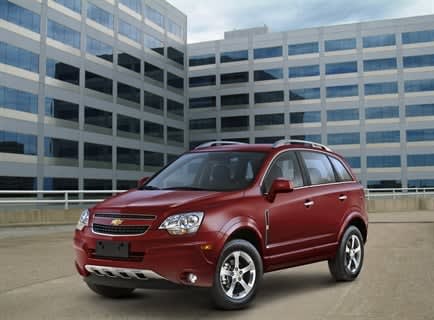
The Captiva Sport is a fleet-only model that is designed to help fulfill fleet demand for a mid-size crossover.
“We are definitely building production to meet demand and, frankly, not exceed demand, which was the norm of the industry not too long ago,” Haag said. “We’re watching [production] every day, every week, to make sure we have the right balance. One example is the Captiva Sport. We’ve got a huge demand, both retail and fleet, for mid-size crossovers, specifically the Equinox. We’re bringing in the Captiva Sport, making it available just to fleet, to offset some of that [Equinox] demand and give them a choice. Purchasing either one is fine, but hopefully we can get some of them to gravitate toward the Captiva Sport and ease up some on the demand on the Equinox.”
According to Haag, the Captiva Sport will launch in October.
“The vehicle basically has the same powertrain as the Equinox,” Haag said. “It’s virtually the same size. It’s on several customers’ selector lists, so hopefully it will be received well.”
Haag said he’s also seeing a lot of fleet interest in the Volt.
“We’re in the middle of the entire Volt rollout,” Haag said. “That’s going to continue to be a big focus of ours as we increase production. We’ve got a lot of people asking about the vehicle, who want allocation.”
Beyond sales trends, Haag said other aspects of selling to the fleet market are running smoothly. He said he and the team at GM are pleased with current order-to-delivery times but are always looking for ways to improve them.
“We don’t see any issues or anything like that,” Haag said. “The railcar industry went through some issues last year, mostly due to weather. Still, we’ve been really pleased with what we’ve been able to do.”
Before AF’s conversation with Haag ended, he said that although he expects a smooth transition, he said fleet customers might be disappointed with him in one way, his golf game.
“For those customers who think I’m as good a golfer as Bill, I’m not.”
Haag’s golf game can only get better, though, and for fleet customers, Haag’s current focus is on improving what’s already working well and completing the smooth transition into his new role.
“I just want the fleet industry to know that we’re not going to miss a beat with this transition,” Haag said. “I don’t see any issues going forward.”
More Operations
Here's When You Should Make an Exception to Fleet Policy
Fleet policies are designed to create consistency, but not every driver or situation fits neatly within standard rules.
Read More →
AI-Native or AI-Acquired: What Should Fleet Managers Look for in an AI Platform?
Six questions can help fleet managers look beyond AI marketing claims to evaluate integration, data access, and real-world operational performance.
Read More →
A buyer's guide to fleet management software in 2027
Buying fleet management software in 2027 means looking beyond features and price. As fleet operations, technology and expectations evolve, this guide explores what today’s fleet professionals should consider when choosing a system that can deliver value now and adapt to what comes next.
Read More →

What Will Shape the Next Era of Fleet Management?
EVs, AI, and autonomous vehicles are reshaping fleet management. Discover what’s ahead—and how fleet leaders can prepare for the next era.
Read More →
How Fleets Can Recruit and Train Veterans for Technician Roles
Here's how the technician shortage has affected uptime for fleets, and what to do about it.
Read More →
Avis Budget Group Deploys Neology Toll Management Technology Across Major Brands
Neology’s neoFleet platform will manage toll transactions and toll-authority operations for vehicles across Avis, Budget, Payless, Budget Truck and Zipcar.
Read More →
Fleet Personal-Use Charges Edge Higher in 2026
Nearly eight in 10 surveyed fleets allow personal use of company vehicles, while just over half of respondents report charging employees for the privilege.
Read More →
The Future of Fleet + What’s Changing Right Now | AF News Recap
Could developments overseas offer a preview of what’s coming for U.S. fleets? This week, we’re looking at the future of AI, autonomy, and electrification, plus Ford Pro’s new certified pre-owned program, smarter vehicle offboarding, and a new way for fleets to manage toll expenses.
Read More →
How to Handle Vehicle Offboarding
What do fleet managers need to do when a driver leaves?
Read More →
Fleet Manager’s Ultimate Playbook: Navigating the New Standard in OEM Connectivity
Rising operating costs, driver safety concerns, and unplanned downtime are putting unprecedented pressure on modern fleets. Discover how fleet managers use embedded OEM connectivity and real-time vehicle data to cut TCO, prevent downtime, and protect drivers without aftermarket telematics hardware.
Read More →