




Scania Tests Autonomous Platooning in Singapore
Scania will design a full-scale autonomous truck platooning operation, based on its own advanced technology, which will use public roads while transporting containers between port terminals in Singapore.
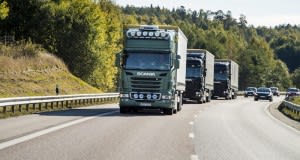
Example of an autonomous truck platoon. Photo: Scania
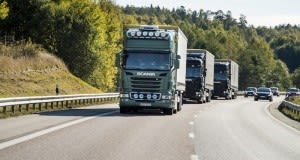
Example of an autonomous truck platoon. Photo: Scania
Scania will design a full-scale autonomous truck platooning operation, based on its own advanced technology, which will use public roads while transporting containers between port terminals in Singapore. The aim is to organize convoys of four trucks — with the following three trucks behind the lead truck autonomously driven, as well as to fully automate the processes for precise docking and undocking of cargo. Singapore has already tested autonomous cars, taxis, utility vehicles and buses.
“Autonomous vehicles and platooning are cornerstones of future sustainable transport systems,” said Claes Erixon, head of Research and Development at Scania. “This is a great opportunity to demonstrate our leadership and technology in this new exciting area. We are pioneering in this field, which has the potential not only to save lives in traffic, but also to significantly decrease the environmental impact of transport.”
The multi-year project was organized by the Ministry of Transport and the Port of Singapore Authority (PSA Corporation). Toyota is also participating in this project, according to Scania.
“Trucking as we know it today is a highly labor-intensive industry. We face a shortage of truck drivers. In this regard, truck platooning technology presents us with an opportunity to boost productivity in both the port sector and the trucking industry. It will also open up opportunities for truck drivers to take on higher-skilled roles as fleet operators and managers,” said Pang Kin Keong, permanent secretary for Transport and chairman of the Committee on Autonomous Road Transport in Singapore (CARTS).
With the vehicle population in Singapore approaching 1 million, the Initiative seeks to address the increasing travel demand and land constraints; 12% of Singapore’s total land is used for road and land transport infrastructure. Additionally, it faces a shortage of drivers, according to Scania.
It has established Singapore as a “living laboratory” for new vehicle concepts that will increase productivity, road safety, optimize road capacity and enable new mobility concepts.
“Scania is well advanced in cutting edge autonomous technology as well as in platooning. Singapore has launched several autonomous vehicle initiatives and together we will now demonstrate how we can substantially enhance productivity in the Port of Singapore,” said Mark Cameron, country manager, Scania Singapore.
The truck platooning trials will take place in two phases. The first phase will focus on designing, testing and refining the truck platooning technology to adapt to local conditions. These will be conducted by Scania and Toyota at their respective research centers in Sweden and Japan, to leverage their existing development work. The second phase will consist of local trials and development of the technology in Singapore, according to Scania.
More Global Fleet
Why Fleet Managers Are Replacing Departmental Vehicles with Shared Motor Pools
Departmentally assigned vehicles often create hidden costs through underutilization, poor visibility, and increased administrative burden. This white paper explores how shared motor pool strategies help fleets reduce costs, improve accountability, and optimize vehicle utilization.
Read More →
Fleet Costs Are Rising: Here’s How Leaders Are Responding
Fleet leaders are under pressure to reduce costs, adapt to economic uncertainty, and make smarter decisions. See how peers across North America are responding with real data, proven strategies, and forward-looking insights. Download the 2026 Market Pulse Report to benchmark your strategy and uncover where you can gain an edge.
Read More →
Enterprise Fleet Management Surpasses 900,000 Vehicles in U.S. & Canada
Enterprise Mobility connects with mobility solutions around the globe
Read More →
Automotive Fleet's Guide to Fleet Electrification
Unlock the secrets to a successful transition to electric fleets with Automotive Fleet's comprehensive Fleet Electrification Guide!
Read More →
Sumitomo Rubber Industries to Acquire Viaduct
Viaduct will join Sumitomo as an independent subsidiary. Partnership strengthens global reach and accelerates AI-driven innovation for fleets and manufacturing.
Read More →
AfMA’s 2025 Education & Leadership Summit: 26 Years of Impactful Connection
Held in Sydney, the Australasian Fleet Management Association’s 2025 Summit marked ten years of growth as the event expanded its global reach and doubled down on practical, non-commercial fleet leadership programming.
Read More →
Closing Soon! Nominate a 2025 Global Fleet Team of the Year
Submit your nomination for the award that honors outstanding multinational fleet teams. Nominations close Aug. 15.
Read More →
Seven Strategies to Reduce Preventable Accidents
“Accidents” suggest inevitability, but most crashes are preventable — caused by driver actions and behaviors. Here’s why shifting the narrative can improve road safety.
Read More →
2024 Global Fleet Conference in Photos
Check out photos from the first two days of the 2024 Global Fleet Conference, which convened for the first time in San Diego Nov. 4-6 as part of the new Fleet Week series of conferences.
Read More →
Inside the 2024 Global Fleet Conference: Insights from Bobit CEO Colin Sutherland
With GFC joining Fleet Forward and Fleet Safety Conferences, attendees can engage in essential discussions on procurement, ESG goals, and safety.
Read More →