The automaker is collaborating with Russian scientists who have used multichannel connectivity principles to further develop space robot communications.
by Staff
September 29, 2015
Illustration courtesy of Ford.
4 min to read
Illustration courtesy of Ford.
Ford Motor Co. and St. Petersburg State Polytechnic University in Russia have reached the final phase of a large-scale research project aimed at enhancing vehicle communication technology, Ford announced.
Building on university telematics expertise in space robot communications, Ford has filed several patents on technologies that can serve to advance connected cars of the future.
Ad Loading...
“The challenge of creating a robust wireless communications network is shared between the space and automotive industries,” said Oleg Gusikhin, technical leader of advanced connected services for Ford Research & Advanced Engineering. “These first results are very promising in terms of offering more reliable communications technology for the future of connected vehicles.”
The primary goal of the three-year joint project was the development of robust communication technology to connect drivers and service providers with information and services on the cloud. The key problem Ford set out to address was maintaining reliable communication between vehicles and the cloud in conditions where there was wireless network overload or poor connectivity.
Data was collected and transmitted from moving vehicles, which featured a variety of capabilities for a connection to the cloud – cellular, Wi-Fi and communication with other vehicles and the infrastructure.
The team created an intelligent connectivity manager that uses software and algorithms to select the connection option best suited to transmit data to the cloud. Each vehicle is given the opportunity to assess the quality of communication channels and to transmit data.
The researchers developed a small-scale connectivity coverage map that keeps the features of the landscape, while incorporating data on fixed and mobile wireless access points, the quality of service of the available communication channels as well as traffic conditions.
Ad Loading...
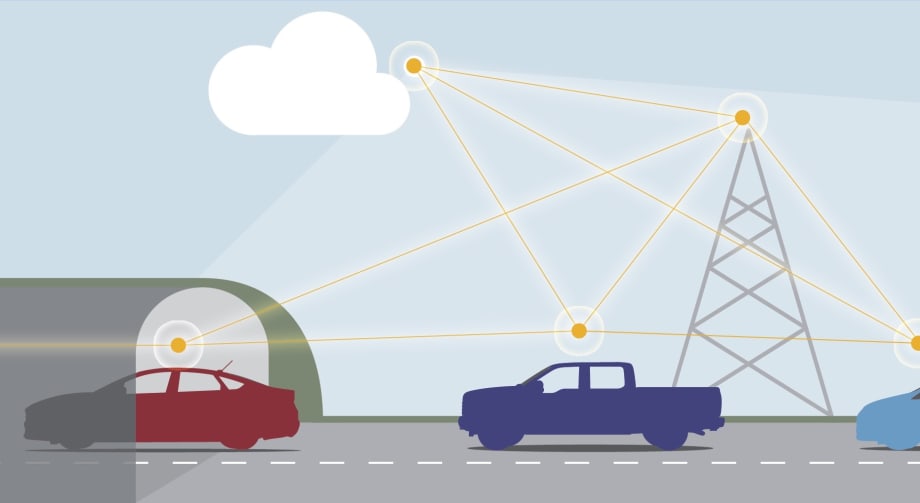
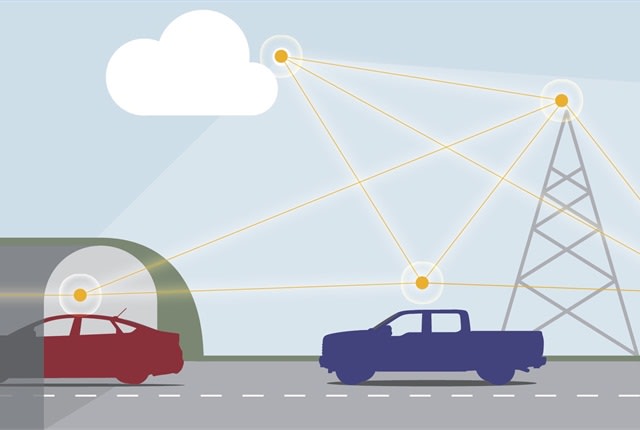
Specifically, the team looked at sharing critical information regarding a road emergency with drivers in an area that has poor connectivity, Ford said. In this scenario, a car entering a tunnel encounters black ice and needs to send a signal noting the slippery conditions for other vehicles. There’s no cellular reception, and Wi-Fi is not an option because there’s no hot spot, but another car leaving the tunnel in the opposite direction has both vehicle-to-vehicle and a cellular connection.
The intelligent connectivity manager selects the second car’s vehicle-to-vehicle channel to deliver information gathered from the first car to the cloud so that it can then transmit a warning to other drivers of the dangerous conditions at the tunnel entrance. If no other cars are around, the connectivity manager would postpone sending the message until the first car leaves the tunnel and a cellular network becomes available.
In nonemergency situations, the connectivity manager can check the coverage map to determine the best point for service delivery. So if a vehicle is traveling in a remote area and a software update is sent out, the update would be delivered over the air when the connection is stronger.
In the future, as information will be collected at the same time from hundreds of vehicles, a universal connectivity map will reflect the current data at all times. This map will act as a database for implementing smart roads and smart city projects. This means that in any given situation, whether moving or parked, the vehicle with the most stable connection – cellular, embedded modem, Wi-Fi, vehicle-to-everything – can be a resource to facilitate a reliable connection to information services. This enhances the connected experience for the entire driving public, Ford said.
Vladimir Zaborovsky, who heads up telematics for St. Petersburg State Polytechnic University, is pleased with the project’s findings.
Ad Loading...
“The developed solutions are of high reliability, scaleability and adaptability, and they open broad prospects for application – both in transportation logistics and in space robotics,” he said. “We’re looking forward to further collaborating with our colleagues from Ford.”
The project will be finalized by year-end, and the results could be integrated into Ford production programs – including vehicle-to-vehicle communication, the delivery of emergency messages and over-the-air software updates.
St. Petersburg State telematics researchers successfully carried out a series of experiments in space using the same multichannel connectivity fundamentals that served as the basis for the research project with Ford. Cosmonauts aboard the International Space Station used a joystick to control a robot based on Earth amid noisy conditions, operating signal time delays and equipment failures.
Now, the team plans to advance the technology to remotely control a group of robots assembling scientific equipment and satellites.
Fleet drivers face constant visual, cognitive, and environmental interruptions the moment they hit the road. From roadside chaos to mental fatigue and digital overload, today’s biggest driving risks often come from outside the vehicle itself.
FLASH Weather AI has launched a first-of-its-kind hail prediction model capable of forecasting hail size and arrival time at 1-kilometer resolution up to 55 minutes ahead, giving fleets and insurers critical time to prepare for severe storms.
As litigation risk rises, vehicles are increasingly targeted. This Coca-Cola bottler shares how it’s reducing exposure through driver training, technology, and a proactive risk management approach.
From identity management to third-party certifications, the right technology partner should make security easier to manage. Here are the three building blocks that fleet managers need to stay in control as connected systems scale.
Distracted driving remains one of the most persistent risks in fleet operations. New approaches focus on removing mobile device use entirely while adding real-time safety support.
As distraction risks evolve, fleets are turning to smarter, more connected technologies to better understand what’s happening behind the wheel. Part 2 explores how these tools are helping identify risky behaviors and improve visibility across operations.
Distracted driving is often measured by what we can see—phones in hand, eyes off the road. But what about the distractions we can’t? A recent incident raises a bigger question about awareness, attention, and why subtle risks so often go unnoticed.