




Ford Unveils New Super Duty With Aluminum Body
Ford introduced the 2017 Ford F-Series Super Duty with a number of enhancements including a lighter weight aluminum-alloy body.
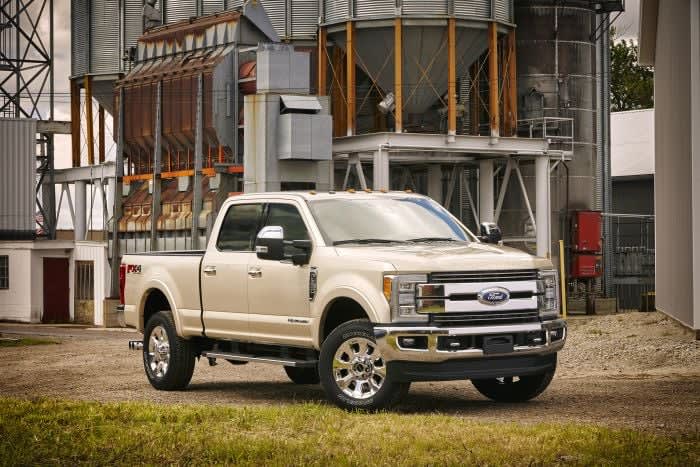
Ford's 2017 Super Duty Photo: Ford

Ford's 2017 Super DutyPhoto: Ford
Ford introduced the 2017 Ford F-Series Super Duty with a number of enhancements including a lighter weight aluminum-alloy body.
The 2017 model includes a new stronger steel frame, aluminum body, improved axles/springs and suspension, class-exclusive features and technologies, and multiple gasoline and diesel engine and transmission combinations.
Following a similar change in the latest F-150, the 2017 Super Duty will include a military-grade aluminum-alloy body, which the company says is more dent- and ding-resistant than the outgoing steel body and not subject to red rust corrosion.
The Super Duty’s frame is composed of more than 95% high-strength steel that offers up to 24 times more stiffness than the previous frame and is designed to improve towing and hauling capability, according to Ford. The aluminum body and steel frame combine to reduce the Super Duty’s weight by up to 350 pounds.
“As we remove weight, we’re making Super Duty more productive by giving our customers better towing and payload capability,” said Craig Schmatz, Super Duty chief engineer.
For powertrains, the 6.7L Power Stroke V-8 diesel engine is available for both pickup and chassis cab models. Available on the F-250 pickup is a 6.2L V-8 gasoline engine that is equipped with Ford's TorqShift-G transmission, which improves capability, according to Ford. The Super Duty chassis-cab lineup includes a choice of 6.7L Power Stroke V-8 Diesel, 6.8L V-10 gasoline or 6.2L V-8 gasoline engines.
“We’re backing up improved capability with a stronger gasoline and diesel Super Duty engine lineup,” said Schmatz. “The bottom line is Super Duty customers will be able to tow and haul more than ever before.”
The F-Series Super Duty is also available with several driver-assist technologies, including lane departure, blind spot, adaptive cruise control and collision warning features.
The Blind Spot Information System with trailer tow is optimized for Super Duty to include the length of the trailer and uses radar sensors in the tail lamps to monitor blind spots. The lane departure warning feature alerts a driver when they stray from a lane through a series of steering wheel vibrations.
Adaptive cruise control and collision warning with brake support makes use of sensors to detect slower vehicles moving in the same direction. If another vehicle gets too close, red lights flash on the windshield and a warning is sounded. If a driver fails to brake, the brake system is pre-charged to stop faster when the brake pedal is pressed.
The truck also features lighting technology, including LED side-view mirror spotlights to light up a work site, LED cargo box lighting and class-exclusive quad-beam LED headlamps and tail lamps.
All three cabs — Regular Cab, SuperCab and Crew Cab — are longer and include new interior design. The new interior features a dual-compartment glove box, overhead console-mounted auxiliary switches and a completely flat SuperCab and Crew Cab second-row floor to make loading large items in the cab easier.
There are five models in the Super Duty lineup — XL, XLT, Lariat, King Ranch and Platinum. The 2017 Super Duty will be built at Ford’s Kentucky truck plant, and goes on sale late next year.
More Operations

90% Use Telematics. Are Fleets Getting Safer? | AF News Recap
This week, we're breaking down which industries have the highest rates, how Jamie McKay manages 2,400 vehicles, what's happening with the 2027 fleet awards, and why software-defined vehicles could introduce new costs.
Read More →
What's Best Handled by an FMC, and What's Better Done Directly?
Fleet managers continue to rely on FMCs for essential services but are taking a closer look at where working directly with suppliers can improve efficiency and responsiveness.
Read More →
Fleet Meets: Erin Gilchrist
Meet Erin Gilchrist, the inaugural Mike Antich Spirit of Fleet Award winner, as she shares insights on leadership, mentorship, the power of industry connections, and why people remain at the heart of fleet's future.
Read More →

How 2026 Fleet Visionary Jamie McKay Manages 2,400 Vehicles Across 37 States
How do you keep 2,400 vehicles running across 37 states? Fleet Visionary Award winner Jamie McKay shares how collaboration, flexibility, and a few simple strategies help her tackle fleet management challenges at Aptive Pest Control.
Read More →
Managing Fleet Costs in an Era of Permanent Volatility
Fleet operating costs have risen more than 20% since 2020, raising a key question: When does extending a vehicle's service life stop making financial sense?
Read More →
The Next Evolution of Fleet Management: Autonomous Operations
This opening keynote session at the Fleet Forward Conference highlights the future of autonomous driving for fleets.
Read More →
How to Reduce the Total Cost of Risk From Catalytic Converter Theft
A stolen catalytic converter can cost fleets far more in downtime and lost productivity than in repairs. A total-cost-of-risk approach can help fleet managers quantify their exposure and prioritize theft prevention.
Read More →
Personal-Use Charges Rise as Vehicle Values Fall | AF News Recap
Personal-use charges are climbing, wholesale used-vehicle values are declining, and commercial fleet sales growth is slowing. This week, we're breaking down the latest fleet data, plus how Element Fleet Management is helping Waymo prepare for its first Canadian robotaxi market.
Read More →
Here's When You Should Make an Exception to Fleet Policy
Fleet policies are designed to create consistency, but not every driver or situation fits neatly within standard rules.
Read More →
AI-Native or AI-Acquired: What Should Fleet Managers Look for in an AI Platform?
Six questions can help fleet managers look beyond AI marketing claims to evaluate integration, data access, and real-world operational performance.
Read More →