Ottomatika, led by Engineering Professor Raj Rajkumar, spun off from Carnegie Mellon University in 2013.
by Staff
August 10, 2015
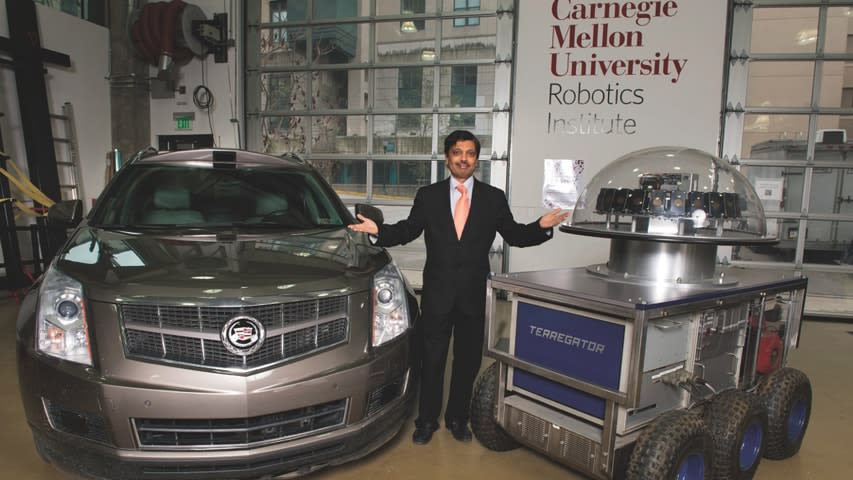
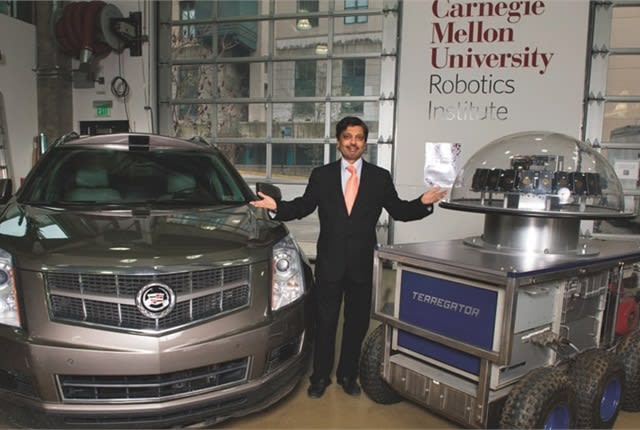
Professor Raj Rajkumar poses between CMU's latest self-driving car, a Cadillar SRX, and the university's first autonomous vehicle 30 years ago. Photo courtesy of Carnegie Mellon University in Pittsburgh.
1 min to read
Professor Raj Rajkumar poses between CMU's latest self-driving car, a Cadillar SRX, and the university's first autonomous vehicle 30 years ago. Photo courtesy of Carnegie Mellon University in Pittsburgh.
Delphi Automotive, an automotive parts giant headquartered in the U.K., has acquired Ottomatika Inc., a Carnegie Mellon University spinoff company specializing in software and systems development for self-driving cars.
Ottomatika, led by Engineering Professor Raj Rajkumar, spun off from Carnegie Mellon in 2013. The company drew an investment from Delphi in November of 2014. The university has spun off 138 companies since 2009.
Ad Loading...
The Delphi Drive system, powered with Ottomatika software, was showcased at the Consumer Electronics Show earlier this year. Additionally, in April the combined software from Delphi and Ottomatika enabled the longest drive by an automated vehicle in North America. The Delphi vehicle completed a 3,400-mile trip from San Francisco to New York in autonomous mode 99 percent of the time. During the nine-day trip, the vehicle navigated through construction zones and met a variety of traffic and weather conditions, according to Carnegie Mellon University.
“The founding and purchase of Ottomatika validates Carnegie Mellon’s pioneering strengths in automation, robotics and software engineering,” Rajkumar said. “Creating high-tech companies in Pittsburgh benefits the university and regional economic development.”
Fleet drivers face constant visual, cognitive, and environmental interruptions the moment they hit the road. From roadside chaos to mental fatigue and digital overload, today’s biggest driving risks often come from outside the vehicle itself.
FLASH Weather AI has launched a first-of-its-kind hail prediction model capable of forecasting hail size and arrival time at 1-kilometer resolution up to 55 minutes ahead, giving fleets and insurers critical time to prepare for severe storms.
As litigation risk rises, vehicles are increasingly targeted. This Coca-Cola bottler shares how it’s reducing exposure through driver training, technology, and a proactive risk management approach.
From identity management to third-party certifications, the right technology partner should make security easier to manage. Here are the three building blocks that fleet managers need to stay in control as connected systems scale.
Distracted driving remains one of the most persistent risks in fleet operations. New approaches focus on removing mobile device use entirely while adding real-time safety support.
As distraction risks evolve, fleets are turning to smarter, more connected technologies to better understand what’s happening behind the wheel. Part 2 explores how these tools are helping identify risky behaviors and improve visibility across operations.
Distracted driving is often measured by what we can see—phones in hand, eyes off the road. But what about the distractions we can’t? A recent incident raises a bigger question about awareness, attention, and why subtle risks so often go unnoticed.