





Miss This? Tyson Foods, Gatik Deploying Class 7 Autonomous Trucks
Isuzu Invests $30 Million in Gatik to Develop Autonomous Driving Business
In an effort to develop autonomous driving solutions, Isuzu has partnered with Gatik to launch a Level 4 autonomous commercial vehicle business in 2027.
May 22, 2024
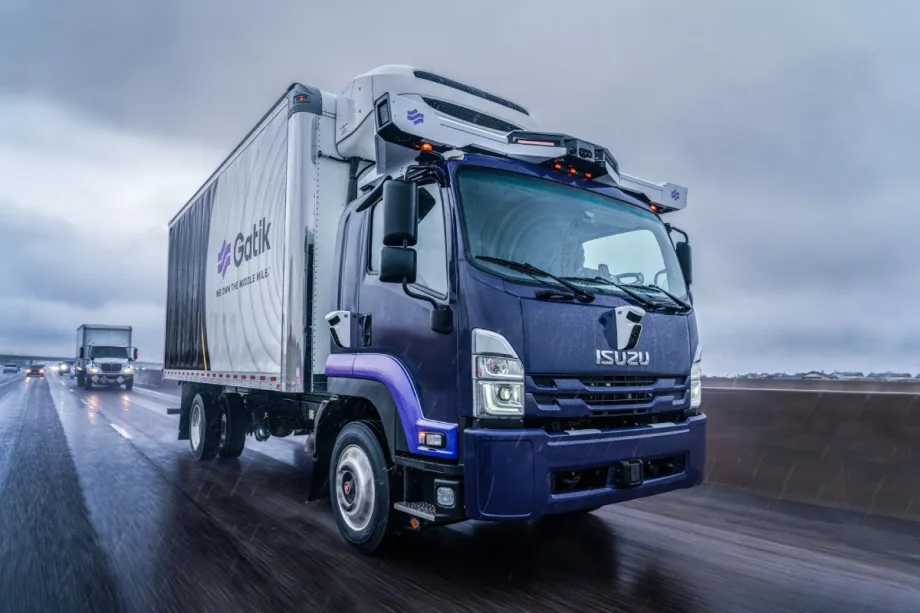
Gatik provides autonomous middle-mile logistics services in North America, using Class 3-7 autonomous driving trucks to deliver goods.
Photo: Business Wire
2 min to read
Isuzu Motors Limited and Gatik AI, Inc. have agreed to collaborate to further develop the North American autonomous driving industry.
Isuzu will invest $30 million in Gatik, forging a solid partnership to realize mobility services based on Level 4 autonomous driving.
The agreement between Isuzu and Gatik focuses on developing middle-mile autonomous driving. It will include designing and creating a new chassis (redundant chassis) that ensures safety when equipped with an autonomous driving system.
In April 2024, as part of its mid-term business plan, "ISUZU Transformation—Growth to 2030 (IX)," Isuzu committed to establishing three new business pillars for the future:
Autonomous driving solutions
Connected services
Carbon-neutral solutions
In an effort to develop autonomous driving solutions, Isuzu has partnered with Gatik to launch a Level 4 autonomous commercial vehicle business in 2027.
Hiroshi Sato, executive officer of Isuzu, commented, "As part of our efforts to develop autonomous driving solutions, we're delighted to be expanding our relationship with Gatik to be operation-ready in 2027."
Gatik provides autonomous middle-mile logistics services in North America, using Class 3-7 autonomous driving trucks to deliver goods. These trucks are currently commercially deployed in Texas, Arkansas, and Ontario, Canada.
The company focuses on middle-mile B2B logistics for large companies. In 2021, it completed fully driverless commercial middle-mile deliveries. This advanced technology will also allow Isuzu to actively address pressing industry issues, such as the worsening driver shortage and rapidly increasing delivery needs in North America.
Through this partnership, Isuzu will enter the middle-mile autonomous driving business in the LCF segment, where the company has already established a market leadership position in the United States and Canada.
The two companies will jointly design and develop a new chassis with safety performance that is compatible with the installation of an autonomous driving system. They aim to start mass production in 2027.
Gautam Narang, CEO and co-founder of Gatik, said, "In 2021, Gatik launched the world's first fully driverless commercial transportation service with a Fortune 500 retailer, and we are thrilled to be once again achieving an industry-first milestone by working with our partner Isuzu towards mass production of SAE Level 4 autonomous trucks. This partnership, coupled with Isuzu's investment in Gatik, signals the company's confidence in our technology and our world-class team, and we're excited to bring autonomous transportation to the market at a significant scale in the coming years."
More Operations
Company Vehicle or Reimbursement? How Fleets Are Rethinking Assignments
As fleet costs and insurance pressures rise, fleet managers are taking a closer look at which employees need company-provided vehicles and when a reimbursement program may make more sense.

Fleetio, ASE Launch Scholarship Program for Automotive Technicians
The second annual program will award 15 scholarships totaling $35,000 to support ASE certification, testing fees, and equipment costs.

Reading the Global Signals: What AI and the Energy Transition Mean for Fleets Now
In this opening keynote of the 2026 Fleet Forward Conference, John Rossant, founder of CoMotion, How can fleet managers navigate a never-ending, changing industry landscape?

90% Use Telematics. Are Fleets Getting Safer? | AF News Recap
This week, we're breaking down which industries have the highest rates, how Jamie McKay manages 2,400 vehicles, what's happening with the 2027 fleet awards, and why software-defined vehicles could introduce new costs.

What's Best Handled by an FMC, and What's Better Done Directly?
Fleet managers continue to rely on FMCs for essential services but are taking a closer look at where working directly with suppliers can improve efficiency and responsiveness.

Fleet Meets: Erin Gilchrist
Meet Erin Gilchrist, the inaugural Mike Antich Spirit of Fleet Award winner, as she shares insights on leadership, mentorship, the power of industry connections, and why people remain at the heart of fleet's future.

How 2026 Fleet Visionary Jamie McKay Manages 2,400 Vehicles Across 37 States
How do you keep 2,400 vehicles running across 37 states? Fleet Visionary Award winner Jamie McKay shares how collaboration, flexibility, and a few simple strategies help her tackle fleet management challenges at Aptive Pest Control.

Managing Fleet Costs in an Era of Permanent Volatility
Fleet operating costs have risen more than 20% since 2020, raising a key question: When does extending a vehicle's service life stop making financial sense?

The Next Evolution of Fleet Management: Autonomous Operations
This opening keynote session at the Fleet Forward Conference highlights the future of autonomous driving for fleets.

How to Reduce the Total Cost of Risk From Catalytic Converter Theft
A stolen catalytic converter can cost fleets far more in downtime and lost productivity than in repairs. A total-cost-of-risk approach can help fleet managers quantify their exposure and prioritize theft prevention.