





Miss This? Hydrogen-Fueled Vehicles Start to Get Fleet Attention
Toyota and BMW Take Hydrogen to the Next Level
Concerns over limited availability of raw materials impacting the growth of battery electric vehicles, Toyota and BMW are are developing a secondary zero emissions vehicle strategy.
December 2, 2022
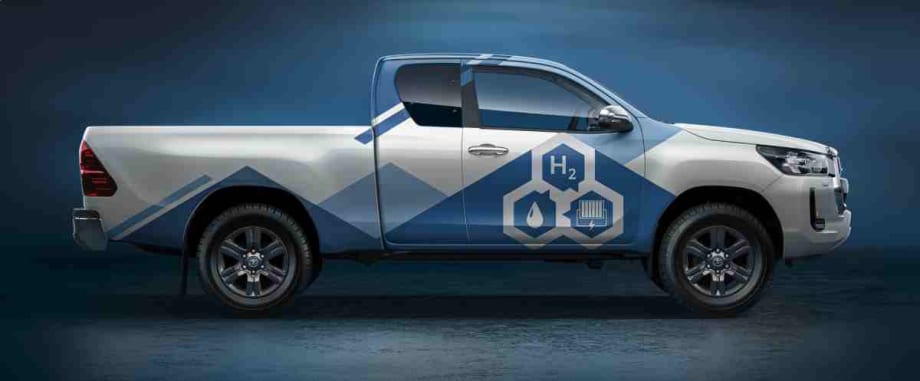
Toyota has secured UK government funding to develop a prototype hydrogen fuel cell-powered version of its Hilux pick-up at the company’s vehicle plant in Burnaston, Derbyshire.
Photo: Toyota
3 min to read
In a market with just two serious players and limited take up — Toyota with its Mirai and Hyundai and its Nexo — it might seem strange that both Toyota and BMW are continuing hydrogen development.
But with concerns over limited availability of raw materials impacting the growth of battery electric vehicles, developing a secondary zero emissions strategy is perhaps no bad thing.
In the U.K., Toyota has secured government funding to develop a prototype hydrogen fuel cell-powered version of its world-famous Hilux pickup at the company’s U.K. vehicle plant in Burnaston, Derbyshire.
Funding for the project is being delivered through the Advanced Propulsion Centre (APC), an organization supporting the development of cleaner technologies and new mobility concepts to accelerate transition to zero emission vehicles.
Toyota is taking its Mirai fuel cell and developing it for application in its Hilux pickup truck.
Matt Harrison, Toyota Motor Europe president and CEO, said: “The U.K. is one of the key markets for pickup trucks and an important market for Toyota. This funding represents a tremendous opportunity to develop a zero emission solution in a critical market segment. We would like to thank the U.K. government for the funding that will enable the consortium to investigate the development of a fuel cell powertrain for the Toyota Hilux, supporting our carbon neutrality ambition.”
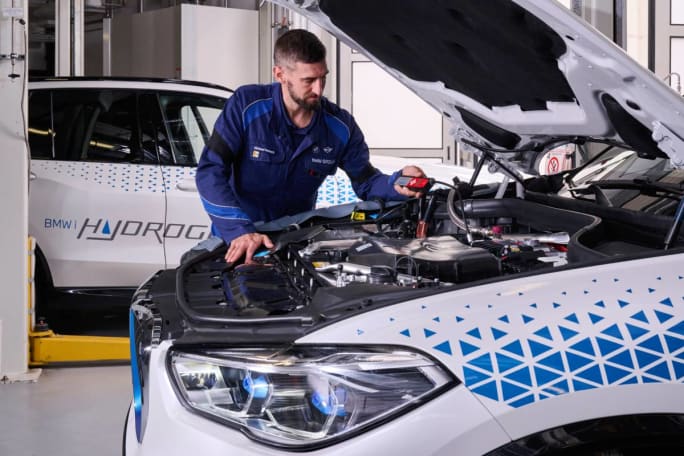
Photo: BMW
Meanwhile in Germany, the BMW Group is commencing production of its BMW iX5 Hydrogen model at its Munich Research and Innovation Centre (FIZ) in Germany.
BMW says the iX5 has already completed an intensive program of testing during its development phase and will now be used as a technology demonstrator for locally carbon-free mobility from spring 2023.
Frank Weber, member of the board of management of BMW AG responsible for development, commented: “Hydrogen is a versatile energy source that has a key role to play as we progress towards climate neutrality.
“We are certain that hydrogen is set to gain significantly in importance for individual mobility and therefore consider a mixture of battery and fuel cell electric drive systems to be a sensible approach in the long term.
“Fuel cells don’t require any critical raw materials such as cobalt, lithium or nickel either, so by investing in this type of drive system we are also strengthening the geopolitical resilience of the BMW Group. Our BMW iX5 Hydrogen test fleet will allow us to gain new and valuable insights, enabling us to present customers with an attractive product range once the hydrogen economy becomes a widespread reality.”
BMW is no stranger to hydrogen, having developed a bi-fuel version of its 7 Series sedan back in 2005. But as both Toyota and Hyundai have discovered, take up was lackluster because of lack of infrastructure, as well as the cost of vehicles.
Nevertheless, there are several advantages to hydrogen vehicles, not least the speed of filling up with hydrogen — equivalent if not faster than a gasoline car and the range capability of the vehicles, which exceeds current BEV models.
While fleet managers might be planning for the electrification of their fleets in the immediate to mid-term, it looks highly possible a mixed approach to decarbonized fleets will be more appropriate in the longer term.
More Global Fleet
GeoFencing Adds to Your Truck Security Arsenal
Geofencing is a familiar fleet tool today, but its early adoption marked a major shift in vehicle tracking, route monitoring, and the debate over employee privacy.
Read More →
Holman Takes Full Ownership of ARIZA in Mexico
Holman is bringing its Mexican fleet management operation fully under its own brand after more than 30 years as a joint venture. The change gives multinational fleet customers a single Holman operation across the U.S., Canada, and Mexico.
Read More →
5 Tire Maintenance Tips to Help Prevent Work Truck Downtime
Regular tire checks can do more than extend tread life. These five maintenance practices can help work truck fleets catch problems early, reduce costs, and prevent downtime.
Read More →

Proven Ways to Reduce Work Truck Downtime
The age-old problem of downtime will always be a reality, but with new strategies at hand, fleets have more ways to keep trucks on the road longer.
Read More →


Cameras, Safety and Insurance: From Reactive Claims to Real-Time Prevention (Part 2 of 2)
Part Two: Commercial auto remains one of the most challenging and costly lines of coverage for fleet operators and insurers alike. Continue learning more about how to effectively address these issues from Onur Aksan, Enterprise Business Development Executive, Geotab
Read More →
Cameras, Safety and Insurance: From Reactive Claims to Real-time Prevention
Commercial auto remains one of the most challenging and costly lines of coverage for fleet operators and insurers alike. Learn more about how to effectively address these issues from Onur Aksan, Enterprise Business Development Executive, Geotab.
Read More →
Fleet Costs Are Rising: Here’s How Leaders Are Responding
Fleet leaders are under pressure to reduce costs, adapt to economic uncertainty, and make smarter decisions. See how peers across North America are responding with real data, proven strategies, and forward-looking insights. Download the 2026 Market Pulse Report to benchmark your strategy and uncover where you can gain an edge.
Read More →
Enterprise Fleet Management Surpasses 900,000 Vehicles in U.S. & Canada
Enterprise Mobility connects with mobility solutions around the globe
Read More →