Truck suspensions support the load, provide stability, and cushion the ride. Understand your options to ensure the best suspension is spec’ed on your valuable work truck assets.
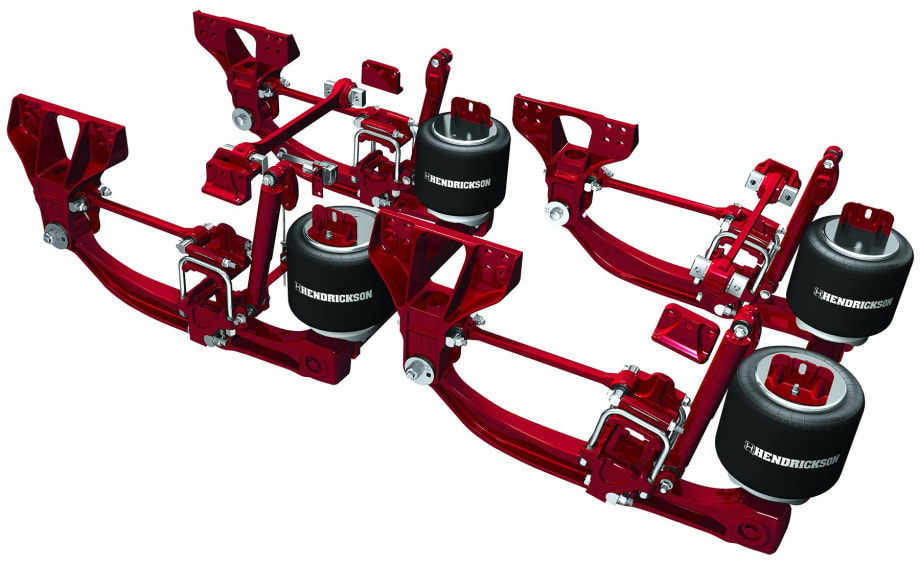
Specific jobs lend themselves better to air suspensions in the vocational world, including logging, oil field, heavy equipment haul, etc.
Photo: Hendrickson
6 min to read
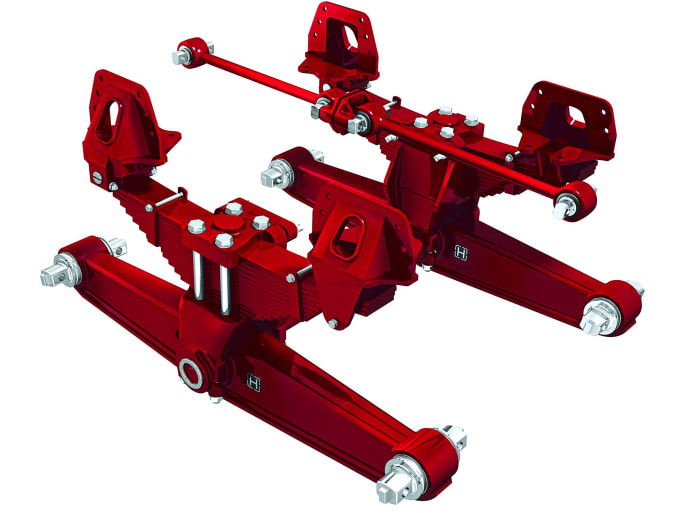
Applications that are not asconcerned with ride quality orweight efficiency but need to bemore cost-effective would be more likelyto use steel spring mechanical suspensions, such as construction, utility, or mining.
Photo: Hendrickson
There are three primary purposes of a suspension in a work truck. These purposes are:
Ad Loading...
Support the load — the suspension needs to be durable enough to handle the work expected of it.
Provide stability so the vehicle can traverse uneven and sometimes treacherous terrain without allowing the vehicle to tip.
Cushion the ride to protect the equipment, the cargo and provide for optimal driver comfort.
Ad Loading...
“Selecting the best suspension for the job relies heavily on what the application and duty cycle of the vehicle is,” according to Sean Whitfield, director of marketing for Hendrickson Truck Commercial Vehicle Systems.
For instance, a vocational vehicle used in rugged off-road conditions on worksites will require a different type of suspension than an on-highway vehicle that spends most of its time on paved streets or interstates.
“Vocational trucks require durability, stability, and traction while an on-highway vehicle will require an optimal ride condition. The keys are to spec the right equipment for the job,” Whitfield said.
Suspension Types by Truck Class
Medium-duty vehicles (Class 5-7) are, for the largest part, single drive axle (4x2 or 4x4) configurations.
“These vehicles are most often equipped with mechanical, steel leaf spring suspensions such as Hendrickson’s HTS suspension, but when used in ride sensitive applications, air suspensions such as Hendrickson’s HAS or PRIMAAX EX are also available. A steel spring mechanical suspension will be the most economical solution and will provide better stability but, in most cases, will be heavier and will deliver a stiffer/rougher ride when compared to an air suspension,” Whitfield said.
Ad Loading...
Typically, mechanical suspensions will be found in applications such as utility, dump, or box van.
According to Whitfield, the air suspension will be lighter and will deliver a smoother ride but will be higher in cost and typically require more maintenance than a mechanical suspension.
“Air suspensions can often be found in applications such as food and beverage, moving van or other applications where optimal ride quality is desired to protect the cargo,” Whitfield said.
Heavy-duty vehicles (Class 8) are most often tandem drive axle (6x4) configurations.“These vehicles can utilize mechanical steel spring suspensions, mechanical elastomeric (rubber) spring suspensions, or air suspensions. Again, the suspension choice is greatly dependent upon the vehicle’s application,” Whitfield noted.
For the most part, on-highway vehicles used primarily to haul freight on highways and interstates utilize mostly air suspensions, which provide the smoothest ride and lower maintenance.
Ad Loading...
Vocational trucks, however, incorporate a variety based on the requirements of the application.
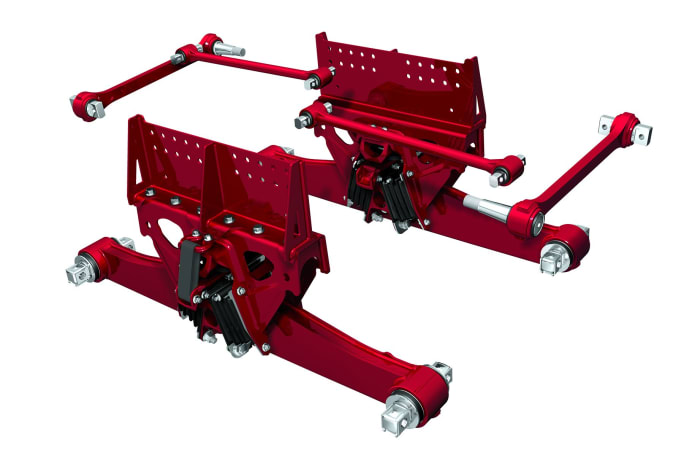
“Applications that are not as concerned with ride quality or weight efficiency but need to be more cost-effective would be more likely to use steel spring mechanical suspensions. This could include vocations such as construction, utility, or mining. Vehicles used in more weight and ride-sensitive applications where traction and durability are still needed, such as refuse, mixer, or dump, would be well suited for an elastomeric (rubber) spring suspension.
Whitfield noted that, in both cases, steel spring and rubber spring configurations, equalizing (walking) beam suspensions are the most common and effective for providing optimal stability, mobility, and traction.
Lastly, specific jobs lend themselves better to air suspensions in the vocational world.
“These would be commonly seen in logging, oil field, heavy equipment haul, etc. In these applications, the vehicles may regularly venture off paved roads to do the dirty work so they require a high level of durability and stability, but they also will spend a significant amount of time on the highway where the smoother ride is beneficial. These suspensions tend to be a little more expensive, but the benefits certainly pay off,” Whitfield said.
Ad Loading...
Vehicles used in moreweight and ride-sensitiveapplications where traction anddurability are still needed, such asrefuse, mixer, or dump, would be well suited for an elastomeric (rubber) spring suspension.
Photo: Hendrickson
Battling Suspension Myths
One common myth in the suspension world is that polyurethane components are suitable replacement parts for rubber components.
“It is insinuated that the polyurethane components perform as well and last longer as aftermarket service replacement components. Only the original equipment components are designed for optimal performance within the original equipment suspension system and should not be replaced by ‘will fit’ parts from non-original equipment suppliers,” said Sean Whitfield, director of marketing for Hendrickson Truck Commercial Vehicle Systems.
Another myth or misconception in the marketplace is that lower cost steel spring suspensions are more cost-effective than elastomeric rubber suspensions.
“When looking at the total cost of ownership (TCO), which includes acquisition cost, maintenance cost including parts and labor over the life of the product, it is advantageous to spec a rubber suspension. The benefits of ride quality, product performance, and longevity and TCO make rubber suspensions a better business case,” he said.
A System that Must Work Together
In addition to the primary suspension structural components, various other components contribute to the system’s performance.
“All suspensions utilize torque rods. Torque rods help maintain the suspension’s longitudinal and lateral alignment and consist of a steel rod with an end hub containing a bushing on either end, which may vary depending on the overall suspension and vehicle configuration. Transverse torque rods hold the tandem axles and suspension modules in place side to side, helping to maintain proper alignment, whereas the Longitudinal rods contribute to maintaining the suspensions and axles in place and prevent them from moving forward or rearward,” Whitfield said.
In some cases, V-Rods replace both the Transverse and Longitudinal torque rods.
“Shock absorbers contribute to controlling the suspension’s upward movement, referred to as jounce, when the vehicle hits a bump or a hole in the surface and also contributes to controlling the return movement downward, otherwise known as rebound. This control helps the tires maintain solid contact with the ground contributing to the vehicle’s traction,” Whitfield said.
A wide variety of shock absorbers are available and often are spec’ed with the suspension to support specific applications.
Ad Loading...
Next, you have springs.
“All suspensions for on-road applications incorporate some sort of spring,” Whitfield added.
Springs are spec’ed in different types, capacities, and sizes based on the vehicle, suspension, and application requirements.
Whitefield shared these options:
Steel Leaf Springs are exactly as the name suggests, a flat leaf of heat-treated spring steel which, incorporated into the suspension system, is allowed to flex to absorb road inputs and cushioning the ride. Expanding on spring technology, Hendrickson has recently introduced composite springs that can stand alone or be combined with steel springs to deliver substantial weight savings vs. a full steel spring suspension.
Rubber Springs can be as simple as thick blocks of rubber or complex geometric shapes with steel plates incorporated to perform the same job as steel springs but are much lighter and provide a much softer ride. Hendrickson’s elastomer business unit design and produces all rubber springs used in Hendrickson suspensions.
Air springs are another common component of suspension systems and provide air cushioning for a smooth ride. Air springs provide the smoothest ride of all mentioned here.
Ad Loading...
“Another important component for any suspension is the bushing. Bushings are used in most joints within a suspension, whether in structural beam connections or torque rods, etc. These bushings allow the suspension components to move as designed but maintain connection,” Whitfield said.
Spec’ing Work Truck Suspensions
The key to suspension performance, according to Whitfield, is to ensure the right suspension is spec’ed for the type of work that is being done and the needs of the business.
“Some suspensions may be more cost-competitive than others but may deliver less than desirable results. Conversely, a suspension can also be over-spec’ed. For instance, the optimal ride of an air suspension may be very desirable, and some may consider it worth the additional cost, but if extreme durability and high stability are requirements for the job, the air suspension may not be the right solution,” Whitfield said.It is important to ensure that the suspension type and capacity rating is spec’ed correctly to ensure maximum uptime for the job at hand.
Additionally, don’t forget about the total cost of ownership (TCO).
“While a steel spring mechanical suspension may be the most economically priced as original equipment, a rubber spring suspension can deliver longer life with less maintenance. So, although the up-front acquisition cost of a rubber suspension may be higher, over the life of the vehicle, the total cost of ownership associated with the rubber suspension is less than that of the steel spring suspension,” Whitfield said.
Ad Loading...
The Bottom Line
In addition to the primary suspension structural components, various other components contribute to the system’s performance.
“Suspension components should be inspected and maintained regularly as indicated in the technical publications to ensure proper function and longevity,” Whitfield said.
It is also important to use genuine original equipment replacement parts for the service of wearable components.
“The components of a system are designed to work together to deliver optimum performance,” Whitfield said.
Chevrolet is updating two of its smallest SUVs with added driver-assistance technology, redesigned interiors, and revised trim options. The changes could add more safety equipment as standard for commercial fleets, while a new Trailblazer configuration adds another all-wheel-drive option.
From managing fleets of thousands of vehicles to advancing safety and mentoring fellow professionals, Mark F. Petersen made his mark across both the corporate and supplier sides of fleet.
The former Prologis Mobility and Shell executive will help expand EV Realty’s truck charging business and move its power-first infrastructure model into autonomous vehicle depots and other fleet sectors.