




Related: How Fleet Management Companies are Addressing COVID-19
Creating a Robust Fleet Safety and Pandemic Plan
Essential Utilities has maintained a robust and thorough safety and accident management program which has seen radical changes during the pandemic.

Andy Lundin・Former Senior Editor
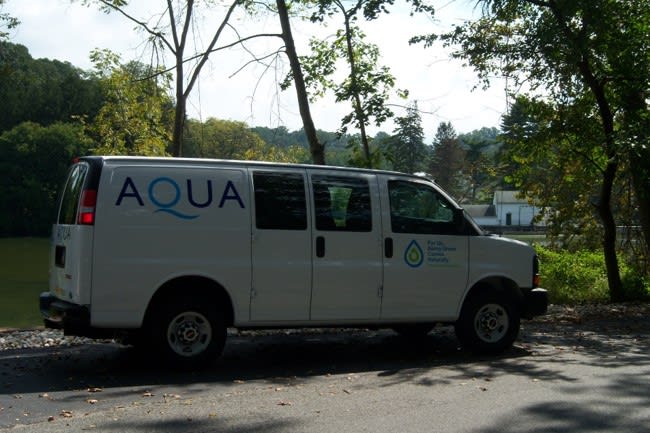
Before the pandemic, an average job for Essential Utilities would consist of two trucks that would travel with a team of four. This has changed to just one person per vehicle.
Photo: Essential Utilities
4 min to read
Essential Utilities, a water and gas utility company based in Pennsylvania, has made major strides in improving its fleet safety management program. Founded on maintaining a keen focus on monitoring driver behavior and strong industry partnerships, it has continued to persevere through the COVID-19 pandemic.
Charlie Stevenson, CAFM, serves as the vice president of fleet operations for Essential Utilities, which has business in Pennsylvania, Ohio, North Carolina, Illinois, Texas, New Jersey, Indiana, Virginia, West Virginia, and Kentucky.
He oversees a fleet of about 2,300 company vehicles, with 1,110 at the water utility and 1,200 for the gas utility.
Essential Utilities has maintained a robust and effective fleet safety program that was set in place in 2008. That driver training program had to make way for changes to support its fleet during the COVID-19 pandemic.
How Fleet Safety Changed During COVID-19
One of the biggest safety adjustments that fleets around the world have had to make this year are those that look to curb COVID-19.
Fleet safety considerations made to the coronavirus pandemic that Stevenson has addressed included how its fleet, operating for both the water utility and gas utility sides of the business, had to reduce the number of drivers in a vehicle for jobs being performed.
Previously, an average job would consist of two trucks that would travel with a team of four. This has changed to just one person since the coronavirus was declared a pandemic in March 2020.
“Every person is single in a truck today, because of COVID-19 we can’t have two people in a truck until we get through this social distance side of things,” Stevenson said. “This made us put some trucks back in service that we were going to retire, and we held on to trucks that were going to auction. We were nervous earlier on during the pandemic because we thought we were going to need more vehicles than we did.”
He also noted that the fleet allowed some employees to drive their own vehicles during the pandemic.
New Safe Sanitation Protocols
The impacts of COVID-19 have also led to extensive cleaning protocols that are performed by drivers and maintenance technicians.
“Our pool vehicles that go out have Clorox bleach wipes, so when somebody gets in a vehicle, they clean the car really well, reaching all the touchpoints. And when our mechanics handle a vehicle, they clean the door panels and clean everything on the vehicle prior to it being serviced,” he said.
The pandemic has also impacted the utility companies’ in-house maintenance shops.
Stevenson said the shops have an area designated for parts delivery sectioned off from the rest of the shop. Interaction between those delivering the parts was eliminated, including any form of signatures that would have previously been used.

Charlie Stevenson
Establishing a Robust Fleet Safety and Accident Program
But the good habits being incorporated into operations are led from the foundations of a robust fleet safety policy and accident management program.
The fleet’s current program was implemented 12 years ago when Stevenson identified the fleet needed to have a more robust safety program that could match the growing pace of the company and its fleet.
“We were growing fast, so we were looking for accident policies we could adopt,” he said.
Stevenson had been speaking with some industry peers for several years until around 2008 in which the utility company had decided Corporate Claims Management (CCM) would best serve the needs of the Essential Utilities fleet and its drivers, which at the time was operating under the name Aqua America and strictly operated as a water utility.
Establishing Key Fleet Safety Relationships
With CCM’s help, the fleet was able to strengthen its safety program for accident prevention.
The program was based on the foundation of a scorecard point system that measures several things that include reviewing driver accident history, analyzing complaints from the made through a public 1-800 number, and regular MVR monitoring.
The elements of this program have helped provide Essential Utilities with the tools needed to curb risky driving behavior, which has improved since its implementation.
“We reduced our at-fault accidents over the past three years with CCM services,” said Stevenson. “We’ve seen a downward trend in accidents.”
CCM has also been a strong supporter for the accident management side of the business, assisting with subrogation, vehicle salvaging (that comes along with a robust repair shop network), and additional accident management driver training services.
“They’ve been a good partner helping us with subrogation, on reporting any losses, reporting any unsafe drivers to our report card system dashboard that is offered,” he said. “They fix all our vehicles from the accident management side of the business.”
Stevenson added that, due to the smaller size of his fleet team, the assistance CCM has provided in the areas of safety has helped tremendously.
“Our program is labor-intensive; before we partnered with them, we were probably getting 200 driver complaints a year,” he said. “And we have a small staff that work in a fleet of over 1,000 vehicles.
Subscribe to Our Newsletter
More Safety

Sponsored•October 1, 2026
Fleet Manager’s Ultimate Playbook: Navigating the New Standard in OEM Connectivity
Rising operating costs, driver safety concerns, and unplanned downtime are putting unprecedented pressure on modern fleets. Discover how fleet managers use embedded OEM connectivity and real-time vehicle data to cut TCO, prevent downtime, and protect drivers without aftermarket telematics hardware.
Read More →
From Driver Well-Being to EV Charging | AF News Recap
Mental health belongs in the fleet safety conversation. This week, we’re looking at five ways fleets can support employee well-being before a crisis, plus Holman’s expansion in Mexico, new one-day Fleet Forward passes, and why EV charging demand is outpacing infrastructure growth.
Read More →
Nexar-Nauto Merger Aims to Give Fleets Better Safety Intelligence Through Larger Driving Dataset
Stefan Heck tells Automotive Fleet that combining more than 10 billion miles of driving history with Nexar's AI models will give fleets deeper insights into driver risk and roadway conditions than either company could provide independently.
Read More →
Don't Wait for a Crisis: 5 Ways to Build Mental Health Into Your Fleet Safety Program
For Suicide Prevention Month, fleet and safety leaders have an opportunity to put mental health where it belongs: at the center of workplace safety.
Read More →
How Camera Data Can Strengthen a Fleet’s Insurance Renewal
Insights from a commercial insurance carrier and a broker show how fleets can turn video telematic data, driver coaching, and improved claims results into a stronger case at insurance renewal.
Read More →
The Safest Fleets Aren’t the Ones with the Most Technology
You’ve made the telematics investment. Here’s how to capture the other half of its value and build the safest fleet on the road.
Read More →
Sponsored•August 7, 2026
Hidden in Plain Sight: Fleet Compliance Risks
Fleet compliance isn't just about having policies — it's about consistently enforcing them. This practical guide reveals six hidden compliance risks common in public sector and shared fleet operations and outlines proven strategies to improve visibility, accountability, and audit readiness
Read More →
NETS Sets 2026 Fleet Safety Benchmark Conference for Indianapolis
The Sept. 15–17 program will feature fleet benchmarking data, case studies, emerging technologies, and implementation strategies while running alongside the NSC Safety Congress & Expo.
Read More →
Off-the-Job Crashes Account for 43% of Employers’ $61.7 Billion Crash Burden
NETS quantifies costs dispersed across fleet, risk, HR, and other departments while providing new per-crash benchmarks for employers.
Read More →
Ram Recalls More Than 1.27 Million 1500 Pickups for Seat Belt Anchor Issue
The recall affects certain 2019-2026 Ram 1500 pickups that may have improperly attached second-row seat belt buckle anchors.
Read More →