




Most Fleets Back to Work, Though Future Uncertainty Remains
An average of 80% of fleets and the mobility community are back at work full time and 90% believe their company will survive through the pandemic, although they face major income loss. Many are unsure when business would operate at “normal” levels.

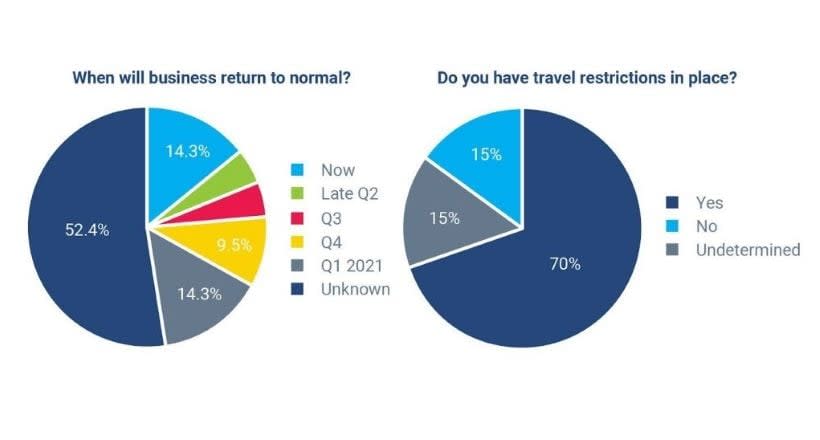
Roughly 52.4% of survey respondents were unsure of when their business would be operating at “normal” levels. The survey also found travel had been significantly reduced and were unsure as to when it would return to normal.
Graphs: Geotab
An average of 80% of fleets and the mobility community are back at work full time, and 90% believe their company will survive through the pandemic, although they face major income loss, according to data from Geotab. However, 52.4% of survey respondents were unsure of when their business would be operating at “normal” levels.
Companies and their fleet operations will continue to focus on asset utilization, productivity and efficiency, and cost reduction measures, regardless of their financial impact resulting from global economic slowdowns, according to Industry Pulse Checks from Geotab that measured fleet activity and analyzed 24 specific industries.
The pulse check also found that respondents said travel had been significantly reduced and were unsure as to when it would return to normal. This meant there would be more engagement with webinars and fewer face-to-face meetings, which also meant a reduction in miles driven for fleets.
Geotab also reported that companies would be incorporating cost-cutting measures for 2020-2021, which means fleet utilization will be critical; and fleets may look to operate with fewer vehicles.
The Pandemic's Impact on Various Industries
The healthcare industry has been severely impacted, due to demand for essential workers, caregivers and personal protective equipment and supplies surges, the report from Geotab found. Impacts have been severe in both areas of COVID-19 related healthcare and non-essential healthcare. Most healthcare industry companies are anticipating a substantial decline in profit margins for the remainder of this year.
Last-mile delivery companies have seen an exceptional increase in business due to COVID-19. These companies are in constant communication with their supply chain to ensure timely product deliveries to keep up with demand. The demand for everyday items has seen more of an increase than for standard items like electronics.
Meanwhile, government fleets have established two-pronged response to this pandemic, Geotab said, Most state/provincial/local agency fleets (police, fire, EMS, DOT, and general service fleets) are operating at over-capacity in response to new COVID-19 related activities, while others (DOE and school buses, parks and recreation) are shut down. Federal fleet activities seem to be largely unaffected, although a disruption in OEM vehicle deliveries have resulted in significant challenges to leasing and rental operations (GSA).
Overall, long-haul fleets are showing true optimism for freight demand again in the past couple weeks since COVID-19 and its impact on fleet operations. The majority of fleets expect to see a continued increase of freight levels over the next 30-90 days, while only a very few mostly smaller fleets expect to see a decrease.
In the first few months after lockdown, the rideshare, carshare, and car rental industries saw 70%-90% reduction in business. Predictions are that business travel will not recover to pre-pandemic levels due to the growing acceptance of video chat meetings. This anticipated drop in business travel will have a long lasting impact on the car rental industry due to its heavy reliance on business travel, particularly from airports.
Meanwhile, the construction industry was reported to have been one of the few industries that has been able to maintain business and continue working during the COVID-19 crisis, Geotab reported. Indications from companies surveyed all felt that, in the short term, there has been little impact on the state of the business. However, in the longer term, there is concern with regards to existing contract work that has been keeping their workers employed and on the job site during this time.
For insurance companies, overall, staff that manage claims show that vehicle activity slowed down tremendously during the latter half of March and early April during COVID-19 and are slowly recovering. With the percentage of vehicle activity in this sector in February ranging from 60%-78% and dropping in early June to ranges of 29%-55% for fleet utilization.
Meanwhile, for oil and gas companies, prices were already suppressed by global competition prior to COVID-19, and the shutdown exacerbated the problem via an instantaneous and unprecedented drop in demand. This caused issues related to where to store excess oil and a rapid drop in prices that were not sustainable for many smaller exploration companies that had a heavy debt load.
More Detailed Data
Companies also said they would begin implementing new corporate safety policies, which would lead to a need for technology to enable compliance. Additional analysis conducted by Nexus Communication that was presented in the pulse check found that clients are wanting advice and innovation above all else from their suppliers, followed by more communication.
With regards to overall business impact from the pandemic, the pulse check found:
47.6% of companies had significant impact to their business.
28.6% of respondents said they had little impact to their business.
43.3% of respondents said competitors have been significantly impacted.
Uncertainty remains for the operational impact as 57.1% of respondents said it was unknown at this time if they would have additional reduction in workforce in the next six months. And, with regards to financial impact, 42.3% of respondents said the pandemic had significant impact to their customer base.
From the bellwether companies identified and who have participated in the study, all but one were fleets with at least more than 500 vehicles, with a majority of vehicles operating in the U.S.
More Operations

90% Use Telematics. Are Fleets Getting Safer? | AF News Recap
This week, we're breaking down which industries have the highest rates, how Jamie McKay manages 2,400 vehicles, what's happening with the 2027 fleet awards, and why software-defined vehicles could introduce new costs.
Read More →
What's Best Handled by an FMC, and What's Better Done Directly?
Fleet managers continue to rely on FMCs for essential services but are taking a closer look at where working directly with suppliers can improve efficiency and responsiveness.
Read More →
Fleet Meets: Erin Gilchrist
Meet Erin Gilchrist, the inaugural Mike Antich Spirit of Fleet Award winner, as she shares insights on leadership, mentorship, the power of industry connections, and why people remain at the heart of fleet's future.
Read More →

How 2026 Fleet Visionary Jamie McKay Manages 2,400 Vehicles Across 37 States
How do you keep 2,400 vehicles running across 37 states? Fleet Visionary Award winner Jamie McKay shares how collaboration, flexibility, and a few simple strategies help her tackle fleet management challenges at Aptive Pest Control.
Read More →
Managing Fleet Costs in an Era of Permanent Volatility
Fleet operating costs have risen more than 20% since 2020, raising a key question: When does extending a vehicle's service life stop making financial sense?
Read More →
The Next Evolution of Fleet Management: Autonomous Operations
This opening keynote session at the Fleet Forward Conference highlights the future of autonomous driving for fleets.
Read More →
How to Reduce the Total Cost of Risk From Catalytic Converter Theft
A stolen catalytic converter can cost fleets far more in downtime and lost productivity than in repairs. A total-cost-of-risk approach can help fleet managers quantify their exposure and prioritize theft prevention.
Read More →
Personal-Use Charges Rise as Vehicle Values Fall | AF News Recap
Personal-use charges are climbing, wholesale used-vehicle values are declining, and commercial fleet sales growth is slowing. This week, we're breaking down the latest fleet data, plus how Element Fleet Management is helping Waymo prepare for its first Canadian robotaxi market.
Read More →
Here's When You Should Make an Exception to Fleet Policy
Fleet policies are designed to create consistency, but not every driver or situation fits neatly within standard rules.
Read More →
AI-Native or AI-Acquired: What Should Fleet Managers Look for in an AI Platform?
Six questions can help fleet managers look beyond AI marketing claims to evaluate integration, data access, and real-world operational performance.
Read More →