




Ford Escape Gets Engine, Safety Upgrades for 2017
Ford is updating its Escape compact SUV with a pair of new engines, standard stop-start, safety options, and enhanced connectivity for the 2017 model year.
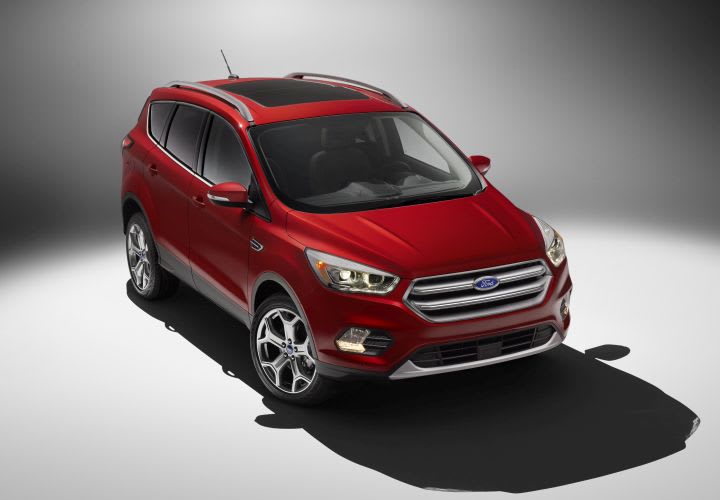
Photo of 2017 Escape courtesy of Ford.
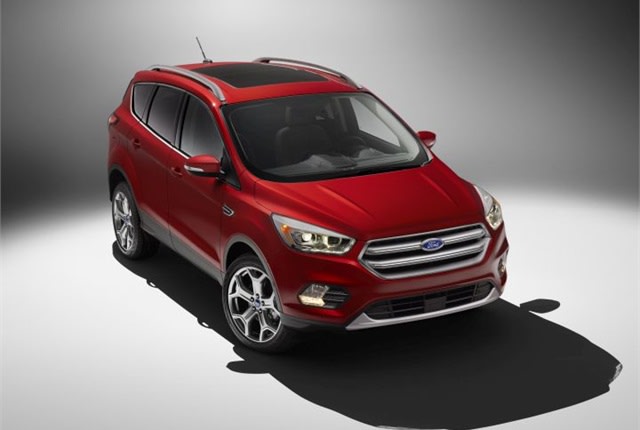
Photo of 2017 Escape courtesy of Ford.
Ford is updating its Escape compact SUV with a pair of new engines, standard stop-start, safety options, and enhanced connectivity for the 2017 model year.
The Escape, which typically ranks high among commercial fleet registrations, entered its third generation with the 2012 model year. Ford will show the 2017 Escape at the Los Angeles Auto Show.
Ford is adding two four-cylinder EcoBoost engine options to the 2017 Escape, including a 1.5L and 2.0L twin-scroll turbo-charged engine. The new engines arrive with standard stop-start technology that shuts off the engine when the driver presses the brake pedal. The engines restart when the brake pedal lifts. Ford expects an improvement of fuel economy of up to 6% in stop-and-go driving.
Escape SE and Titanium trim levels come standard with the 1.5L EcoBoost, while the 2.0L EcoBoost is optional. A 6-speed automatic transmission is standard across the line, with new paddle-shift technology available for Escape SE and Titanium.
The twin-scroll turbocharged 2.0-liter EcoBoost delivers 245 horsepower and 275 lb.-ft. of
torque, along with greater efficiency and improved noise, vibration and harshness performance.
New pistons provide a higher, more efficient compression ratio, and a newly designed,
integrated exhaust manifold is optimized for the twin-scroll turbo system.
The aluminum-block, twin-cam 1.5L EcoBoost with integrated exhaust manifold is projected to deliver an expected 180 hp and 185 lb.-ft. of torque, which is comparable to the 1.6L engine.
Ford also offers a 2.5L i-VCT four-cylinder engine that carries over as standard equipment for the Escape S.
New optional driver-assist technologies include enhanced active park assist, lane-keeping system, adaptive cruise control and forward collision warning with brake support.
Commercial fleets added 31,434 Escape SUVs in 2013, making it the fourth most added fleet vehicle.
More Operations

How to Write Better AI Prompts for Fleet Analysis
Include these six elements in your fleet prompts to generate more relevant analysis and accurate answers.
Read More →
Fleet Meets: Eric Kilgore
This edition of the Fleet Meets series features one of the industry's best leaders driving multi-market and national operations.
Read More →
Why Reactive Fleet Management Is Becoming Too Expensive to Sustain
Research highlights a growing need for proactive management strategies to address rising costs in fleet operations effectively.
Read More →


What Your Fleet KPIs Aren’t Telling You
Tracking fleet metrics is only useful when the data leads to better decisions. This guide helps fleet leaders assess cost, utilization, and downtime more accurately, identify performance gaps, and prioritize the actions that can improve operational results.
Read More →
Hidden in Plain Sight: Fleet Compliance Risks
Fleet compliance isn't just about having policies — it's about consistently enforcing them. This practical guide reveals six hidden compliance risks common in public sector and shared fleet operations and outlines proven strategies to improve visibility, accountability, and audit readiness
Read More →
Turning Fleet Payment Data into Executive Insights
Does data alone drive results in operations?
Read More →
Automotive Fleet Opens 2026 Personal Use Survey for Commercial Fleet Managers
Commercial and corporate fleet managers are invited to share how their organizations handle company vehicle personal-use policies, charges, and driver eligibility.
Read More →
Gary Van Orden Retires After Nearly Four Decades in Commercial Fleet
From answering customer calls at Ford Motor Company to leading fleet sales across multiple OEMs and a fleet management company, Gary Van Orden's career reflects nearly four decades of leadership in commercial fleet.
Read More →
How Stellantis Plans to Get Ahead of Fleet Downtime
Vehicle acquisition may grab the headlines, but fleet uptime increasingly determines operating success. Darren Bradshaw of Mopar North America gives the details.
Read More →
Hyundai Releases 2027 Commercial Program Incentives
The 2027 Model Year "Fleet Street Incentives" are available to commercial and government fleets.
Read More →