




Surprising Fleet Resale Trends
The market is shifting and you don’t want to be caught off guard. Pay attention to gas prices and retail buying trends, as well as the resale market so you don’t get caught with the wrong vehicle at the wrong time.

The perfect storm of increasing gas prices and increasing prices for mid-size cars versus SUVs and crossovers means it’s even more imperative for fleet managers to make the correct decision now, to reap the gains in cost savings and gain on-sale increases.
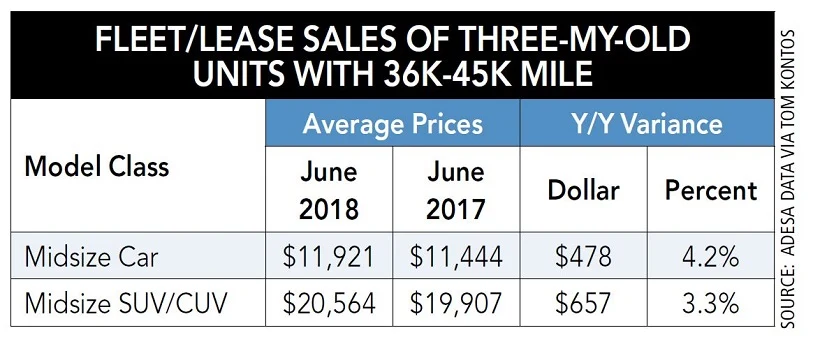
Chart courtesy of ADESA via Tom Kontos, executive VP and chief economist for ADESA Analytical Services
Midsize cars have performed better in the resale market than crossovers and SUVs. This has not been the case for the last three years.
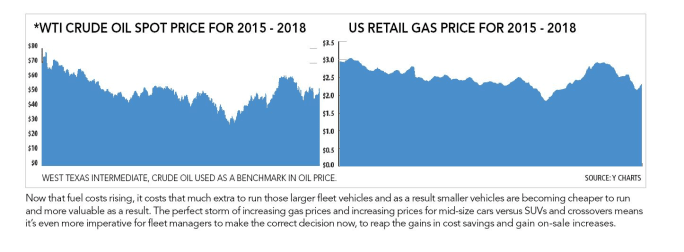
Resale of vehicles for fleets is always a major issue. One must intelligently forecast which types of vehicles are going to resell the best down the road, monitor oil/gas prices, and not run the vehicles into the ground in the meantime. Due to historically low oil prices the past few years, the popularity of larger vehicles has gone up, such as SUVs and crossovers. Lower oil prices means lower recurring costs for your fleet, making the marginal utility of the larger vehicle worth the slight increase in fuel costs. Now that fuel costs are going up again, it costs that much extra to run those larger fleet vehicles and as a result smaller vehicles are becoming cheaper to run and more valuable as a result.
On top of these large macroeconomic trends, manufacturers have cut way back on mid-size car sales to more closely match demand. This means they aren’t flooding the rental market with excess inventory anymore. Thus, right as demand might be increasing for mid-size cars due to oil/gas prices, supply is decreasing due to manufacturer’s more careful moderation of their inventory and demand forecasting.
Fleet must think three years into the future when they are buying vehicles. Which vehicles are going to depreciate the least? Which are going to see a spike in demand? Which are going to hold their value the most? These are all questions that are pertinent to answer. Right now, mid-size vehicles are seeing a decrease in demand, making them hot commodities right now and likely in the future.
The fundamental macroeconomic data also supports the thesis that mid-size cars will be more valuable in the future, so it’s not just speculation either. As noted in this chart from ADESA, analytical services from June 2018, year-over-year car resale prices have increased more than 4%, reversing a trend that has persisted for multiple years now, correlating with an increase in gas and oil commodity prices. The perfect storm of increasing gas prices and increasing prices for mid-size cars versus SUVs and crossovers means it’s even more imperative for fleet managers to make the correct decision now, to reap the gains in cost savings and gain on-sale increases.
The bottom line is that the market is shifting and you don’t want to be caught off guard. Pay attention to gas prices and retail buying trends, as well as the resale market so you don’t get caught with the wrong vehicle at the wrong time. Not only could it hurt you down the road, but also every time you go to the pump as gas prices increase.
Related: Better Safe Than Sorry
More Blog Posts

Getting a PhD in Fleet
COVID-19 has changed how fleets connect with each other but that doesn’t mean you have to give up the opportunity to grow, learn, and get better at managing your fleet.
Read More →
All Charged Up
There is an avalanche of new electric vehicles slated to hit the market in the next couple years. There are over 100 new models slated to hit by 2022 from the Big Three, the major imports, and from a lot of new start-ups.
Read More →
Fleet on the Rebound
Most of the key players in the fleet market are either stuck at home or working in an office but unable to travel. So we’re changing our business model to help maintain the flow of information until things get back to the way they were.
Read More →
Undertaking the Complexities of Fleet
Staying on top of industry trends to keep up with the intricacies of fleet can be a full-time job all by itself, and to be a top performing fleet requires a little forward thinking and anticipation.
Read More →
The Real Transportation Revolution
The fleet market is leading the charge on making real gains in efficiency and safety with telematics, in-cab video, and safety technologies that are available today.
Read More →
Stay Out of My Lane
Let’s get a framework in place and a legislative plan that allows us to develop autonomous vehicle technologies without putting lives at risk in the short term.
Read More →
Wrapping Up Another Year
Thanks to the strong economy that the U.S. is enjoying, U.S. commercial companies have been able to invest more money into their fleets, and strong fleet sales are a reflection of that.
Read More →
AFLA's New Canadian Conference Continues Growth Tradition
Fleets know how valuable of a resource that AFLA conferences can be, and the upcoming summit in Canada will serve as another wealth of knowledge that the association has delivered for decades.
Read More →
The Next Chapter
It’s impossible to attend great fleet events like AFLA and not get caught up in why is has helped make the industry so great, but equally exciting is seeing how much the association is ready to take on the evolving industry that is fleet.
Read More →
Fleet Ground Zero
You are missing out on some potentially game changing information when you don’t get out to meet regularly with your peers.
Read More →