




2016 Pedestrian Deaths Projected to Shatter Records
Preliminary estimates released by the Governors Highway Safety Association indicate an 11% surge in pedestrian road fatalities last year compared to 2015.
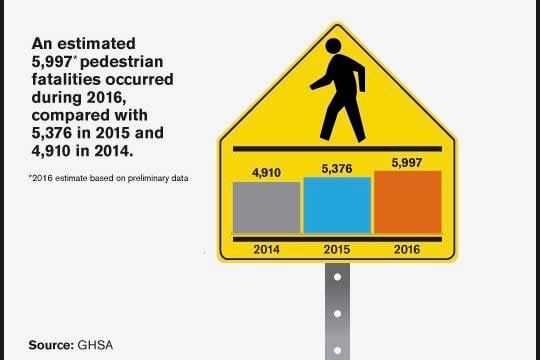
Graphic courtesy of GHSA.
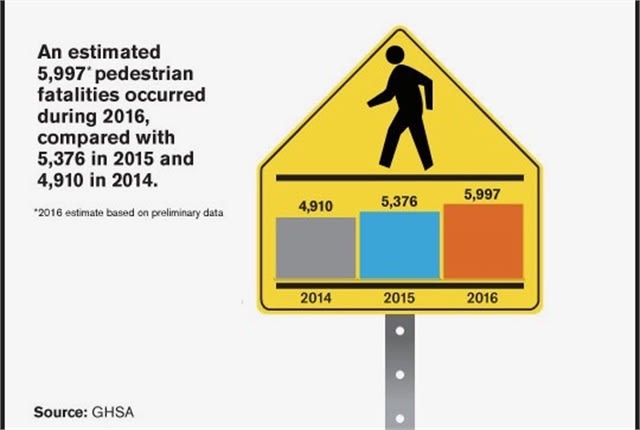
Graphic courtesy of GHSA.
The number of pedestrians killed on U.S. roads climbed 11% in 2016 — the steepest year-to-year increase since record keeping on the matter began, according to preliminary estimates from the Governors Highway Safety Association.
The surge is expected to set new records in both the number of deaths and the increase in percentage. The Governors Highway Safety Association (GHSA) relied on preliminary 2016 data from all 50 state highway safety offices and the District of Columbia. Richard Retting of Sam Schwartz Transportation Consultants authored the report.
“This is the second year in a row that we have seen unprecedented increases in pedestrian fatalities, which is both sad and alarming,” Retting said.
From 2014 to 2015, the number of pedestrian deaths spiked more than 9%. Compared to 2014, the number of pedestrians killed in 2016 increased by 22%.
“It is critical that the highway safety community understand these disturbing statistics and work to aggressively implement effective countermeasures,” Retting said. “The information in this report will help states and localities pursue engineering, enforcement and education solutions to reverse this trend.”
States reported 2,660 pedestrian fatalities for the first six months of 2016, compared to 2,486 deaths during the same period in 2015. The report adjusts for underreporting and past full-year data trends. Pedestrians represent approximately 15% of all motor vehicle deaths.
More than twice as many states reported an uptick in pedestrian fatalities in the first six months of 2016 than had decreasing numbers. Thirty-four states saw an increase, while 15 states and the District of Columbia reported decreases. Just one state had no change.
There are many possible factors contributing to this spike. As economic conditions improve and gas prices remain low, the U.S. has seen an increase in motor vehicle miles traveled. At the same time, a growing number of Americans are choosing to travel by foot for health, transportation, economic or environmental reasons. Another potential factor is a sharp rise in the use of smartphones to send and receive multimedia messages, a frequent source of mental and visual distraction for both walkers and drivers.
“Everyone walks, and we want to encourage that, but at the same time we want to make sure that we all get to our destinations safely,” said Jonathan Adkins, GHSA executive director. “Unfortunately, this latest data shows that the U.S. is not meeting the mark on keeping pedestrians safe on our roadways. Every one of these lives represents a loved one not coming home tonight, which is absolutely unacceptable.”
GHSA also asked its state members, which are responsible for addressing behavioral safety, to provide examples of their efforts to reduce pedestrian and motor vehicle collisions. Promising strategies include: high visibility enforcement and public information campaigns aimed at both motorists and pedestrians; identifying high-risk zones and conducting educational outreach in these areas; adoption of Complete Streets policies, which ensure streets are safe for all users regardless of mode, age and ability; and strategic partnerships with local universities and community organizations to advance pedestrian safety.
The National Safety Council echoed GHSA’s call to action.
“The National Safety Council is alarmed by new numbers from the Governors Highway Safety Association indicating a historic rise in pedestrian fatalities last year,” the organization said in a released statement. “Pedestrians are among our most vulnerable roadway users. They are unprotected and, in most cases, outnumbered. As motor vehicle deaths continue to climb, we must not forget that the risks we are all facing extend to the sidewalks too. Everyone deserves safe passage, and these numbers are yet another indication that we must do more to keep each other safe.”
To download the report, click here.
More Safety

Nexar-Nauto Merger Aims to Give Fleets Better Safety Intelligence Through Larger Driving Dataset
Stefan Heck tells Automotive Fleet that combining more than 10 billion miles of driving history with Nexar's AI models will give fleets deeper insights into driver risk and roadway conditions than either company could provide independently.
Read More →
Don't Wait for a Crisis: 5 Ways to Build Mental Health Into Your Fleet Safety Program
For Suicide Prevention Month, fleet and safety leaders have an opportunity to put mental health where it belongs: at the center of workplace safety.
Read More →
How Camera Data Can Strengthen a Fleet’s Insurance Renewal
Insights from a commercial insurance carrier and a broker show how fleets can turn video telematic data, driver coaching, and improved claims results into a stronger case at insurance renewal.
Read More →
The Safest Fleets Aren’t the Ones with the Most Technology
You’ve made the telematics investment. Here’s how to capture the other half of its value and build the safest fleet on the road.
Read More →
Hidden in Plain Sight: Fleet Compliance Risks
Fleet compliance isn't just about having policies — it's about consistently enforcing them. This practical guide reveals six hidden compliance risks common in public sector and shared fleet operations and outlines proven strategies to improve visibility, accountability, and audit readiness
Read More →
NETS Sets 2026 Fleet Safety Benchmark Conference for Indianapolis
The Sept. 15–17 program will feature fleet benchmarking data, case studies, emerging technologies, and implementation strategies while running alongside the NSC Safety Congress & Expo.
Read More →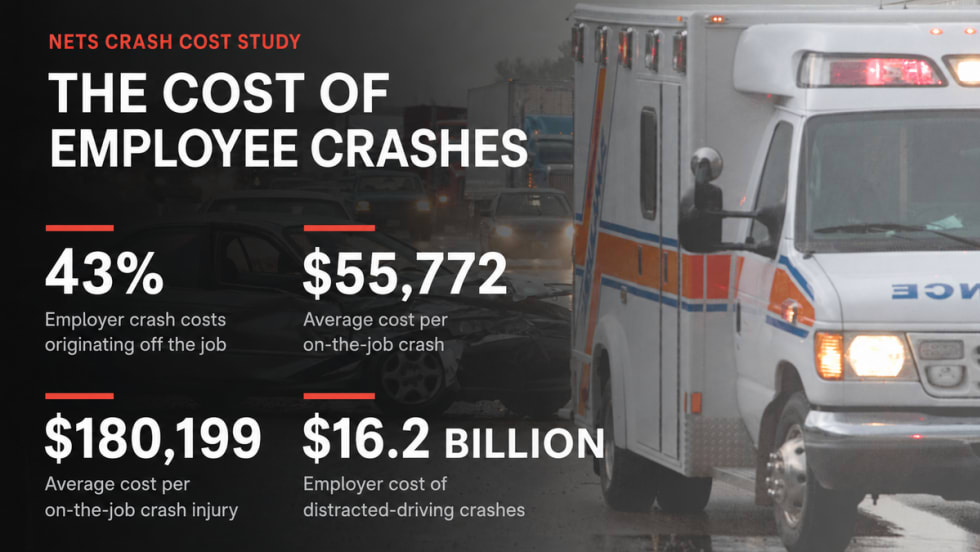
Off-the-Job Crashes Account for 43% of Employers’ $61.7 Billion Crash Burden
NETS quantifies costs dispersed across fleet, risk, HR, and other departments while providing new per-crash benchmarks for employers.
Read More →
Ram Recalls More Than 1.27 Million 1500 Pickups for Seat Belt Anchor Issue
The recall affects certain 2019-2026 Ram 1500 pickups that may have improperly attached second-row seat belt buckle anchors.
Read More →
How Better Visibility Cut Speeding Violations by 48%
Fleet leaders don't need more data, they need clearer visibility into what the data is saying. This case study explores how one utility replaced speeding-event counts with a single metric — miles driven in violation — to strengthen safety and significantly reduce speeding violations.
Read More →
Operation Safe Driver Week: Why the Industry's Oldest Safety Campaign Still Matters to Fleets
A look at how a 2007 enforcement initiative became one of the most consequential weeks on the fleet safety calendar, and what it means for your drivers in 2026.
Read More →