




Ram Raises Capacities for 2017 Chassis Cab Trucks
Ram has increased the towing capacities and gross combination weight rating (GCWR) for its 3500, 4500, and 5500 chassis cab trucks for the 2017 model year, Ram has announced.

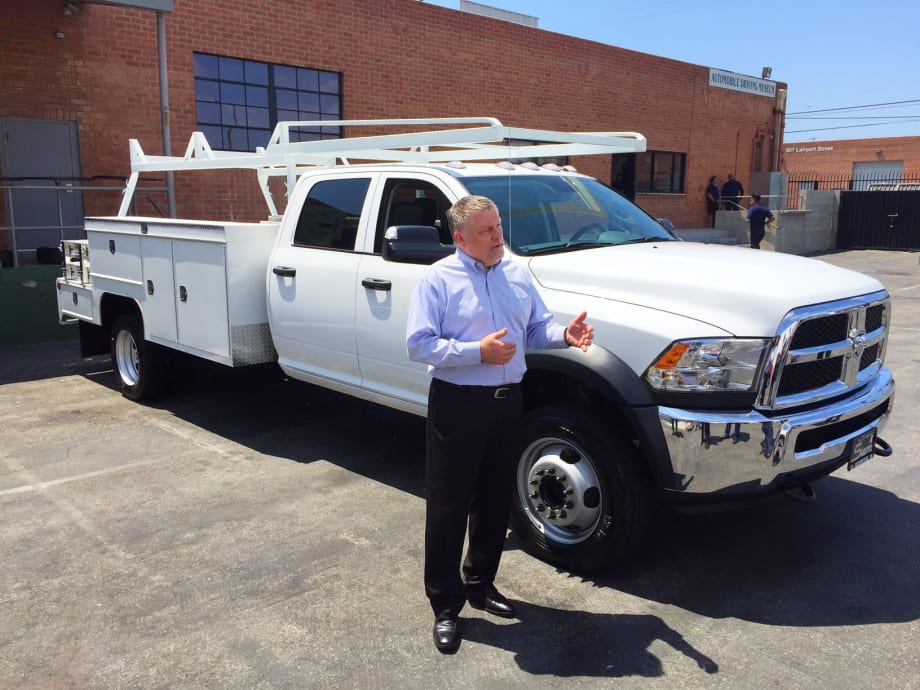
Dave Sowers, head of Ram Truck marketing, commercial vehicles, shows journalists the 2017 Ram 4500 chassis cab truck. Photo by Paul Clinton.
Dave Sowers, head of Ram Truck marketing, commercial vehicles, shows journalists the 2017 Ram 4500 chassis cab truck. Photo by Paul Clinton.
Ram has increased the towing capacities and gross combination weight rating (GCWR) for its 3500, 4500, and 5500 chassis cab trucks for the 2017 model year, Ram has announced.
The tow capacities and GCWR increase 1,000 pounds each. Ram will also offer an optional LED tail lamp and standard five-micron cabin air filter.
The max trailering weight for 2017 increases to 23,770 pounds for the Ram 3500, 25,650 pounds for the Ram 4500, and 30,600 for the Ram 5500. The GCWR increases to 31,000 pounds for the Ram 3500, 33,500 pounds for the Ram 4500, and 38,500 pounds for the Ram 5500.
The chassis cab trucks are available in three trim levels, including Tradesman, SLT, and Laramie. Regular or crew cab trucks offer cab-to-axle lengths of 60, 84, 108, and 120 inches.
Engine options carry over, including a choice between the 6.4L HEMI V-8 and 6.7L Cummins diesel inline-6. The diesel offers 15,000-mile oil change intervals. The trucks offer a 74-gallon fuel tank and optional 22-gallon auxiliary tank.
More Operations

Fleet Has a Talent Pipeline Problem. What Comes Next? | AF News Recap
Where will fleet’s next generation of leaders come from? This week, we’re looking at the industry’s talent pipeline, what certification can add to a fleet career, how to build an award-worthy track record, and the return of Automotive Fleet’s Personal Use Survey.
Read More →
Smith System Launches Driver Risk Management Program
Fleets have more driver data than ever, but identifying risky behavior doesn't necessarily correct it. Smith System's new Driver Risk Management program combines monitoring, training, and follow-up coaching to help fleets connect risk signals with driver intervention.
Read More →
Automotive Fleet Opens 2026 Personal Use Survey for Commercial Fleet Managers
Less than two weeks left! Commercial and corporate fleet managers are invited to share how their organizations handle company vehicle personal-use policies, charges, and driver eligibility.
Read More →
From AI Prompts to AI-Generated Safety Songs | AF News Recap
Can better prompts make AI more useful for fleet managers? This week, we’re breaking down smarter fleet analysis, an AI-assisted experiment that turned safety training into music, and what happened to fuel prices in August.
Read More →
How to Write Better AI Prompts for Fleet Analysis
Include these six elements in your fleet prompts to generate more relevant analysis and accurate answers.
Read More →
Fleet Meets: Eric Kilgore
This edition of the Fleet Meets series features one of the industry's best leaders driving multi-market and national operations.
Read More →
Why Reactive Fleet Management Is Becoming Too Expensive to Sustain
Research highlights a growing need for proactive management strategies to address rising costs in fleet operations effectively.
Read More →
What Your Fleet KPIs Aren’t Telling You
Tracking fleet metrics is only useful when the data leads to better decisions. This guide helps fleet leaders assess cost, utilization, and downtime more accurately, identify performance gaps, and prioritize the actions that can improve operational results.
Read More →
Hidden in Plain Sight: Fleet Compliance Risks
Fleet compliance isn't just about having policies — it's about consistently enforcing them. This practical guide reveals six hidden compliance risks common in public sector and shared fleet operations and outlines proven strategies to improve visibility, accountability, and audit readiness
Read More →
Turning Fleet Payment Data into Executive Insights
Does data alone drive results in operations?
Read More →