




Ford Testing Self-Driving Cars in Snow
The challenging winter-weather testing is based in Michigan, including Mcity on the campus of the University of Michigan.
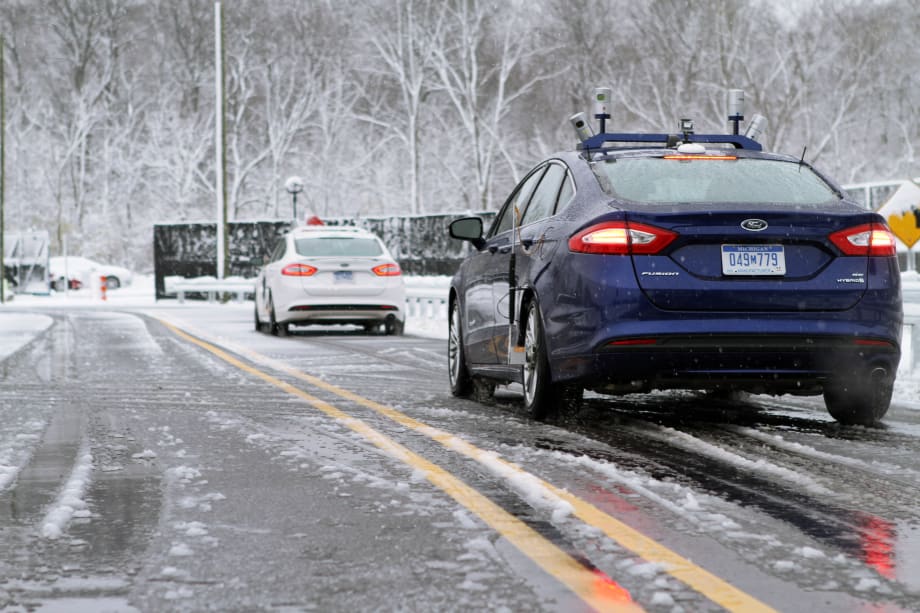
Photo courtesy of Ford.
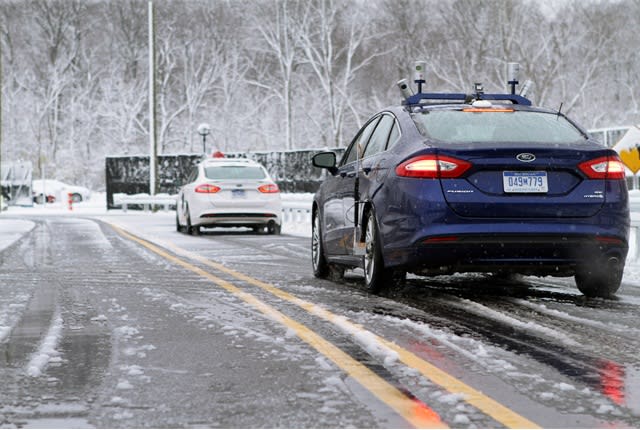
Photo courtesy of Ford.
Ford is conducting autonomous vehicle tests in snow-covered environments — another step in the company’s plan to bring self-driving vehicles to millions of customers worldwide, the automaker said.
“It’s one thing for a car to drive itself in perfect weather,” said Jim McBride, Ford technical leader for autonomous vehicles. “It’s quite another to do so when the car’s sensors can’t see the road because it’s covered in snow. Weather isn’t perfect, and that’s why we’re testing autonomous vehicles in wintry conditions — for the roughly 70 percent of U.S. residents who live in snowy regions.”
Ford’s winter-weather testing takes place in Michigan, including at Mcity — a 32-acre, simulated urban environment at the University of Michigan.
Fully autonomous driving can’t rely on GPS, which is accurate only to several yards — not enough to localize or identify the position of the vehicle. And it’s key that an autonomous vehicle knows its precise location, not just within a city or on a road, but in its actual driving lane. A variation of a few inches makes a big difference.
LiDAR, on the other hand, is much more accurate than GPS – identifying the Fusion Hybrid’s lane location right down to the centimeter, according to Ford. LiDAR emits short pulses of laser light to precisely allow the vehicle to create a realtime, highdefinition 3D image of what’s around it.
In ideal weather, LiDAR is the most efficient means of gathering important information and metadata — underlying information about the data itself — from the surrounding environment. LiDAR can sense nearby objects and use cues to determine the best driving path. But on snowcovered roads or in high-density traffic, LiDAR and other sensors such as cameras can’t see the road. This is also the case when the sensor lens is covered by snow, grime or debris.
Together, Ford and University of Michigan technologists began developing a solution that would allow an autonomous vehicle to see on a snow-covered road. To navigate snowy roads, Ford autonomous vehicles are equipped with high-resolution 3D maps. The maps are complete with information about the road and what’s above it, including road markings, signs, geography, landmarks and topography.
“Maps developed by other companies don’t always work in snow-covered landscapes,” said Ryan Eustice, associate professor at University of Michigan’s college of engineering. “The maps we created with Ford contain useful information about the 3D environment around the car, allowing the vehicle to localize even with a blanket of snow covering the ground.”
An autonomous vehicle creates the maps while driving the test environment in favorable weather, with technologies automatically annotating features such as traffic signs, trees and buildings. When the car can’t see the ground, the vehicle detects above-ground landmarks to pinpoint itself on the map, and then subsequently uses the map to drive successfully in inclement conditions.
“The vehicle’s normal safety systems, like electronic stability control and traction control, which often are used on slippery winter roads, work in unison with the autonomous driving software,” McBride explained. “We eventually want our autonomous vehicles to detect deteriorating conditions, decide whether it’s safe to keep driving, and if so, for how long.”
Winter driving still presents a host of challenges, but Ford considers this testing an important achievement on the road to autonomous driving. That road goes back roughly a decade to the first-generation autonomous vehicle from Ford — a LiDAR-equipped F250 Super Duty.
More Safety

From Driver Well-Being to EV Charging | AF News Recap
Mental health belongs in the fleet safety conversation. This week, we’re looking at five ways fleets can support employee well-being before a crisis, plus Holman’s expansion in Mexico, new one-day Fleet Forward passes, and why EV charging demand is outpacing infrastructure growth.
Read More →
Nexar-Nauto Merger Aims to Give Fleets Better Safety Intelligence Through Larger Driving Dataset
Stefan Heck tells Automotive Fleet that combining more than 10 billion miles of driving history with Nexar's AI models will give fleets deeper insights into driver risk and roadway conditions than either company could provide independently.
Read More →
Don't Wait for a Crisis: 5 Ways to Build Mental Health Into Your Fleet Safety Program
For Suicide Prevention Month, fleet and safety leaders have an opportunity to put mental health where it belongs: at the center of workplace safety.
Read More →
How Camera Data Can Strengthen a Fleet’s Insurance Renewal
Insights from a commercial insurance carrier and a broker show how fleets can turn video telematic data, driver coaching, and improved claims results into a stronger case at insurance renewal.
Read More →
The Safest Fleets Aren’t the Ones with the Most Technology
You’ve made the telematics investment. Here’s how to capture the other half of its value and build the safest fleet on the road.
Read More →
Hidden in Plain Sight: Fleet Compliance Risks
Fleet compliance isn't just about having policies — it's about consistently enforcing them. This practical guide reveals six hidden compliance risks common in public sector and shared fleet operations and outlines proven strategies to improve visibility, accountability, and audit readiness
Read More →
NETS Sets 2026 Fleet Safety Benchmark Conference for Indianapolis
The Sept. 15–17 program will feature fleet benchmarking data, case studies, emerging technologies, and implementation strategies while running alongside the NSC Safety Congress & Expo.
Read More →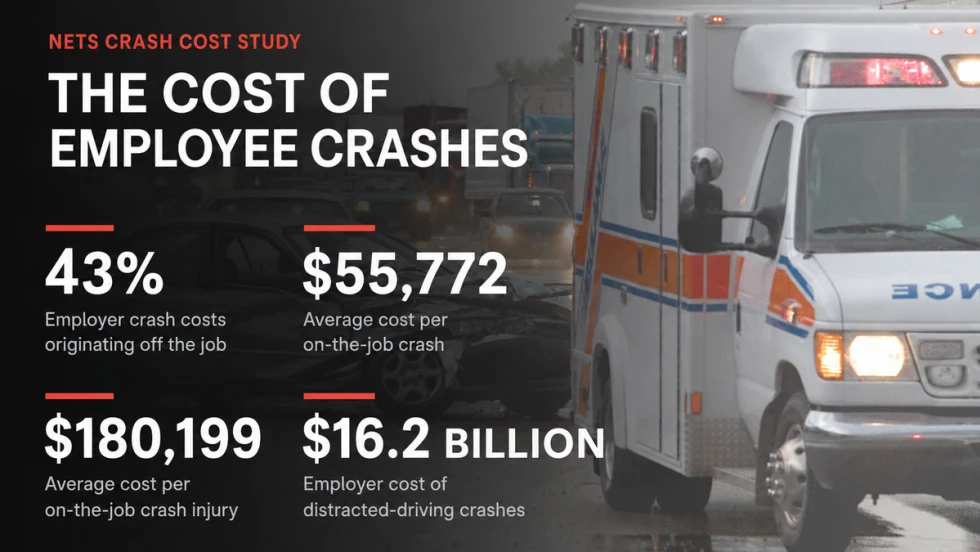
Off-the-Job Crashes Account for 43% of Employers’ $61.7 Billion Crash Burden
NETS quantifies costs dispersed across fleet, risk, HR, and other departments while providing new per-crash benchmarks for employers.
Read More →
Ram Recalls More Than 1.27 Million 1500 Pickups for Seat Belt Anchor Issue
The recall affects certain 2019-2026 Ram 1500 pickups that may have improperly attached second-row seat belt buckle anchors.
Read More →
Operation Safe Driver Week: Why the Industry's Oldest Safety Campaign Still Matters to Fleets
A look at how a 2007 enforcement initiative became one of the most consequential weeks on the fleet safety calendar, and what it means for your drivers in 2026.
Read More →