




Feds, Automakers Reach Safety Recall Accord
Eighteen vehicle manufacturers and the U.S. Department of Transportation finalize an agreement aimed at taking a more proactive approach to identifying and fixing vehicle defects that pose safety risks.
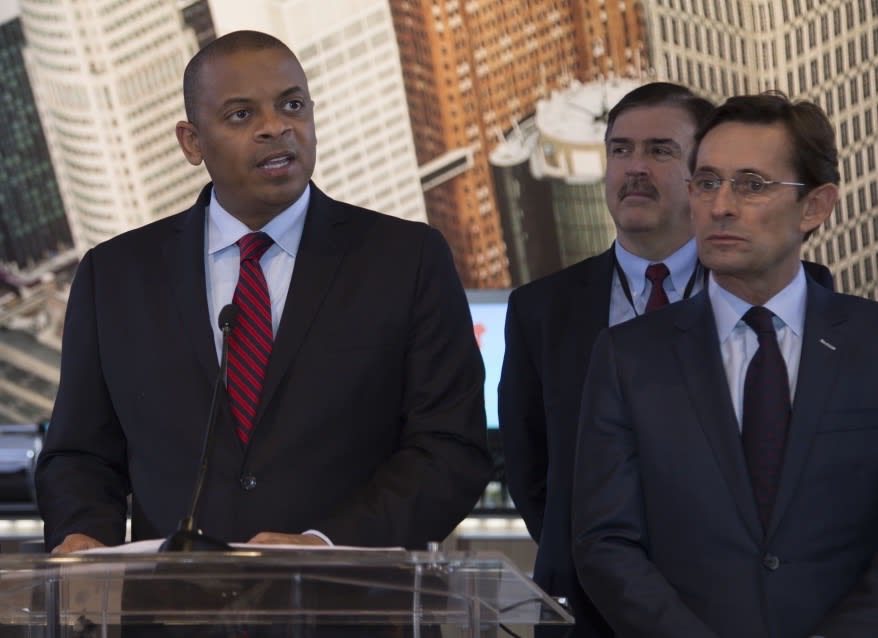
U.S. Transportation Secretary Anthony Foxx (left) at the North American International Auto Show in Detroit. Photo courtesy of U.S. DOT.
U.S. Transportation Secretary Anthony Foxx (left) at the North American International Auto Show in Detroit. Photo courtesy of U.S. DOT.
Eighteen automakers and the U.S. Department of Transportation have reached an agreement to work more closely together to identify vehicle manufacturing defects earlier and improve the overall safety recall process.
“The commitments we make today will help catch safety defects before they explode into massive recalls,” said U.S. Secretary of Transportation Anthony Foxx. “They will help improve the quality of data that automakers and NHTSA [the National Highway Traffic Safety Administration] analyze to seek defects today, and they will find ways to generate better data in the future. When recalls are necessary, they will help us reach customers and get their vehicles repaired.”
The agreement is built around four stated goals: enhance and facilitate proactive safety, enhance analysis and examination of early-warning reporting data, maximize safety recall participation rates, and enhance automotive cybersecurity.
The automakers committing to the accord are American Honda Motor Co., BMW of North America, FCA US (Fiat Chrysler Automobiles), Ford Motor Co., General Motors, Hyundai Motor America, Jaguar Land Rover North America, Kia Motors America, Mazda North American Operations, Mercedes-Benz USA, Mitsubishi Motors North America, Nissan North America, Porsche Cars North America, Subaru of America, Tesla Motors, Toyota Motor North America, Volkswagen Group of America and Volvo Cars USA.
"FCA US LLC embraces this initiative and, through our ongoing engagement with NHTSA, we are already moving in the direction outlined in the agreed-upon principles," said Sergio Marchionne, FCA CEO, in a released statement. "FCA US has more than doubled the complement of professionals assigned to its vehicle-safety organization."
The agreement’s objectives include greater reliance on advanced data analytics to more readily identify safety threats, based on early-warning reporting data. Under the Transportation Recall Enhancement, Accountability and Documentation (TREAD) Act of 2000, manufacturers must submit to NHTSA quarterly early-warning reports that include information about crashes involving death or injury, property damage claims, consumer complaints, warranty claims and field reports.
Additionally, the new agreement directs automakers to share best practices to improve recall participation rates among vehicle owners. These efforts will include exploring how car and truck dealers, insurance companies and state DMVs might assist in tracking down a vehicle’s current owner to ensure recall repairs are completed.
The accord, announced at the 2016 North American International Auto Show in Detroit, also calls for greater industry collaboration to improve automotive cybersecurity and mitigate cyber threats that pose safety risks. In this area, the agreement describes an increased role for the auto industry’s Information Sharing and Analysis Center (Auto-ISAC), an industry initiative announced in July. The Auto-ISAC serves as a hub for automotive cyber threat intelligence and analysis.
More Safety
What’s Next for Fleet? Safety, AI & Industry Recognition | AF News Recap
Could your company's culture be encouraging distracted driving? This week, we're exploring how workplace expectations affect driver safety, what AI, EVs, and autonomous vehicles could mean for the future of fleet management, and how fleet professionals can strengthen their award nominations.
Read More →
Does Your Fleet's Culture Encourage Distracted Driving?
What happens when the people responsible for enforcing safety rules are the ones setting the wrong example? The answer may reveal why some of the biggest risks to fleet drivers have little to do with what's written in the employee handbook.
Read More →
Fleet Manager’s Ultimate Playbook: Navigating the New Standard in OEM Connectivity
Rising operating costs, driver safety concerns, and unplanned downtime are putting unprecedented pressure on modern fleets. Discover how fleet managers use embedded OEM connectivity and real-time vehicle data to cut TCO, prevent downtime, and protect drivers without aftermarket telematics hardware.
Read More →
From Driver Well-Being to EV Charging | AF News Recap
Mental health belongs in the fleet safety conversation. This week, we’re looking at five ways fleets can support employee well-being before a crisis, plus Holman’s expansion in Mexico, new one-day Fleet Forward passes, and why EV charging demand is outpacing infrastructure growth.
Read More →
Nexar-Nauto Merger Aims to Give Fleets Better Safety Intelligence Through Larger Driving Dataset
Stefan Heck tells Automotive Fleet that combining more than 10 billion miles of driving history with Nexar's AI models will give fleets deeper insights into driver risk and roadway conditions than either company could provide independently.
Read More →
Don't Wait for a Crisis: 5 Ways to Build Mental Health Into Your Fleet Safety Program
For Suicide Prevention Month, fleet and safety leaders have an opportunity to put mental health where it belongs: at the center of workplace safety.
Read More →
How Camera Data Can Strengthen a Fleet’s Insurance Renewal
Insights from a commercial insurance carrier and a broker show how fleets can turn video telematic data, driver coaching, and improved claims results into a stronger case at insurance renewal.
Read More →
The Safest Fleets Aren’t the Ones with the Most Technology
You’ve made the telematics investment. Here’s how to capture the other half of its value and build the safest fleet on the road.
Read More →
Hidden in Plain Sight: Fleet Compliance Risks
Fleet compliance isn't just about having policies — it's about consistently enforcing them. This practical guide reveals six hidden compliance risks common in public sector and shared fleet operations and outlines proven strategies to improve visibility, accountability, and audit readiness
Read More →
NETS Sets 2026 Fleet Safety Benchmark Conference for Indianapolis
The Sept. 15–17 program will feature fleet benchmarking data, case studies, emerging technologies, and implementation strategies while running alongside the NSC Safety Congress & Expo.
Read More →