




Researchers Study Human Interaction With Automated Cars
The University of Michigan’s Transportation Research Institute is busy examining the human factor in automated driving, including how drivers respond when vehicle control is transferred back to them.
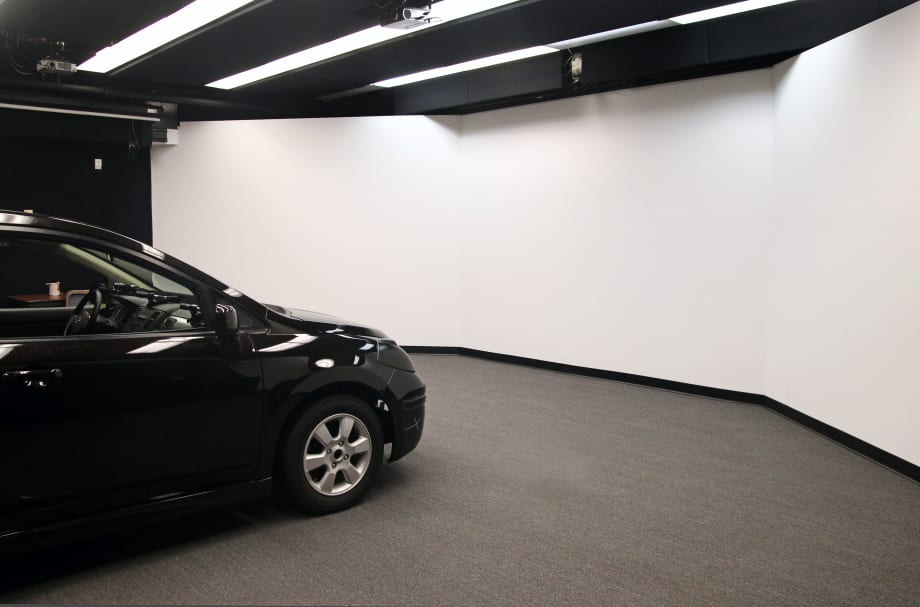
Photo of UMTRI's driving simulator lab courtesy of University of Michigan Transportation Research Institute.
Photo of UMTRI's driving simulator lab courtesy of University of Michigan Transportation Research Institute.
Progress toward fully automated vehicles is happening rapidly, but many questions remain unanswered – particularly those related to human behavior.
“Some of the pressing issues are those related to human factors,” said Anuj K. Pradhan, part of the University of Michigan Transportation Research Institute’s Young Driver Behavior and Injury Prevention Group. “Until vehicles are fully automated, 100-percent of the time, humans will still play an active and important role in the driving loop. So for automation levels 2 and 3, the human factor is critical.”
According to the National Highway Transportation Safety Administration, a fully automated vehicle allowing unmanned operation is designated as level 4. In level 3, a vehicle essentially self-drives and controls all safety-critical functions, but certain situations might require transition back to driver control.
Level 2 automation represents combinations of multiple functions that enable a car to drive itself but require constant monitoring by the driver. The transitioning between automated and human control might be rapid.
These transitions may not be as simple as they sound.
“When you’re driving [normally], one is expected to possess a certain degree of situational awareness, especially with regard to the driving scene, traffic flow, and other driving related factors,” Pradhan explained. “But when a vehicle is in automated mode, the person inside may be reading, texting, or even napping. He or she may not be prepared to suddenly and safely take control of the vehicle when control is handed back from the automation.”
So the question for researchers is this: How can you safely and economically conduct empirical research to better understand the human-factor issues inherent in automated driving?
One approach is to perform vehicle testing in an off-roadway setting such as M City, the 32-acre testing facility located at the university’s north campus research complex. But since access to self-driving cars is very limited, even for research purposes, an alternate approach is to use high-fidelity driving simulators with automated-vehicle capabilities, such as the one at UMTRI.
The project has drawn seed funding from U-M’s Mobility Transformation Center (MTC) and secured an industrial partner, Realtime Technologies Inc.
Pradhan is working with programmer Christopher Atkins and lead electronics engineer Mark Gilbert to enhance UMTRI’s driving simulator to provide different levels of automated-driving capabilities. The software and hardware enhancements will provide for various customizations and experimental setups and designs. As a result, researchers can study human behavior in the context of automated driving with a high degree of validity.
When Pradhan pushes a small button on the steering wheel of UMTRI’s driving simulator, a voice announces, “Automated mode engaged.” The instrument cluster takes on a green background, and the car centers itself in the lane and cruises forward at a steady speed. The steering wheel turns by itself to keep the vehicle in the lane during curves and turns.
“The driving simulator, as is, is a very powerful and versatile tool that is used to study driver behavior," Pradhan said. "By adding self-driving capabilities, it allows us to significantly extend human-factors research on vehicle automation and to start examining a host of new questions that have been raised about vehicle automation in relation to the human driver or operator.”
Pradhan offered these examples of pertinent questions related to the transfer of vehicle control:
How do people react when control of the vehicle is transferred back to them from automation during different circumstances? How does this differ if the driver is already monitoring the roadway versus engaged in something else?
How do individual driver characteristics – such as age or experience – affect behaviors related to automation, including acceptance of technology and expectations of automation? Are alerts related to transfer of control best relayed by single or multiple modes (audio and seat vibrations) depending on the driver’s age or experience?
In a related project recently awarded by the MTC, Pradhan will examine these types of behavioral issues and gain a better understanding of the role that the driver’s state of attention plays during vehicle automation.
“It appears that when a human is in a self-driving car, it becomes important for the automation to also monitor the driver,” Pradhan noted. “That’s the next step.”
More Safety
IIHS Crash Avoidance Tests Reveal Safety Gaps in Cargo Vans and Work Trucks
New crash-avoidance ratings from the Insurance Institute for Highway Safety reveal inconsistent performance among commercial vehicles, with several popular cargo vans and heavy-duty pickups struggling to avoid collisions with other vehicles and pedestrians.
Read More →
What’s Next for Fleet? Safety, AI & Industry Recognition | AF News Recap
Could your company's culture be encouraging distracted driving? This week, we're exploring how workplace expectations affect driver safety, what AI, EVs, and autonomous vehicles could mean for the future of fleet management, and how fleet professionals can strengthen their award nominations.
Read More →
Does Your Fleet's Culture Encourage Distracted Driving?
What happens when the people responsible for enforcing safety rules are the ones setting the wrong example? The answer may reveal why some of the biggest risks to fleet drivers have little to do with what's written in the employee handbook.
Read More →
Fleet Manager’s Ultimate Playbook: Navigating the New Standard in OEM Connectivity
Rising operating costs, driver safety concerns, and unplanned downtime are putting unprecedented pressure on modern fleets. Discover how fleet managers use embedded OEM connectivity and real-time vehicle data to cut TCO, prevent downtime, and protect drivers without aftermarket telematics hardware.
Read More →
From Driver Well-Being to EV Charging | AF News Recap
Mental health belongs in the fleet safety conversation. This week, we’re looking at five ways fleets can support employee well-being before a crisis, plus Holman’s expansion in Mexico, new one-day Fleet Forward passes, and why EV charging demand is outpacing infrastructure growth.
Read More →
Nexar-Nauto Merger Aims to Give Fleets Better Safety Intelligence Through Larger Driving Dataset
Stefan Heck tells Automotive Fleet that combining more than 10 billion miles of driving history with Nexar's AI models will give fleets deeper insights into driver risk and roadway conditions than either company could provide independently.
Read More →
Don't Wait for a Crisis: 5 Ways to Build Mental Health Into Your Fleet Safety Program
For Suicide Prevention Month, fleet and safety leaders have an opportunity to put mental health where it belongs: at the center of workplace safety.
Read More →
How Camera Data Can Strengthen a Fleet’s Insurance Renewal
Insights from a commercial insurance carrier and a broker show how fleets can turn video telematic data, driver coaching, and improved claims results into a stronger case at insurance renewal.
Read More →
The Safest Fleets Aren’t the Ones with the Most Technology
You’ve made the telematics investment. Here’s how to capture the other half of its value and build the safest fleet on the road.
Read More →
Hidden in Plain Sight: Fleet Compliance Risks
Fleet compliance isn't just about having policies — it's about consistently enforcing them. This practical guide reveals six hidden compliance risks common in public sector and shared fleet operations and outlines proven strategies to improve visibility, accountability, and audit readiness
Read More →