




Related: Test Drive: Daimler's Detroit Assurance Safety System
NHTSA Urged to Mandate Truck Crash Avoidance Technology
Highway-safety lobbies have petitioned the NHTSA to require forward collision avoidance and mitigation braking systems on all new trucks and buses rated at 10,000 pounds or more GVW.
by David Cullen, Executive Editor
February 20, 2015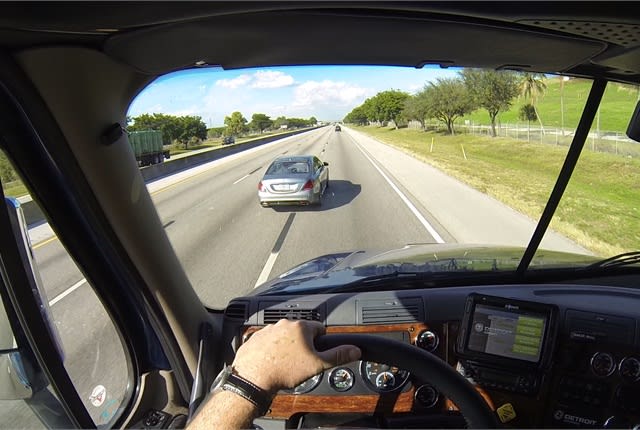
Photo: Jim Park
3 min to read
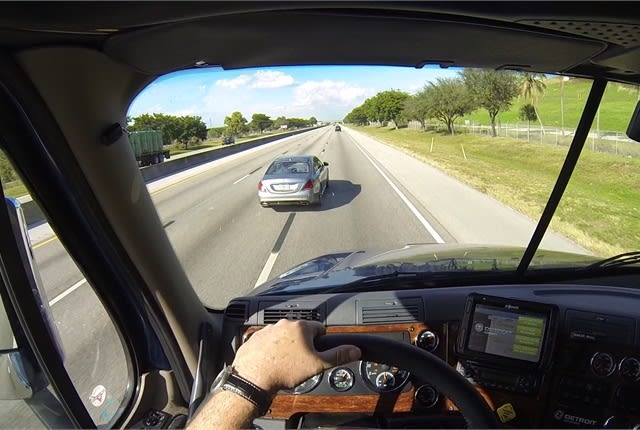
Photo: Jim Park
Four highway-safety lobbies have petitioned the National Highway Traffic Safety Administration to initiate a rulemaking that would require forward collision avoidance and mitigation braking (F-CAM) systems on all new trucks and buses rated at 10,000 pounds or more GVW. The lobbies argue that specific technology exists that would markedly reduce truck-related crashes if it were mandated on commercial vehicles.
“F-CAM technology uses radar and sensors to first alert the driver and then to apply the brakes when a crash is imminent,” explained a statement jointly released by the petitioning groups: Advocates for Highway and Auto Safety; Truck Safety Coalition; Center for Auto Safety, and Road Safe America.
The safety advocates said that such F-CAM systems “employ a Forward Collision Warning (FCW) to alert a driver when his/her vehicle gets too close to another vehicle that is stopped or traveling more slowly in front of his/her vehicle, giving the driver a chance to brake. When the system determines that a crash is about to occur, a Collision Mitigation Braking (CMB) system automatically applies the brakes to avoid the crash or reduce its severity.”
The petitioners contend that while “NHTSA estimates that current generation F-CAM systems can prevent over 2,500 crashes each year and future generation systems could prevent over 6,300 crashes annually,” the agency has yet to determine if it will mandate the technology on commercial vehicles. They also stressed that F-CAM systems are designed “precisely” to mitigate fatal crashes in which the front end of the truck is the initial point of impact.
“The safety technology is available to reduce the carnage on America’s roads resulting from rear-end crashes by large trucks,” said Henry Jasny, senior vice president of Advocates for Highway and Auto Safety. “The NHTSA can take action to improve safety and reduce preventable losses by requiring F-CAM technology on all large commercial motor vehicles.”
John Lannen, Executive Director of the Truck Safety Coalition, remarked that whenever traffic is significantly slowed or at a complete stop in general as well as by speed limits in work-zone areas, “cars are particularly vulnerable to being rear-ended by large trucks. Trucks are overrepresented in fatal highway crashes, and they are even more so in fatal work zone crashes. This is why it is imperative that F-CAM technology is required safety equipment in large trucks.”
In making their case for a mandate, the safety advocates also pointed out that “while nearly every truck manufacturer currently offers some type of F-CAM system on new vehicles, there is no national standard for F-CAM system performance and not all buyers purchase this safety option. Thus, few trucks are actually equipped with the technology despite its availability. Only 3% of the more than 3 million standard tractor-trailers (Class 8) on the road today are equipped with some form of this technology.”
Regarding the petition’s merits, Sean McNally, Vice President of Public Affairs for the American Trucking Associations told HDT, that the trucking lobby “supports proven safety technologies that prevent crashes and, therefore, save lives. ATA plans to carefully review the data cited in this petition to make an informed decision on the efficacy of the recommended approach.
“More importantly,” he continued, “any organization truly interested in highway safety should be urging NHTSA to first take action on ATA's 2006 petition -now almost nine years old - seeking a new rule requiring large trucks to be electronically speed-governed/limited at no more than 65 mph. [That’s] an approach ATA knows would reduce the frequency and severity of crashes."
More Safety
Tips for Driving Safely on Halloween Night
This video features a reminder from the Connecticut Department of Transportation (DOT) and the Connecticut Police Chiefs Association, urging drivers to prioritize safety this Halloween.
Read More →
IIHS Crash Avoidance Tests Reveal Safety Gaps in Cargo Vans and Work Trucks
New crash-avoidance ratings from the Insurance Institute for Highway Safety reveal inconsistent performance among commercial vehicles, with several popular cargo vans and heavy-duty pickups struggling to avoid collisions with other vehicles and pedestrians.
Read More →
What’s Next for Fleet? Safety, AI & Industry Recognition | AF News Recap
Could your company's culture be encouraging distracted driving? This week, we're exploring how workplace expectations affect driver safety, what AI, EVs, and autonomous vehicles could mean for the future of fleet management, and how fleet professionals can strengthen their award nominations.
Read More →
Does Your Fleet's Culture Encourage Distracted Driving?
What happens when the people responsible for enforcing safety rules are the ones setting the wrong example? The answer may reveal why some of the biggest risks to fleet drivers have little to do with what's written in the employee handbook.
Read More →
Sponsored•October 1, 2026
Fleet Manager’s Ultimate Playbook: Navigating the New Standard in OEM Connectivity
Rising operating costs, driver safety concerns, and unplanned downtime are putting unprecedented pressure on modern fleets. Discover how fleet managers use embedded OEM connectivity and real-time vehicle data to cut TCO, prevent downtime, and protect drivers without aftermarket telematics hardware.
Read More →
From Driver Well-Being to EV Charging | AF News Recap
Mental health belongs in the fleet safety conversation. This week, we’re looking at five ways fleets can support employee well-being before a crisis, plus Holman’s expansion in Mexico, new one-day Fleet Forward passes, and why EV charging demand is outpacing infrastructure growth.
Read More →
Nexar-Nauto Merger Aims to Give Fleets Better Safety Intelligence Through Larger Driving Dataset
Stefan Heck tells Automotive Fleet that combining more than 10 billion miles of driving history with Nexar's AI models will give fleets deeper insights into driver risk and roadway conditions than either company could provide independently.
Read More →
Don't Wait for a Crisis: 5 Ways to Build Mental Health Into Your Fleet Safety Program
For Suicide Prevention Month, fleet and safety leaders have an opportunity to put mental health where it belongs: at the center of workplace safety.
Read More →
How Camera Data Can Strengthen a Fleet’s Insurance Renewal
Insights from a commercial insurance carrier and a broker show how fleets can turn video telematic data, driver coaching, and improved claims results into a stronger case at insurance renewal.
Read More →
The Safest Fleets Aren’t the Ones with the Most Technology
You’ve made the telematics investment. Here’s how to capture the other half of its value and build the safest fleet on the road.
Read More →