




Nissan Details 2016 Titan's Cummins Turbo Diesel
Nissan is offering a 5.0-liter Cummins turbo diesel with its 2016 Titan pickup for the first time that will give work truck buyers greater capability for towing and payload, Nissan has announced.
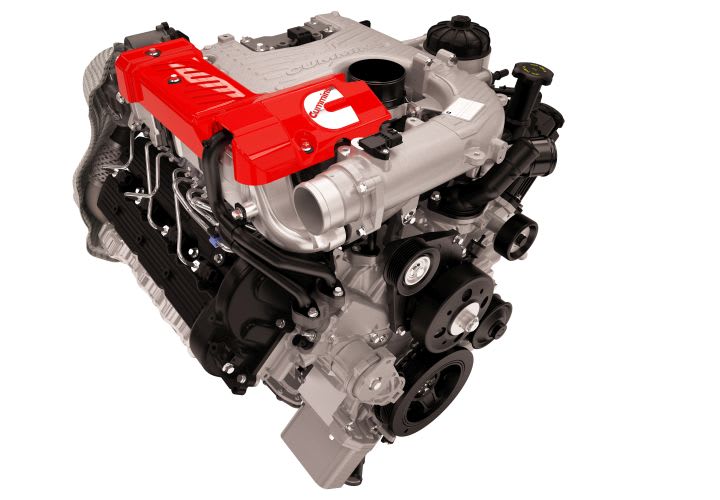
Photo of Cummins 5.0L turbo diesel courtesy of Nissan.
Photo of Cummins 5.0L turbo diesel courtesy of Nissan.
Nissan is offering a 5.0-liter Cummins turbo diesel with its 2016 Titan pickup for the first time that will give work truck buyers greater capability for towing and payload, Nissan has announced.
Nissan introduced its redesigned next-gen Titan at the North American International Auto Show in Detroit.
The new 5.0-liter V-8 turbo diesel, from the Cummins ISV family, is rated to produce 310 hp and 555 lb.-ft. of torque. It contains 70 percent of the parts offered on the commercial variant of the engine. The turbo diesel will be offered on the Titan XD model.
Nissan has been working with Cummins since 2007 in a partnership to possibly introduce a diesel engine for the Titan. Production will begin later in 2015.
The turbo diesel uses a compacted graphite iron cylinder block, forged steel crankshaft, high-strength aluminum allow heads, and composite valve covers to achieve a durable, lightweight package. The engine uses dual overhead camshafts.
The Cummins M2 two-stage turbocharger has been configured to work well at low and high engine speeds.
The series sequential turbocharging system uses two differently sized turbochargers, including a small turbocharger for low air flow requirements and a large turbo for high air flow. The small turbo provides good transient response due to its low inertia, and the large turbo maintains power at higher engine speeds. This helps eliminates turbo lag, providing a continuous delivery of peak torque through the RPM range, according to Nissan.
In order to control the air flow between the two turbo chargers, the new M2 system uses a rotary valve to open ports that perform the bypass or waste-gate functionality and provide exhaust after-treatment thermal management.
High injection pressures from the Bosch High Pressure Common Rail (HPCR) fuel system and piezo fuel injectors provide precise fuel control for optimized in-cylinder combustion, leading to better fuel efficiency and reduced emissions, Nissan announced.
More Operations

Fleet Has a Talent Pipeline Problem. What Comes Next? | AF News Recap
Where will fleet’s next generation of leaders come from? This week, we’re looking at the industry’s talent pipeline, what certification can add to a fleet career, how to build an award-worthy track record, and the return of Automotive Fleet’s Personal Use Survey.
Read More →
Smith System Launches Driver Risk Management Program
Fleets have more driver data than ever, but identifying risky behavior doesn't necessarily correct it. Smith System's new Driver Risk Management program combines monitoring, training, and follow-up coaching to help fleets connect risk signals with driver intervention.
Read More →
Automotive Fleet Opens 2026 Personal Use Survey for Commercial Fleet Managers
Less than two weeks left! Commercial and corporate fleet managers are invited to share how their organizations handle company vehicle personal-use policies, charges, and driver eligibility.
Read More →
From AI Prompts to AI-Generated Safety Songs | AF News Recap
Can better prompts make AI more useful for fleet managers? This week, we’re breaking down smarter fleet analysis, an AI-assisted experiment that turned safety training into music, and what happened to fuel prices in August.
Read More →
How to Write Better AI Prompts for Fleet Analysis
Include these six elements in your fleet prompts to generate more relevant analysis and accurate answers.
Read More →
Fleet Meets: Eric Kilgore
This edition of the Fleet Meets series features one of the industry's best leaders driving multi-market and national operations.
Read More →
Why Reactive Fleet Management Is Becoming Too Expensive to Sustain
Research highlights a growing need for proactive management strategies to address rising costs in fleet operations effectively.
Read More →
What Your Fleet KPIs Aren’t Telling You
Tracking fleet metrics is only useful when the data leads to better decisions. This guide helps fleet leaders assess cost, utilization, and downtime more accurately, identify performance gaps, and prioritize the actions that can improve operational results.
Read More →
Hidden in Plain Sight: Fleet Compliance Risks
Fleet compliance isn't just about having policies — it's about consistently enforcing them. This practical guide reveals six hidden compliance risks common in public sector and shared fleet operations and outlines proven strategies to improve visibility, accountability, and audit readiness
Read More →
Turning Fleet Payment Data into Executive Insights
Does data alone drive results in operations?
Read More →